
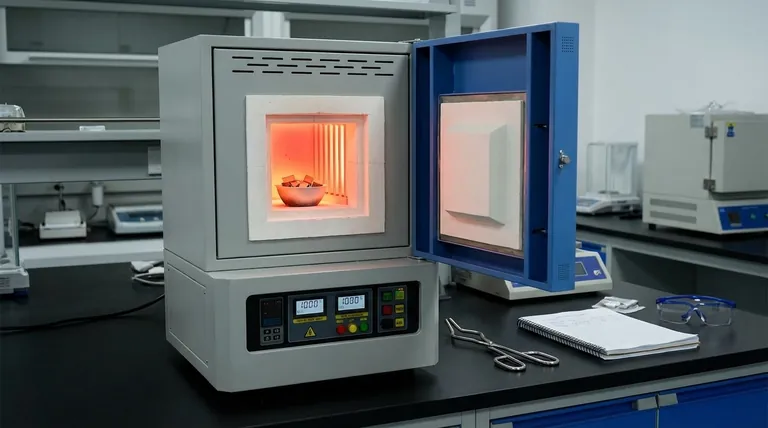
The function of a laboratory box-type high-temperature furnace is to provide a controlled thermal environment that drives AlCoCrFeNi2.1 eutectic high-entropy alloys from a non-equilibrium state toward a stable equilibrium state. Specifically, by maintaining constant temperatures at levels such as 600°C and 1000°C, the furnace supplies the precise thermal energy required to induce critical phase transformations and microstructural adjustments.
Core Takeaway The furnace acts as a mechanism for microstructural regulation, specifically converting the B2 phase into the FCC phase and promoting grain coarsening. This controlled evolution is the defining factor in determining the alloy's final corrosion resistance.
Driving Microstructural Evolution
Transitioning to Equilibrium
As-cast or sintered high-entropy alloys often exist in a non-equilibrium state due to rapid cooling during their initial formation.
The primary role of the box-type furnace is to sustain a stable high-temperature environment. This allows atomic diffusion to occur, pushing the material structure toward a thermodynamically stable equilibrium.
Controlling Phase Transformations
The specific heat treatment regime facilitates a distinct phase change within the AlCoCrFeNi2.1 alloy.
Thermal energy input induces the transformation from the B2 phase to the Face-Centered Cubic (FCC) phase. This transformation is temperature-dependent and critical for defining the material's mechanical and chemical behavior.
Modifying Grain Structure
Beyond phase changes, the furnace environment promotes grain coarsening.
While grain refinement is often sought in other contexts, the primary reference indicates that for this specific alloy and treatment cycle, the furnace facilitates the growth of grains as part of the stabilization process.
Regulating Material Properties
Optimizing Corrosion Resistance
The ultimate engineering function of this heat treatment is to tune the material's performance in corrosive environments.
By controlling the temperature (e.g., 600°C vs. 1000°C) and duration, you directly regulate the phase ratio and grain size. This allows you to tailor the corrosion resistance of the AlCoCrFeNi2.1 alloy to specific application requirements.
Eliminating Residual Stresses
While the primary focus for this alloy is phase evolution, box furnaces generally serve to relieve internal strain.
Extended exposure to constant heat helps eliminate residual stresses introduced during previous processing steps, such as sintering or casting, ensuring the material does not fail prematurely under load.
Understanding the Trade-offs
Atmosphere Limitations
Unless equipped with a retort or gas purge system, standard box-type furnaces operate in an air atmosphere.
For high-entropy alloys containing reactive elements like Aluminum or Chromium, this presents a risk of surface oxidation. Unlike vacuum annealing furnaces, a standard box furnace may require additional steps (like encapsulation) to prevent the loss of active elements.
Cooling Rate Sensitivity
The box furnace excels at maintaining a constant temperature (isothermal holding), but the cooling method after treatment is equally critical.
The transition from the high-temperature equilibrium state back to room temperature must be controlled. If the furnace cools too slowly, undesired secondary phases may precipitate; if removed too quickly (quenching), the high-temperature structure may be locked in differently than intended.
Making the Right Choice for Your Goal
When employing a box-type furnace for AlCoCrFeNi2.1 alloys, your specific objectives should dictate your parameters:
- If your primary focus is Phase Stability: Utilize the furnace to drive the B2-to-FCC transformation, ensuring sufficient holding time for the material to reach equilibrium.
- If your primary focus is Corrosion Performance: Adjust the treatment temperature (between 600°C and 1000°C) to modulate the grain size and phase distribution, as these directly correlate to chemical resistance.
Success relies not just on reaching high temperatures, but on the precision of the thermal energy used to dictate the alloy's final identity.
Summary Table:
| Heat Treatment Function | Impact on AlCoCrFeNi2.1 Alloy |
|---|---|
| Phase Transformation | Induces transition from B2 phase to stable FCC phase |
| Structural Regulation | Facilitates grain coarsening and thermodynamic equilibrium |
| Performance Tuning | Optimizes corrosion resistance through temperature control |
| Stress Relief | Eliminates residual stresses from casting or sintering |
| Temperature Range | Typically processed between 600°C and 1000°C |
Unlock Precision in Your Alloy Research with KINTEK
Achieving the perfect B2-to-FCC phase transformation requires absolute thermal stability. KINTEK provides industry-leading Muffle, Tube, Rotary, Vacuum, and CVD systems specifically engineered to give you total control over microstructural evolution and corrosion resistance.
Backed by expert R&D and manufacturing, our high-temperature lab furnaces are fully customizable to meet the unique heating and atmosphere requirements of your advanced materials.
Ready to optimize your heat treatment results?
Contact our experts today to find your custom solution!
References
- Effect of Heat Treatment on Corrosion of an AlCoCrFeNi2.1 Eutectic High-Entropy Alloy in 3.5 wt% NaCl Solution. DOI: 10.3390/met15060681
This article is also based on technical information from Kintek Furnace Knowledge Base .
Related Products
- 1700℃ High Temperature Laboratory Tube Furnace with Alumina Tube
- 1400℃ High Temperature Laboratory Tube Furnace with Alumina Tube
- 1800℃ High Temperature Muffle Oven Furnace for Laboratory
- 1200℃ Muffle Oven Furnace for Laboratory
- 1700℃ High Temperature Muffle Oven Furnace for Laboratory
People Also Ask
- How does zone-melting in tube furnaces synthesize bismuth micro-wires? Master Single-Crystal Thermoelectric Growth
- How do high-temperature laboratory tube furnaces ensure environmental stability? Precision Thermal Reduction Tips
- How are high-temp tube furnaces used to measure diffusion coefficients per Fick's law? Master Precision Annealing
- How are high-temperature laboratory tube furnaces applied in long-term vacuum homogenization heat treatments for intermetallic samples?
- How are high-temperature tube furnaces applied in testing ceramic-supported alloy membranes? Insights



















