
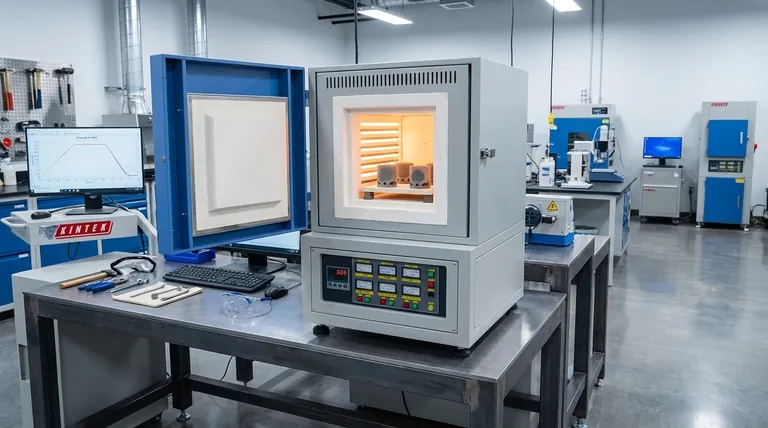
The high-temperature debinding and sintering furnace serves as the critical metallurgical engine in the Bound Metal Deposition (BMD) workflow. It takes the printed "green" parts—composites of metal powder and wax/polymer binders—and subjects them to a precise thermal cycle. This process has two distinct functions: thermally removing the organic binders and fusing the remaining metal particles into a solid, cohesive unit.
The furnace is the bridge between a fragile printed shape and a functional metal component. It eliminates the polymer matrix and utilizes high heat to drive atomic diffusion, converting a loose aggregate of powder into a high-density part with final mechanical properties.
The Two-Stage Transformation
The furnace does not simply heat the part; it orchestrates a complex, multi-stage transformation that turns a printed geometry into usable metal.
Stage 1: Thermal Debinding
The "green parts" produced by BMD printers contain significant amounts of wax and polymer binders. These hold the metal powder in shape during printing but are structural impurities in the final product.
The furnace initiates a controlled heating phase to burn off or evaporate these organic components. This must be done gradually to prevent internal pressure buildup, which could crack the part.
Stage 2: Sintering and Diffusion
Once the binder is removed, the furnace ramps up to temperatures near the melting point of the metal alloy.
At this stage, diffusion bonding occurs. Metal atoms migrate across particle boundaries, fusing the individual powder grains together. This process eliminates the voids left by the binder, resulting in a dense, solid metal structure.
The Physics of Densification
Understanding what happens inside the furnace is key to understanding why the equipment is so specialized.
Pore Elimination
As referenced in similar sintering processes, the goal is to eliminate internal pores. The thermal energy promotes grain boundary migration, causing the material to shrink and densify.
This creates a high-density component capable of withstanding mechanical stress, rather than a porous, brittle object.
Atmosphere Control
While not explicitly detailed in every BMD manual, high-temperature sintering generally requires a controlled atmosphere to succeed.
As seen in general industrial sintering, environments using inert gases (like argon) or specific pressures are often employed to prevent oxidation. This ensures the metal matrix remains pure and the chemical composition is not altered by reacting with the air at high temperatures.
Critical Trade-offs to Consider
While the furnace enables the creation of solid metal parts, the physics of the process introduces specific constraints you must account for.
Dimensional Shrinkage
Because the binder is removed and the metal particles fuse closer together, the part shrinks significantly during this process.
The "green" part must be printed larger than the desired final dimensions to account for this predictable volume loss.
Processing Time
This is not an instantaneous step. To ensure the part does not warp or crack, the thermal ramp-up and cool-down must be slow and steady.
Achieving a uniform thermal field and allowing sufficient time for atomic diffusion often requires cycle times measured in hours, not minutes.
Making the Right Choice for Your Goal
To maximize the effectiveness of the debinding and sintering process, consider your specific application requirements.
- If your primary focus is mechanical strength: Ensure the furnace cycle allows for complete densification; incomplete sintering leaves pores that act as failure points under stress.
- If your primary focus is dimensional accuracy: You must rigorously calibrate your printing scale factors to match the specific shrinkage rate induced by the furnace's thermal cycle.
The furnace is not merely an oven; it is the environment where the material properties of your final product are defined.
Summary Table:
| Stage | Primary Action | Key Result |
|---|---|---|
| Thermal Debinding | Gradual heating to evaporate wax/polymer binders | Removal of organic matrix without cracking |
| Sintering | High-heat heating near the alloy melting point | Atomic diffusion and fusion of metal particles |
| Densification | Pore elimination and grain migration | Increased material density and mechanical strength |
| Atmosphere Control | Use of inert gases (e.g., Argon) | Prevention of oxidation and chemical purity |
Elevate Your Metal 3D Printing with KINTEK
Transitioning from a fragile 'green' part to a high-performance metal component requires precision thermal control. Backed by expert R&D and manufacturing, KINTEK offers specialized Muffle, Tube, Rotary, Vacuum, and CVD systems tailored for the most demanding debinding and sintering requirements. Our lab high-temperature furnaces are fully customizable to handle specific shrinkage rates and atmosphere controls for your unique BMD needs.
Ready to achieve superior density and dimensional accuracy? Contact our experts today to find the perfect sintering solution for your laboratory or production line.
References
- Tobia Romano, Maurizio Vedani. Metal additive manufacturing for particle accelerator applications. DOI: 10.1103/physrevaccelbeams.27.054801
This article is also based on technical information from Kintek Furnace Knowledge Base .
Related Products
- High Temperature Muffle Oven Furnace for Laboratory Debinding and Pre Sintering
- 2200 ℃ Tungsten Vacuum Heat Treat and Sintering Furnace
- 2200 ℃ Graphite Vacuum Heat Treat Furnace
- Vacuum Heat Treat Sintering Furnace Molybdenum Wire Vacuum Sintering Furnace
- 9MPa Air Pressure Vacuum Heat Treat and Sintering Furnace
People Also Ask
- What thermal phenomena occur during polymer binder burnout in ceramic green bodies? Lab Furnace Guide
- Why is controlled heat treatment in a muffle furnace necessary for calcined clay? Achieve Optimal Pozzolanic Activity
- What role does a high-temperature muffle furnace play in STFO synthesis? Achieve Pure Perovskite Results
- How does a high-temperature muffle furnace facilitate the formation of LaNbxAl1−xO3+δ perovskite structures? Key Roles
- What role does a high-temperature muffle furnace play in the formation of biochar catalysts? Master Catalyst Synthesis



















