
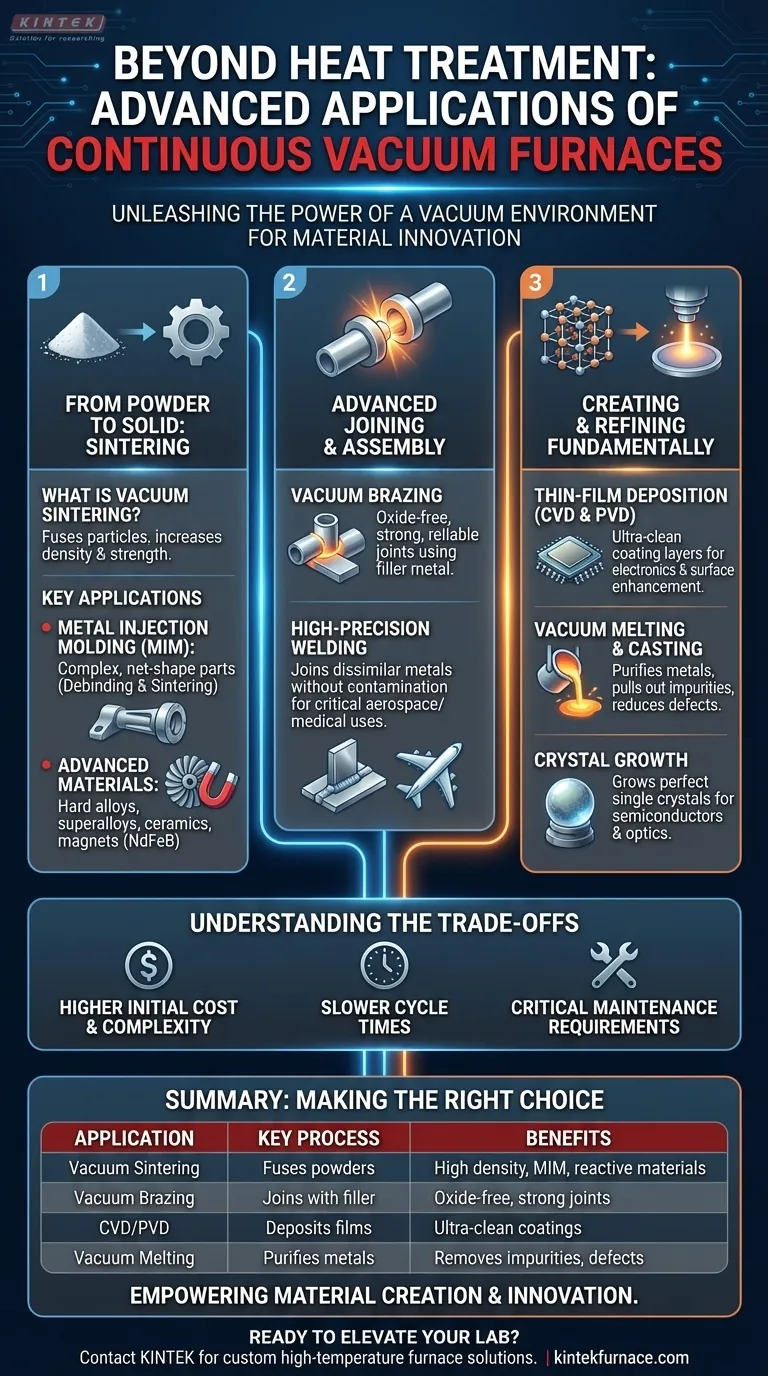
Beyond simple heat treatment, the applications for continuous vacuum furnaces extend into advanced material creation, atomic-level surface modification, and high-integrity component assembly. While processes like annealing and hardening are common, the true power of a vacuum environment is realized in applications like vacuum sintering, brazing, and physical or chemical vapor deposition (PVD/CVD). These methods leverage the absence of air to achieve results impossible in a standard atmospheric furnace.
The core function of a vacuum furnace in advanced applications is not merely to prevent contamination. It acts as an enabling environment, fundamentally changing how materials can be formed, joined, and refined at a microscopic level.

From Powder to Solid: The Role of Sintering
Vacuum sintering is a process that transforms powdered materials into a solid, dense mass by heating them to just below their melting point. The vacuum ensures that no trapped gases or oxides interfere with the bonding of the material particles.
What is Vacuum Sintering?
This process uses heat and vacuum to fuse individual particles together, dramatically increasing the density and strength of the final component. It is a cornerstone of modern powder metallurgy.
Key Application: Metal Injection Molding (MIM)
For complex, net-shape metal parts, MIM is a leading manufacturing method. A vacuum furnace is critical for the final two stages: debinding, where a binding agent is removed, and sintering, where the metal powder fuses into a solid, high-density part.
Key Application: Advanced Materials
Vacuum sintering is essential for producing high-performance materials that are highly reactive to oxygen. This includes hard alloys, superalloys, high-purity ceramics, and powerful magnetic materials like Neodymium Iron Boron (NdFeB).
Advanced Joining and Assembly
Creating strong, clean, and reliable joints between components, especially with reactive or dissimilar metals, is a significant challenge. A vacuum furnace provides an ideal environment for this.
Vacuum Brazing: Creating High-Integrity Joints
Brazing uses a filler metal to join two components. Performing this in a vacuum prevents oxidation at the joint interface, resulting in a significantly stronger, cleaner, and more reliable bond than what can be achieved in open air.
High-Precision Welding
Similarly, welding certain materials in a vacuum allows for the joining of different metals without contamination or the formation of brittle compounds. This is critical in aerospace and medical applications where joint failure is not an option.
Creating and Refining Materials Fundamentally
The most advanced applications use the vacuum not just to protect the material, but to facilitate its creation or purification at a molecular level.
Thin-Film Deposition (CVD & PVD)
Chemical Vapor Deposition (CVD) and Physical Vapor Deposition (PVD) are processes that deposit exceptionally thin layers of material onto a substrate. A deep vacuum is mandatory for these processes to work, as it allows molecules of the coating material to travel unimpeded to the part's surface.
Vacuum Melting and Casting
To produce extremely high-purity metals, raw material can be melted under a vacuum. This pulls out dissolved gases and other impurities. Subsequently, vacuum casting ensures the molten metal fills the mold without introducing any porosity or gas-related defects.
Crystal Growth for High-Tech Industries
The controlled, ultra-clean environment of a vacuum furnace is necessary for growing single crystals used in semiconductors and advanced optical equipment. The precise temperature control and lack of contaminants are critical for achieving a perfect crystal lattice structure.
Understanding the Trade-offs
While powerful, vacuum furnace technology is not a universal solution. The advantages are balanced by practical considerations that must be evaluated for any given application.
Higher Initial Cost and Complexity
Vacuum furnaces involve sophisticated pumping systems, seals, and instrumentation, making their initial acquisition and installation costs significantly higher than their atmospheric counterparts.
Slower Cycle Times
Achieving a deep vacuum (pumping down) and then executing precisely controlled cooling ramps inherently takes more time than simply heating and cooling a part in open air. This can impact overall throughput.
Critical Maintenance Requirements
The performance of a vacuum furnace is entirely dependent on its integrity. Regular maintenance of vacuum seals, pumps, and control systems is non-negotiable to prevent leaks and ensure process repeatability.
Making the Right Choice for Your Goal
Selecting the right process depends entirely on your final objective. The versatility of a vacuum furnace allows it to serve vastly different manufacturing needs.
- If your primary focus is creating complex, net-shape parts from powder: Your best path is vacuum sintering, especially for MIM components, hard alloys, or advanced ceramics.
- If your primary focus is joining dissimilar or reactive metals with maximum strength: Vacuum brazing is the ideal solution, as it eliminates oxidation and ensures a pristine, high-integrity joint.
- If your primary focus is enhancing surface properties or producing electronics: You should investigate advanced processes like PVD/CVD coating or crystal growth, which rely on the ultra-clean vacuum environment.
Ultimately, a vacuum furnace empowers you to not just improve existing materials, but to create entirely new ones with superior properties.
Summary Table:
| Application | Key Process | Benefits |
|---|---|---|
| Vacuum Sintering | Fuses powders into solids | High density, strength, ideal for MIM and reactive materials |
| Vacuum Brazing | Joins metals with filler | Oxidation-free, strong, reliable joints for aerospace/medical |
| CVD/PVD | Deposits thin films | Ultra-clean coatings for electronics and surface enhancement |
| Vacuum Melting/Casting | Purifies and casts metals | Removes impurities, reduces defects in high-purity alloys |
| Crystal Growth | Grows single crystals | Perfect lattice structures for semiconductors and optics |
Ready to elevate your lab's capabilities with custom high-temperature furnace solutions? At KINTEK, we leverage exceptional R&D and in-house manufacturing to provide advanced furnaces like Muffle, Tube, Rotary, Vacuum & Atmosphere, and CVD/PECVD Systems. Our deep customization ensures they meet your unique experimental needs for applications such as sintering, brazing, and thin-film deposition. Contact us today to discuss how we can help you achieve superior results in material processing and innovation!
Visual Guide
Related Products
- Vacuum Sealed Continuous Working Rotary Tube Furnace Rotating Tube Furnace
- Electric Rotary Kiln Continuous Working Small Rotary Furnace Kiln for Pyrolysis Plant Heating
- Vacuum Heat Treat Sintering Furnace with Pressure for Vacuum Sintering
- Vacuum Heat Treat Sintering Furnace Molybdenum Wire Vacuum Sintering Furnace
- Vacuum Hot Press Furnace Machine Heated Vacuum Press Tube Furnace
People Also Ask
- What is the purpose of rotary tube furnaces? Achieve Uniform Heat Treatment for Powders and Granules
- What are the key advantages of using a rotary tube furnace? Achieve Dynamic, Uniform Heating for Powders
- How does the amount of material processed vary between batch and continuous rotary tube furnaces? Scale Your Production Efficiently
- What are the advantages of rotary tube furnaces in fuel compatibility? Boost Efficiency and Cut Costs
- What is the temperature range of some rotary tube furnaces? Achieve Uniform Heating Up to 1200°C



















