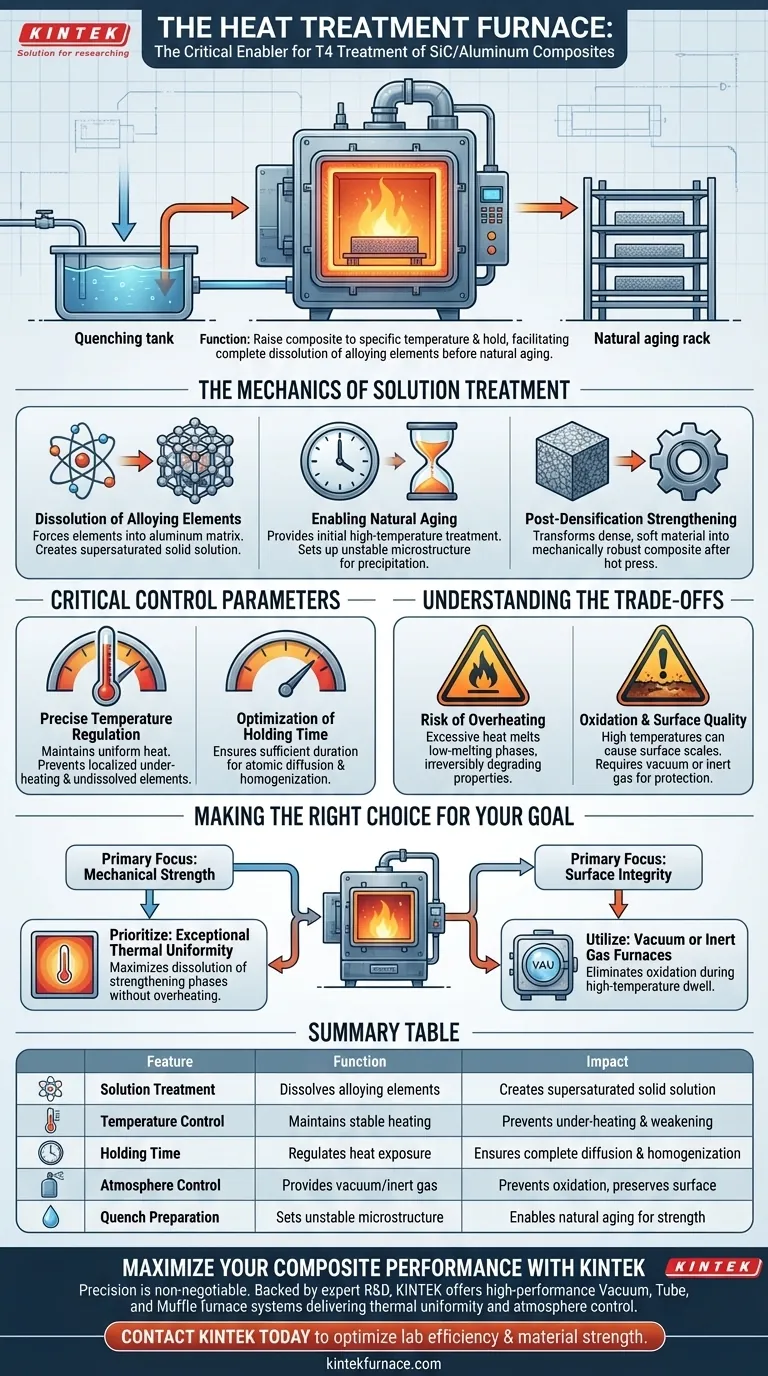
The heat treatment furnace serves as the critical enabler for the T4 temper condition in SiC/Aluminum composites, primarily by facilitating solution treatment. Its function is to raise the composite to a specific temperature and hold it there, ensuring that alloying elements fully dissolve into the aluminum matrix before the material undergoes natural aging.
The furnace's role is to create a homogenous solid solution by dissolving alloying elements under strict temperature control. This prepares the matrix for the subsequent precipitation of strengthening phases during natural aging, which is essential for maximizing the strength of the composite after hot press densification.
The Mechanics of Solution Treatment
Dissolution of Alloying Elements
The fundamental purpose of the furnace during the T4 cycle is to dissolve soluble alloying elements. By applying high heat, the furnace forces these elements to integrate fully into the aluminum matrix. This creates a supersaturated solid solution, which is the prerequisite for any future strengthening.
Enabling Natural Aging
While T4 involves "natural" aging (occurring at room temperature), the process cannot start without the furnace. The furnace provides the initial high-temperature solution treatment that creates the unstable microstructure necessary for aging. Once removed from the furnace and quenched, the material naturally precipitates strengthening phases over time.
Post-Densification Strengthening
The furnace treatment typically follows hot press densification. While the hot press ensures the material is dense and free of voids, the heat treatment furnace is responsible for the metallurgical properties. It transforms a dense but potentially soft material into a mechanically robust composite.
Critical Control Parameters
Precise Temperature Regulation
The furnace must maintain a stable and uniform temperature field throughout the heating zone. This uniformity ensures that the solution treatment is consistent across the entire geometry of the composite part. Precise control prevents localized under-heating, which would leave alloying elements undissolved and weaken the material.
Optimization of Holding Time
The furnace regulates the duration of the heat exposure, known as the holding time. This time must be sufficient to allow atomic diffusion and homogenization of the microstructure. Proper timing ensures the maximum amount of strengthening phases are available for precipitation later.
Understanding the Trade-offs
The Risk of Overheating
While high temperatures are necessary for dissolution, excessive heat can be detrimental. If the furnace exceeds specific limits, it may melt low-melting-point eutectic phases within the matrix. This results in incipient melting, which irreversibly degrades the mechanical properties of the composite.
Oxidation and Surface Quality
At the high temperatures required for solution treatment, aluminum and SiC are prone to oxidation. Standard furnaces may allow surface scales to form, compromising the part's integrity. Vacuum or atmosphere-controlled furnaces are often required to evacuate oxygen or backfill with inert gas, preventing surface degradation.
Making the Right Choice for Your Goal
To achieve the best results with T4 treatment of SiC/Aluminum composites, align your furnace capabilities with your specific material requirements:
- If your primary focus is mechanical strength: Prioritize a furnace with exceptional thermal uniformity to ensure maximum dissolution of strengthening phases without overheating.
- If your primary focus is surface integrity: Utilize a vacuum furnace or one with inert gas capabilities (like argon) to eliminate oxidation during the high-temperature dwell.
The heat treatment furnace acts as the bridge between a raw densified part and a high-performance structural component.
Summary Table:
| Feature | Function in T4 Treatment | Impact on SiC/Al Composite |
|---|---|---|
| Solution Treatment | Dissolves alloying elements into the matrix | Creates a supersaturated solid solution |
| Temperature Control | Maintains stable and uniform heating | Prevents under-heating and localized weakening |
| Holding Time | Regulates duration of heat exposure | Ensures complete atomic diffusion and homogenization |
| Atmosphere Control | Provides vacuum or inert gas (Argon) | Prevents oxidation and preserves surface integrity |
| Quench Preparation | Sets the unstable microstructure | Enables natural aging for post-densification strength |
Maximize Your Composite Performance with KINTEK
Precision is non-negotiable when managing the T4 treatment of SiC/Aluminum composites. Backed by expert R&D and world-class manufacturing, KINTEK offers high-performance Vacuum, Tube, and Muffle furnace systems specifically designed to deliver the thermal uniformity and atmosphere control required for advanced material metallurgy.
Whether you need to eliminate oxidation or ensure perfect solution treatment, our customizable laboratory furnaces provide the reliability your research and production demand. Contact KINTEK today to discover how our high-temperature solutions can optimize your lab's efficiency and material strength.
Visual Guide
Related Products
- 2200 ℃ Tungsten Vacuum Heat Treat and Sintering Furnace
- Vacuum Heat Treat Furnace with Ceramic Fiber Liner
- Vacuum Heat Treat Sintering Furnace with Pressure for Vacuum Sintering
- Small Vacuum Heat Treat and Tungsten Wire Sintering Furnace
- 2200 ℃ Graphite Vacuum Heat Treat Furnace
People Also Ask
- How does a tungsten-heated vacuum sintering furnace prepare (TbxY1-x)2O3 ceramics? Achieve 99%+ Density & Purity
- How do compaction pressure and vacuum sintering optimize porous ceramics? Maximize Density & Toughness
- What wear-resistance enhancements are achieved by powder coating? The Role of Vacuum Sintering Furnaces
- What role does a high-temperature vacuum sintering furnace play in the densification of WC-10(Ni, Ni/Co) alloys?
- What core role does a high-temperature vacuum sintering furnace play in Sm:YAG ceramics? Mastering Optical Clarity