
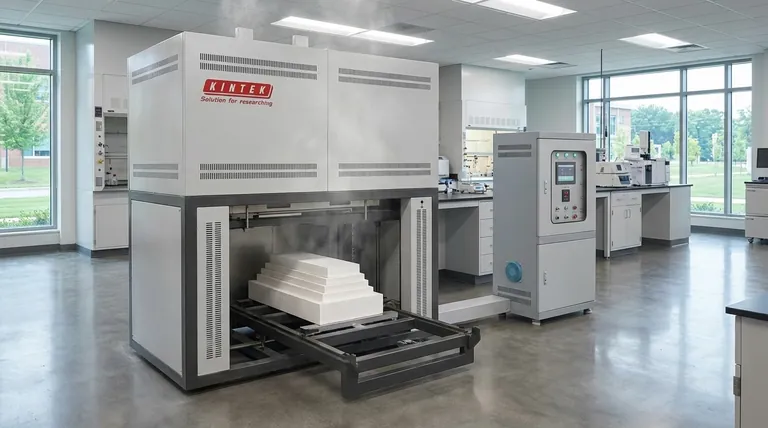
The flash furnace functions as the critical thermal preparation unit in the sludge treatment and phosphorus recovery pipeline. Its primary operational goal is to convert solid sludge into a liquid molten pool through controlled gasification and partial combustion. This phase change is the prerequisite for the subsequent chemical reduction and phosphorus extraction that occurs in a refining furnace.
The flash furnace acts as a thermal engine that harvests energy from the sludge's own organic components to liquefy the material, ensuring it is physically prepared for the downstream reduction and refining stages.
The Mechanism of Action
Generating Thermal Energy
The flash furnace does not simply incinerate waste; it employs a sophisticated method of controlled gasification and partial combustion.
By targeting the organic components inherent in the sludge, the furnace generates significant thermal energy internally. This process maximizes energy efficiency by utilizing the waste material itself as a fuel source.
Creating the Molten Pool
The immediate physical objective of the flash furnace is melting.
The high temperatures generated during gasification transition the sludge from a solid state into a liquid molten pool. This state is essential because solid sludge cannot be effectively processed in the subsequent reduction phases used for phosphorus recovery.
Integration with the Refining Process
Preparing for Reduction
The flash furnace is the precursor to the refining furnace.
While the flash furnace handles the physical phase change (melting), the refining furnace handles the chemical separation. The molten pool created by the flash furnace provides the necessary feed material for the refining furnace to perform reduction.
The Role of Research Simulation
It is important to distinguish industrial operation from laboratory simulation.
In research settings, tools like industrial-grade vertical tube furnaces are used to simulate the environment of the refining furnace—specifically to test variables like basicity and temperature (1500°C–1600°C) on small samples. While these tube furnaces provide data on how the molten material behaves, the flash furnace is the industrial workhorse responsible for creating that molten material at scale.
Understanding the Operational Trade-offs
Temperature and State Control
The success of the entire phosphorus recovery line depends on the flash furnace achieving a stable liquid state.
If the flash furnace fails to fully melt the sludge or maintain the molten pool, the refining furnace cannot function. Inconsistent melting leads to inefficiencies in the chemical reduction process downstream.
Energy Balance
Reliance on the organic content of sludge means the feedstock composition matters.
Since the furnace utilizes the organic components for partial combustion, variations in sludge quality can affect thermal output. Operators must ensure the process is controlled precisely to maintain the high temperatures required for melting without external energy waste.
Making the Right Choice for Your Goal
To optimize your phosphorus recovery strategy, consider where your focus lies within the process chain:
- If your primary focus is Process Efficiency: Prioritize the flash furnace's ability to maintain a consistent molten pool, as this physical state dictates the throughput of the refining stage.
- If your primary focus is Process Design: Ensure the flash furnace's gasification controls are calibrated to the specific organic composition of your sludge to maximize self-generated thermal energy.
- If your primary focus is Chemical Optimization: Utilize data from vertical tube furnace simulations to determine the ideal temperature and basicity targets that the flash furnace and refining furnace must achieve.
The flash furnace is not merely a waste disposal unit; it is the thermal catalyst that transforms raw waste into a workable liquid resource.
Summary Table:
| Stage of Process | Primary Function | Key Output |
|---|---|---|
| Thermal Generation | Controlled gasification & partial combustion | Internal heat energy from organics |
| Phase Transformation | High-temperature melting of solid sludge | Stable liquid molten pool |
| Downstream Prep | Feedstock preparation for refining | Optimized material for chemical reduction |
| Process Simulation | Researching temperature & basicity (1500°C+) | Data-driven optimization of recovery |
Optimize Your Phosphorus Recovery with KINTEK
Transitioning from raw sludge to high-purity phosphorus recovery requires precision at every thermal stage. Whether you are scaling industrial flash furnace operations or simulating chemical reduction in the lab, KINTEK provides the advanced heating solutions you need.
Backed by expert R&D and manufacturing, we offer Muffle, Tube, Rotary, Vacuum, and CVD systems, including high-temperature industrial-grade vertical tube furnaces capable of reaching 1600°C for refining simulations. All our systems are fully customizable to meet your unique research or production requirements.
Ready to enhance your thermal processing efficiency? Contact us today to consult with our experts and discover the KINTEK advantage.
Visual Guide

References
- Antoinette Kotzé, Sander Arnout. Thermochemical evaluation of elemental phosphorus recovery from sewage sludge. DOI: 10.17159/2411-9717/3556/2025
This article is also based on technical information from Kintek Furnace Knowledge Base .
Related Products
- Spark Plasma Sintering SPS Furnace
- Laboratory Muffle Oven Furnace with Bottom Lifting
- 1400℃ Muffle Oven Furnace for Laboratory
- High Temperature Muffle Oven Furnace for Laboratory Debinding and Pre Sintering
- 1700℃ High Temperature Muffle Oven Furnace for Laboratory
People Also Ask
- How does the heating mechanism of Spark Plasma Sintering (SPS) function? Enhance TiC/SiC Composite Fabrication
- Why is it necessary to maintain a high vacuum environment during the SPS of SiC? Key to High-Density Ceramics
- What are the technical advantages of using an SPS sintering furnace? Elevate Al2O3-TiC Material Performance
- What are the steps in the discharge plasma sintering process? Master Fast, High-Density Material Consolidation
- What are the advantages of spark plasma sintering (SPS) over traditional forging? Precision Microstructural Control








