
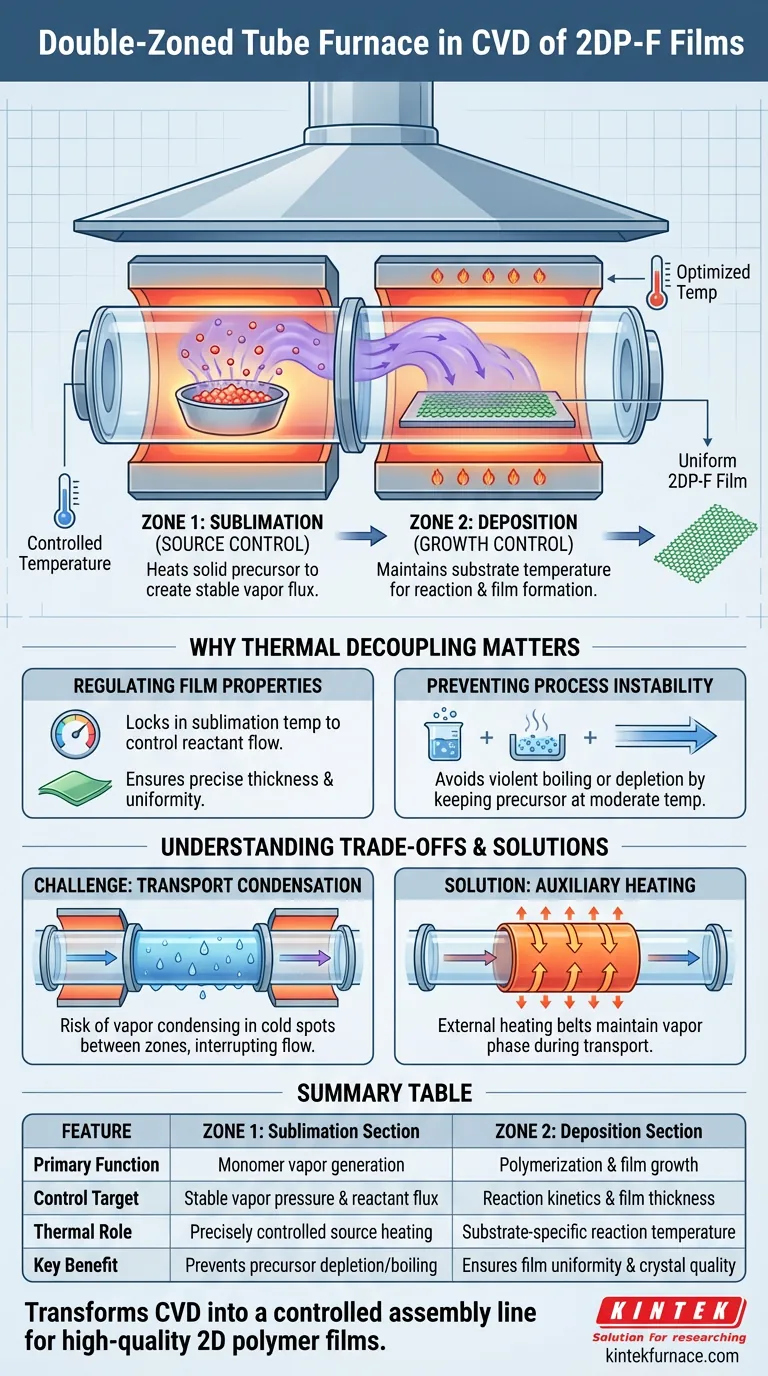
The primary function of a double-zoned tube furnace in the chemical vapor deposition (CVD) of fluorinated two-dimensional polymer (2DP-F) films is to decouple the precursor supply from the reaction process. By establishing two independently controllable heating sections, the system allows you to manage the sublimation of monomers separately from the polymerization and deposition occurring on the substrate.
Core Takeaway Achieving high-quality 2DP-F films requires balancing vapor generation with reaction kinetics. The double-zoned furnace solves this by isolating the sublimation temperature (source control) from the deposition temperature (growth control), ensuring a stable flow of reactants and precise regulation of film thickness.
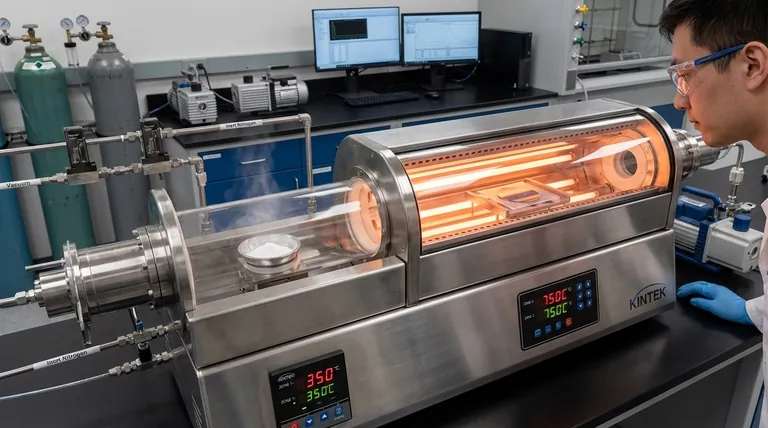
The Mechanics of Dual-Zone Control
The defining feature of this setup is the ability to maintain a specific thermal gradient. This is not merely about heating; it is about creating distinct thermodynamic environments for different stages of the process.
Zone 1: Controlled Sublimation
The first zone is dedicated to the precursor monomers. The goal here is to heat the solid source material to a precise temperature where it sublimates into a vapor phase.
By isolating this zone, you ensure the monomers enter the gas phase at a stable, controlled rate. This stability establishes a consistent vapor pressure, which is the "supply line" for the rest of the process.
Zone 2: Optimized Deposition
The second zone contains the substrate where the film will actually grow. This zone is maintained at the specific temperature required to trigger the chemical reaction and facilitate the deposition of the 2DP-F film.
Independent control here allows you to set the thermodynamic conditions favorable for polymerization without affecting the rate at which the source material is being consumed in the first zone.
Why Thermal Decoupling Matters
Using a single-zone furnace for this application would force a compromise between generating vapor and growing the film. The double-zone configuration eliminates this compromise.
Regulating Film Properties
The quality of a 2DP-F film is heavily dependent on the flux of monomers reaching the substrate.
By locking in the sublimation temperature in the first zone, you effectively control the "flow rate" of the reactants. This precise supply is critical for regulating the final thickness of the film and ensuring high uniformity across the substrate.
Preventing Process Instability
If the precursor is heated too aggressively (a risk in single-zone systems trying to reach high deposition temps), the source material may boil violently or deplete too quickly.
The dual-zone setup prevents this by keeping the precursor at a moderate volatilization temperature while the reaction zone is held at the potentially higher temperature needed for proper crystal growth or polymerization.
Understanding the Trade-offs
While a double-zoned furnace provides superior control, it introduces complexity that must be managed to avoid failure points.
The Risk of Transport Condensation
A significant challenge in multi-zone CVD is the potential for "cold spots" between the sublimation zone and the deposition zone, or in upstream piping.
If the temperature drops in the transport tubing, the sublimated monomer vapors can condense and adsorb onto the tube walls before reaching the substrate. This interrupts the continuous delivery of chemical components, leading to inconsistent film formation.
The Need for Auxiliary Heating
To mitigate condensation, the furnace is often used in conjunction with external heating belts wrapped around upstream pipelines.
These belts provide auxiliary heat to maintain the vapor phase during transport. Relying solely on the furnace's internal zones without accounting for thermal losses in the transport lines is a common pitfall.
Making the Right Choice for Your Goal
When configuring your CVD system for 2DP-F growth, focus on the specific parameters of your monomer and desired film structure.
- If your primary focus is Film Uniformity: Prioritize fine-tuning the first zone to find the lowest possible sublimation temperature that yields a stable vapor pressure, preventing "surges" of reactant.
- If your primary focus is Reaction Quality: Prioritize the second zone's calibration to ensure the substrate temperature sits exactly within the thermodynamic window for optimal polymerization, regardless of the source temperature.
Ultimately, the double-zoned furnace transforms the CVD process from a chaotic thermal event into a controlled assembly line, allowing for the precise manufacturing of high-quality 2D polymer films.
Summary Table:
| Feature | Zone 1: Sublimation Section | Zone 2: Deposition Section |
|---|---|---|
| Primary Function | Monomer vapor generation | Polymerization & film growth |
| Control Target | Stable vapor pressure & reactant flux | Reaction kinetics & film thickness |
| Thermal Role | Precisely controlled source heating | Substrate-specific reaction temperature |
| Key Benefit | Prevents precursor depletion/boiling | Ensures film uniformity & crystal quality |
Elevate Your Thin-Film Research with KINTEK
Precise 2DP-F film synthesis demands the rigorous thermal decoupling that only a high-performance system can provide. KINTEK delivers the expert R&D and manufacturing excellence you need to master Chemical Vapor Deposition. From Double-Zoned Tube Furnaces to specialized Muffle, Rotary, Vacuum, and CVD systems, our equipment is fully customizable to meet your unique laboratory requirements.
Ready to optimize your deposition process? Contact KINTEK Today to Consult with Our Specialists
Visual Guide
References
- Qiyi Fang, Jun Lou. High-performance 2D electronic devices enabled by strong and tough two-dimensional polymer with ultra-low dielectric constant. DOI: 10.1038/s41467-024-53935-6
This article is also based on technical information from Kintek Furnace Knowledge Base .
Related Products
- Magnesium Extraction and Purification Condensing Tube Furnace
- Split Multi Heating Zone Rotary Tube Furnace Rotating Tube Furnace
- Multi Heating Zones CVD Tube Furnace Machine for Chemical Vapor Deposition Equipment
- Multi Zone Laboratory Quartz Tube Furnace Tubular Furnace
- Split Chamber CVD Tube Furnace with Vacuum Station CVD Machine
People Also Ask
- What are the advantages of using a condensing tube furnace for magnesium extraction? Achieve High Purity and Efficient Metal Recovery
- Why is a tube furnace with precise temperature control necessary for atmosphere annealing? Master Ceramic Engineering
- Why are a tube furnace and nitrogen flow required? Master Carbon Microsphere Activation with Precision
- What is the heating rate of a tube furnace? Balancing Speed with Safety for Your Lab
- Why is an industrial monitoring camera necessary for measuring aluminum powder ignition delay in a tube furnace?



















