
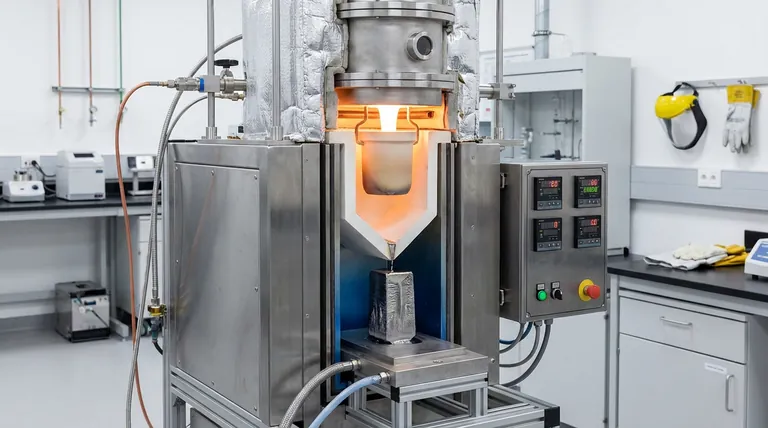
The Bridgman furnace serves as the mechanical architect of single crystal superalloys. Its core role is to generate and rigorously control a specific temperature gradient required for directional solidification. By precisely coordinating the relative movement between a heating zone, an insulating baffle, and a cooling zone, the furnace forces heat to transfer in a single direction, compelling the metal to solidify into upward-growing columnar dendrites along the critical [001] crystal orientation.
The success of single crystal casting relies entirely on strictly controlled heat flow. The Bridgman furnace achieves this by physically segregating heating and cooling environments, creating the thermal conditions necessary to suppress random grain formation and dictate the alloy's microstructure.
The Mechanics of Directional Solidification
Establishing the Thermal Gradient
The fundamental purpose of the Bridgman furnace is to create a directional heat transfer environment.
Rather than allowing the metal to cool uniformly from all sides, the furnace imposes a strict temperature difference.
This gradient is the driving force that aligns the solidification front, ensuring the material grows systematically rather than chaotically.
The Function of the Insulation Baffle
Crucial to maintaining this gradient is the insulation baffle, often referred to as a heat shield or annular baffle.
This component acts as a thermal barrier, sharply separating the high-temperature heating zone from the low-temperature cooling zone.
By preventing radiative heat exchange between these two zones, the baffle ensures a steep, positive temperature gradient remains consistent along the height of the casting.
Managing Relative Movement
The furnace does not simply hold the metal static; it manages the relative movement of the mold.
As the mold is slowly withdrawn from the heating zone, past the baffle, and into the cooling zone (typically a chill plate or chill ring), the solidification front advances.
This controlled withdrawal rate is the variable that allows engineers to dictate the speed and stability of crystal growth.
Enabling Single Crystal Formation
Promoting [001] Orientation
The specific hardware configuration of the Bridgman furnace is designed to promote growth along the [001] crystal orientation.
This orientation is highly desirable for the mechanical properties of nickel-based superalloys, particularly for turbine blades.
The furnace acts as the essential hardware foundation that makes this non-natural growth pattern possible.
Facilitating Columnar Dendrite Growth
The directional heat extraction forces the formation of columnar dendrites.
Because heat is removed only from the bottom (via the chill plate) and not the sides (due to the heating zone and insulation), grains are forced to grow upwards.
This competitive growth process eventually selects a single grain orientation, eliminating the grain boundaries that act as failure points in high-stress environments.
Understanding the Trade-offs
Sensitivity to Process Variables
While the Bridgman process is effective, it is highly sensitive to the withdrawal rate.
If the movement is too fast, the gradient breaks down, leading to stray grain formation or equiaxed crystals.
If the movement is too slow, production efficiency drops, and interaction between the mold and the melt can degrade the alloy.
Complexity of Baffle Design
The performance of the furnace is heavily dependent on the integrity of the insulation baffle.
Any gap or failure in the baffle allows heat leakage from the hot zone to the cold zone.
This "thermal short circuit" reduces the temperature gradient, compromising the directional nature of the solidification and potentially ruining the single crystal structure.
Making the Right Choice for Your Goal
To maximize the effectiveness of a Bridgman furnace in your casting process, focus on the specific parameters that align with your metallurgical targets.
- If your primary focus is Structural Integrity: Prioritize the precision of the withdrawal mechanism to ensure a steady, uninterrupted solidification front along the [001] axis.
- If your primary focus is Chemical Purity: Ensure the furnace operates within a high-vacuum environment (typically 1.4 to 5.3 Pa) to remove volatile impurities before solidification begins.
The Bridgman furnace is not merely a heating vessel; it is a precision instrument used to engineer the atomic alignment of high-performance materials.
Summary Table:
| Component/Process | Core Function in Bridgman Furnace |
|---|---|
| Heating Zone | Maintains alloy in a molten state above the liquidus temperature |
| Insulation Baffle | Creates a sharp thermal barrier to establish a steep temperature gradient |
| Chill Plate/Ring | Facilitates unidirectional heat extraction from the bottom of the mold |
| Withdrawal Mechanism | Controls the solidification front speed to promote [001] grain orientation |
| Vacuum System | Ensures chemical purity by removing volatile impurities during processing |
Elevate Your Material Engineering with KINTEK Precision
Unlock the full potential of directional solidification with KINTEK’s advanced thermal solutions. Backed by expert R&D and world-class manufacturing, KINTEK offers high-performance Muffle, Tube, Rotary, Vacuum, and CVD systems, alongside specialized high-temp furnaces—all fully customizable to meet your unique metallurgical research and production needs.
Whether you are refining single crystal superalloys or developing next-generation ceramics, our equipment provides the stability and control your lab requires. Contact KINTEK today to discuss how our customizable furnace systems can optimize your thermal gradients and enhance your material structural integrity.
References
- Study of the Non-uniform Distribution of Primary Dendrite Arm Spacing (PDAS) Across the Width of a Single-Crystal Nickel-Based Superalloy Casting. DOI: 10.1007/s40962-025-01717-1
This article is also based on technical information from Kintek Furnace Knowledge Base .
Related Products
- Dental Porcelain Zirconia Sintering Ceramic Vacuum Press Furnace
- High Temperature Muffle Oven Furnace for Laboratory Debinding and Pre Sintering
- Vacuum Heat Treat Sintering Furnace with Pressure for Vacuum Sintering
- Mesh Belt Controlled Atmosphere Furnace Inert Nitrogen Atmosphere Furnace
- 1700℃ Controlled Inert Nitrogen Atmosphere Furnace
People Also Ask
- What factors determine the quality of sintered zirconia restorations? Master Material, Equipment, and Technique
- How do conventional vs rapid sintering in dental furnaces affect zirconia? Optimize Efficiency Without Sacrificing Strength
- What is the purpose of dental sintering furnaces? Transform Zirconia into Durable, High-Quality Dental Restorations
- What precautions should be taken when sintering zirconia in the Fast Slow Dental Sintering Furnace? Master Key Steps for Perfect Results
- What temperature range is used for sintering zirconia ceramics? Achieve Optimal Strength and Translucency



















