
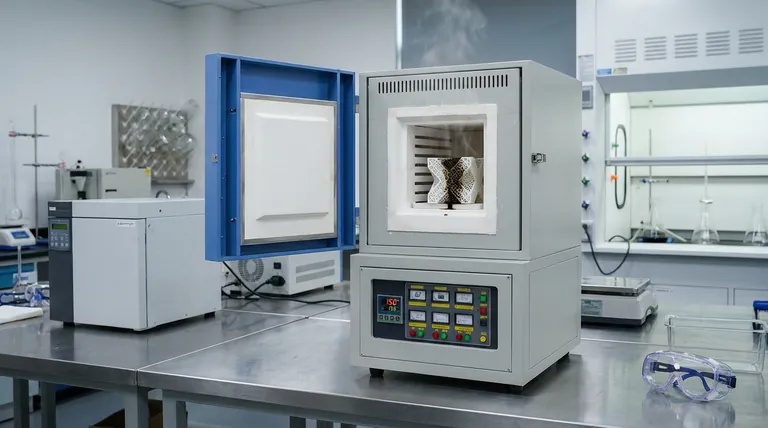
Thermostatic heating devices, such as muffle furnaces, provide the precise thermal energy required to chemically transform and stabilize 3D-printed polypropylene. By maintaining a uniform high-temperature environment, these devices facilitate the deep diffusion of concentrated sulfuric acid into the polymer matrix. This enables the molecular chains to undergo sulfonation-induced crosslinking, converting the material from a meltable thermoplastic into a heat-resistant, infusible structure.
The muffle furnace acts as a catalyst for structural survival. It creates the specific thermodynamic conditions needed to "lock" the 3D-printed shape, ensuring the part does not melt or collapse when subjected to extreme heat in subsequent processing steps.
The Mechanics of Sulfonation-Induced Crosslinking
Facilitating Acid Penetration
The primary function of the heating device is to accelerate chemical kinetics. At elevated temperatures, the diffusion rate of concentrated sulfuric acid increases significantly.
This allows the acid to penetrate beyond the surface and deep into the core of the 3D-printed precursor. Uniform penetration is essential for creating a consistent material structure throughout the part.
Inducing Phase Transformation
Standard polypropylene exists in a semi-crystalline state. The muffle furnace, specifically when maintaining a stable temperature around 150 °C, drives a critical phase change.
The heat transforms the polypropylene chains from a crystalline state to an amorphous state. This amorphous structure is more receptive to chemical modification, allowing the sulfonation process to occur more efficiently.
Creating an Infusible Precursor
The ultimate goal of this thermal treatment is a fundamental change in material properties. The heat drives the crosslinking reaction that bridges the polymer chains.
This turns the polypropylene from a thermoplastic—which would simply melt when heated—into an "infusible" crosslinked precursor. This chemical rigidity is the only reason the complex 3D-printed geometry survives later stages.
The Role in Process Stability
Preventing Structural Collapse
The crosslinking process is a race against thermal deformation. If the material is not chemically stabilized quickly and uniformly, gravity and heat will destroy the print.
The thermostatic device ensures the crosslinking density is high enough to support the part's own weight. This preservation of structural integrity is the defining success metric for this stage.
Preparation for Pyrolysis
This heating stage is effectively a "hardening" phase before the most intense processing step. The material is being prepped for high-temperature pyrolysis (often used to create carbon structures).
Without the thermal stability imparted by the furnace during sulfonation, the precursor would disintegrate or liquefy during pyrolysis.
Understanding the Trade-offs
The Necessity of Uniformity
The effectiveness of this process relies entirely on thermal precision. A standard oven with fluctuating temperatures is often insufficient.
If the heating is non-uniform, the crosslinking will be patchy. This leads to internal stresses and potential structural failure, as some areas remain thermoplastic while others harden.
Balancing Temperature and Chemistry
There is a critical balance to maintain. The temperature must be high enough to induce the amorphous state and drive diffusion (e.g., 150 °C).
However, precise control is required to prevent degrading the polymer before the acid has done its work. The muffle furnace provides the stability needed to walk this tightrope.
Making the Right Choice for Your Goal
To ensure the success of your sulfonation process, prioritize the following parameters based on your specific objectives:
- If your primary focus is Geometric Fidelity: Ensure your furnace provides exceptional thermal uniformity to guarantee even crosslinking and prevent warping.
- If your primary focus is Chemical Conversion: Maintain a strict temperature profile (around 150 °C) to maximize the transition to the amorphous state for optimal acid reaction.
By strictly controlling the thermal environment, you convert a vulnerable plastic into a robust precursor capable of enduring extreme thermal transformation.
Summary Table:
| Function | Description | Impact on Precursor |
|---|---|---|
| Acid Penetration | Accelerates diffusion of concentrated sulfuric acid. | Ensures uniform chemical modification to the core. |
| Phase Transformation | Shifts PP from semi-crystalline to amorphous at ~150°C. | Increases reactivity for efficient molecular crosslinking. |
| Structural Locking | Facilitates chemical bridging of polymer chains. | Converts thermoplastic into a heat-resistant, infusible part. |
| Thermal Uniformity | Maintains a stable, constant temperature environment. | Prevents warping, melting, and internal stresses. |
Elevate Your Materials Research with KINTEK Precision
Achieving the perfect sulfonation-induced crosslinking requires more than just heat—it requires absolute thermal precision. KINTEK’s advanced muffle furnaces and high-temperature systems are engineered to provide the uniform environment necessary to transform 3D-printed polypropylene into robust, heat-resistant precursors without structural failure.
Why partner with KINTEK?
- Expert R&D Integration: Our systems are designed for complex chemical and thermal workflows.
- Customizable Solutions: Whether you need Muffle, Tube, Rotary, Vacuum, or CVD systems, we tailor our tech to your lab's unique requirements.
- Reliable Manufacturing: Durable, high-performance equipment that ensures process repeatability.
Don't let thermal instability compromise your research. Contact KINTEK today to find your ideal furnace solution.
References
- Paul N. Smith, Zhe Qiang. Accurate additive manufacturing of lightweight and elastic carbons using plastic precursors. DOI: 10.1038/s41467-024-45211-4
This article is also based on technical information from Kintek Furnace Knowledge Base .
Related Products
- 1400℃ Muffle Oven Furnace for Laboratory
- 1700℃ High Temperature Muffle Oven Furnace for Laboratory
- 1800℃ High Temperature Muffle Oven Furnace for Laboratory
- 1200℃ Muffle Oven Furnace for Laboratory
- High Temperature Muffle Oven Furnace for Laboratory Debinding and Pre Sintering
People Also Ask
- What is the primary function of a high-temperature laboratory muffle furnace in chemical synthesis? Achieve Precision.
- How does a high-temperature laboratory muffle furnace affect material properties? Transform Anodic Oxide Films Fast
- How is a laboratory high-temperature muffle furnace utilized in g-C3N4 synthesis? Optimize Your Thermal Polycondensation
- How does a laboratory high-temperature muffle furnace contribute to the final formation of Bismuth Oxide nanosheets?
- How is a laboratory high-temperature muffle furnace utilized to achieve the specific crystalline structure of LaFeO3 catalysts?



















