
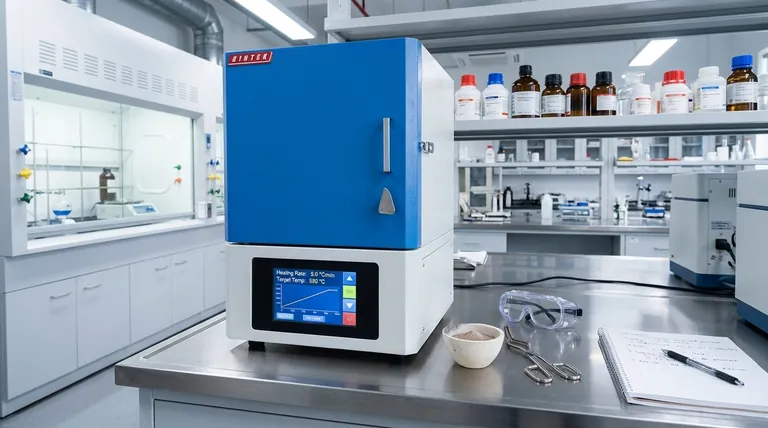
The specific heating rate serves as a critical kinetic control mechanism during the synthesis of graphitic carbon nitride (g-C3N4). By strictly regulating the speed of the temperature increase—commonly set to a rate such as 5 °C/min—you ensure that the melamine precursor materials are heated uniformly throughout the crucible. This controlled ramp prevents the structural chaos associated with thermal shock, ensuring the material decomposes and polymerizes evenly rather than erratically.
Core Takeaway The heating rate dictates the quality of the chemical transformation. A controlled ramp is non-negotiable for enabling the full deammoniation and polycondensation required to convert monomers into a stable, highly crystalline 2D layered structure, while preventing defects caused by uneven thermal gradients.
The Mechanics of Thermal Polymerization
Ensuring Uniform Heat Distribution
The primary technical function of a set heating rate is to guarantee thermal uniformity.
When the temperature rises too quickly, the outer layers of the precursor may react while the inner core remains cool. A specific rate, such as 5 °C/min or 10 °C/min, allows heat to penetrate the precursor mass evenly.
Facilitating Complete Deammoniation
The synthesis of g-C3N4 is not a simple melting process; it is a complex chemical reaction involving deammoniation.
This process requires the orderly release of ammonia gas as the structure condenses. A controlled heating rate provides the necessary time window for this gas release to occur without disrupting the forming lattice.
Driving Polycondensation
The muffle furnace provides the energy field necessary for polycondensation, where monomers link together.
By maintaining a steady ramp up to the target temperature (typically 550 °C), you ensure the precursors undergo a complete transformation. This transforms the material from simple monomers into a polymerized framework.
The Impact on Crystalline Structure
Preventing Structural Defects
A strictly controlled heating rate is the primary defense against structural defects.
Excessively rapid temperature increases can lead to incomplete decomposition. This results in a material with a disordered atomic arrangement rather than a clean, semiconductor-grade lattice.
Achieving a 2D Layered Architecture
The ultimate goal of g-C3N4 synthesis is the formation of a well-crystallized 2D layered structure.
The stability of the heating profile allows these layers to stack and grow securely. Whether utilizing a standard muffle furnace or a tube furnace, precise thermal control is what facilitates the formation of a structurally regular graphitic layer.
Understanding the Trade-offs: The Risks of Rapid Heating
Incomplete Transformation
If the heating rate is too aggressive, the chemical reaction effectively "skips" steps.
The material may reach the target temperature of 550 °C, but it will not have spent enough time in the intermediate temperature zones required for proper polymerization. This leads to bulk material that is chemically unstable or amorphous.
Thermal Shock and Inconsistency
Rapid heating introduces thermal gradients within the sample.
This results in a product that is heterogeneous—partially polymerized on the outside and under-reacted on the inside. This inconsistency makes the material unsuitable for high-precision applications, such as the production of ultrathin nanosheets.
Making the Right Choice for Your Goal
To maximize the quality of your graphitic carbon nitride, you must match your thermal program to your structural requirements.
- If your primary focus is high crystallinity: Utilize a slower, strictly controlled ramp rate (e.g., 5 °C/min) to maximize structural order and minimize defects.
- If your primary focus is process consistency: Ensure the furnace is capable of maintaining a static air environment and holding the target temperature (e.g., 550 °C) for a sufficient duration (typically 4 hours) to complete the reaction.
Precision in the heating ramp is the difference between a high-performance semiconductor and a defective amorphous powder.
Summary Table:
| Technical Parameter | Role in g-C3N4 Synthesis | Impact on Final Product |
|---|---|---|
| Heating Rate | Kinetic control of polymerization | Ensures high crystallinity and 2D layered structure |
| Uniformity | Prevents thermal gradients | Eliminates structural defects and heterogeneous layers |
| Deammoniation | Orderly release of ammonia gas | Facilitates stable lattice formation without disruption |
| Thermal Ramp | Manages chemical transformation steps | Prevents 'skipping' critical intermediate reaction phases |
Elevate Your Materials Synthesis with KINTEK Precision
Achieving the perfect 2D layered structure in graphitic carbon nitride requires more than just heat; it requires absolute thermal control. Backed by expert R&D and manufacturing, KINTEK offers high-performance Muffle, Tube, Rotary, Vacuum, and CVD systems—all customizable to meet your specific heating rate and atmospheric needs.
Why choose KINTEK?
- Precision Engineering: Maintain strict ramp rates (e.g., 5°C/min) for flawless polycondensation.
- Versatile Solutions: Ideal for high-precision semiconductor and nanosheet applications.
- Expert Support: Our furnaces are designed to minimize thermal gradients and structural defects.
Ready to optimize your lab's efficiency and material quality? Contact our experts today to find your perfect furnace solution!
References
- Construction of a 1D/0D/2D BiFeO <sub>3</sub> /Ag/g-C <sub>3</sub> N <sub>4</sub> Z-scheme heterojunction for enhanced visible light photocatalysis of methylene blue. DOI: 10.1039/d5ra04825g
This article is also based on technical information from Kintek Furnace Knowledge Base .
Related Products
- 1400℃ Muffle Oven Furnace for Laboratory
- High Temperature Muffle Oven Furnace for Laboratory Debinding and Pre Sintering
- 1200℃ Muffle Oven Furnace for Laboratory
- Laboratory Muffle Oven Furnace with Bottom Lifting
- 1800℃ High Temperature Muffle Oven Furnace for Laboratory
People Also Ask
- How does a high-temperature laboratory muffle furnace affect material properties? Transform Anodic Oxide Films Fast
- What is the primary function of a high-temperature laboratory muffle furnace in chemical synthesis? Achieve Precision.
- How is a laboratory high-temperature muffle furnace utilized in g-C3N4 synthesis? Optimize Your Thermal Polycondensation
- How is a laboratory high-temperature muffle furnace utilized to achieve the specific crystalline structure of LaFeO3 catalysts?
- What is the role of a laboratory high-temperature muffle furnace in H13 steel treatment? Optimize Tool Performance



















