
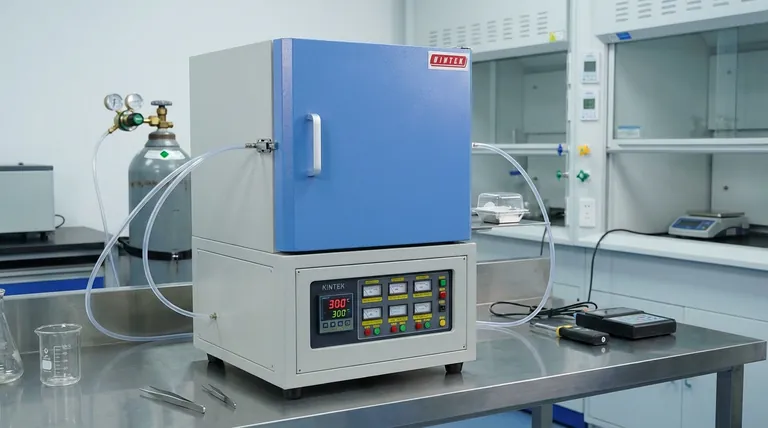
A muffle furnace acts as the precision thermal chamber essential for the self-assembly phase of Nanosphere-on-Hyperbolic Metamaterial (NHoHMM) fabrication. It provides a strictly controlled environment to heat multilayer structures containing thin silver films (approximately 5nm) to 300°C, triggering the physical transformation of the metal layers.
The muffle furnace facilitates the critical process of solid-state dewetting, where continuous silver films break apart and self-assemble into dispersed nanospheres. This transformation is fundamental to creating the localized surface plasmon resonance (LSPR) properties required for optical metamaterials.
The Mechanism of Transformation
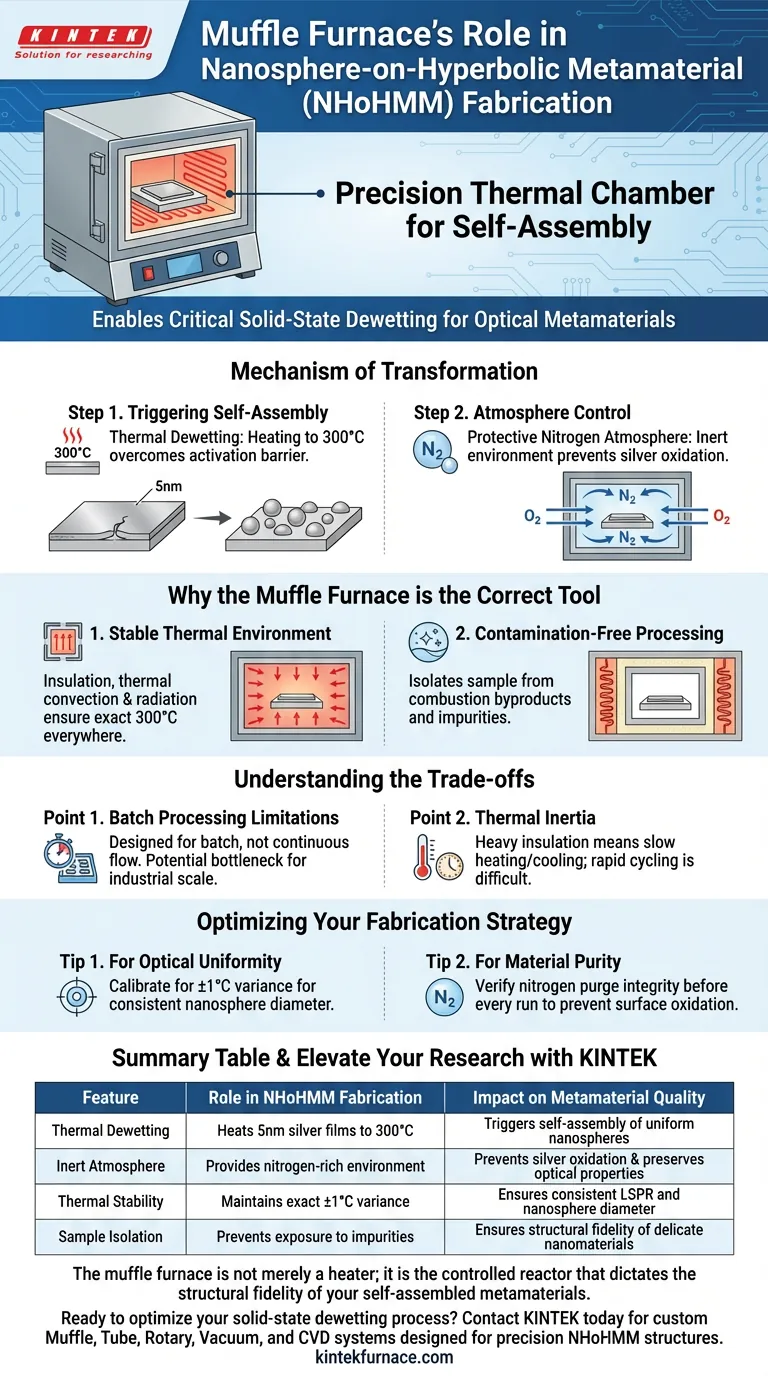
Triggering Self-Assembly
The primary function of the muffle furnace in this context is to induce thermal dewetting.
By heating the substrate to 300°C, the furnace adds enough energy to the system to overcome the activation barrier of the thin silver film.
This causes the continuous 5nm layer to rupture and reorganize into isolated, spherical islands (nanospheres) to minimize surface energy.
Atmosphere Control
The furnace maintains a protective nitrogen atmosphere during the heating process.
This inert environment is vital because silver is highly reactive to oxygen at elevated temperatures.
Without this protective gas flow, the silver would oxidize rather than dewet cleanly, destroying the optical properties of the final metamaterial.
Why the Muffle Furnace is the Correct Tool
Stable Thermal Environment
Success in NHoHMM fabrication requires absolute temperature stability to ensure uniform nanosphere size distribution.
Muffle furnaces utilize insulating materials to prevent heat loss and combine thermal convection and radiation to distribute heat evenly.
This ensures that every part of the sample experiences the exact same 300°C condition, preventing gradients that would lead to irregular structures.
Contamination-Free Processing
Unlike direct-flame heating methods, a muffle furnace isolates the sample from combustion byproducts.
The heating coils are separated from the chamber or embedded in insulation, ensuring the heat source does not introduce impurities.
This contamination-free environment is critical for nanomaterials, where even microscopic impurities can disrupt the delicate LSPR effects.
Understanding the Trade-offs
Batch Processing Limitations
Muffle furnaces are inherently designed for batch processing, not continuous flow manufacturing.
While excellent for research and high-precision fabrication, this can become a bottleneck if you are attempting to scale production to industrial levels.
Thermal Inertia
These furnaces rely on heavy insulation to maintain stability, which results in significant thermal inertia.
This means heating up and cooling down takes time; rapid temperature cycling is generally not possible.
If your process requires immediate quenching after dewetting, you must account for the time required to safely remove the sample from the hot chamber.
Optimizing Your Fabrication Strategy
To ensure high-quality NHoHMM structures, align your furnace usage with your specific technical goals:
- If your primary focus is optical uniformity: Ensure your furnace is calibrated to maintain 300°C with less than ±1°C variance to guarantee consistent nanosphere diameter across the sample.
- If your primary focus is material purity: Verify the integrity of the nitrogen purge system before every run to prevent surface oxidation of the silver layer.
The muffle furnace is not merely a heater; it is the controlled reactor that dictates the structural fidelity of your self-assembled metamaterials.
Summary Table:
| Feature | Role in NHoHMM Fabrication | Impact on Metamaterial Quality |
|---|---|---|
| Thermal Dewetting | Heats 5nm silver films to 300°C | Triggers self-assembly of uniform nanospheres |
| Inert Atmosphere | Provides nitrogen-rich environment | Prevents silver oxidation and preserves optical properties |
| Thermal Stability | Maintains exact ±1°C variance | Ensures consistent LSPR and nanosphere diameter |
| Sample Isolation | Prevents exposure to combustion/impurities | Ensures structural fidelity of delicate nanomaterials |
Elevate Your Nanomaterial Research with KINTEK
Precision is the heartbeat of metamaterial fabrication. Backed by expert R&D and manufacturing, KINTEK offers high-performance Muffle, Tube, Rotary, Vacuum, and CVD systems designed to provide the stable thermal environments and atmosphere control required for complex NHoHMM structures. Our lab furnaces are fully customizable to meet your unique research needs, ensuring contamination-free results and uniform thermal distribution every time.
Ready to optimize your solid-state dewetting process? Contact KINTEK today to discuss your custom furnace solution!
Visual Guide
References
- R. Niguma, Koichi Okamoto. Novel Plasmonic Metamaterials Based on Metal Nano-Hemispheres and Metal-Dielectric Composites. DOI: 10.3390/photonics11040356
This article is also based on technical information from Kintek Furnace Knowledge Base .
Related Products
- 1400℃ Muffle Oven Furnace for Laboratory
- 1700℃ High Temperature Muffle Oven Furnace for Laboratory
- 1800℃ High Temperature Muffle Oven Furnace for Laboratory
- 1200℃ Muffle Oven Furnace for Laboratory
- High Temperature Muffle Oven Furnace for Laboratory Debinding and Pre Sintering
People Also Ask
- What is the primary function of a high-temperature laboratory muffle furnace in chemical synthesis? Achieve Precision.
- How does a high-temperature laboratory muffle furnace affect material properties? Transform Anodic Oxide Films Fast
- What is the role of a laboratory high-temperature muffle furnace in H13 steel treatment? Optimize Tool Performance
- How does a muffle furnace facilitate Ag/ATP catalyst preparation? Optimize Calcination for Superior Performance
- What is the purpose of using a laboratory high-temperature muffle furnace for drying Fe-Ni-Co catalysts? Boost Purity



















