
A high vacuum annealing furnace establishes a rigorous testing environment characterized by specific pressure and temperature parameters designed to isolate thermal effects from chemical reactions. By maintaining an extremely low pressure of approximately 1.2 x 10^-4 Pa and offering heating capabilities up to 800 °C, this equipment allows for the precise stress-testing of materials. These conditions are essential for preventing unintended oxidation, ensuring that the failure mechanisms observed are due to thermal instability rather than environmental contamination.
The core value of this experimental setup is its ability to decouple thermal stress from oxidative stress. By removing atmospheric variables, researchers can accurately verify the endurance limits of barrier layers based solely on their structural integrity and resistance to diffusion.
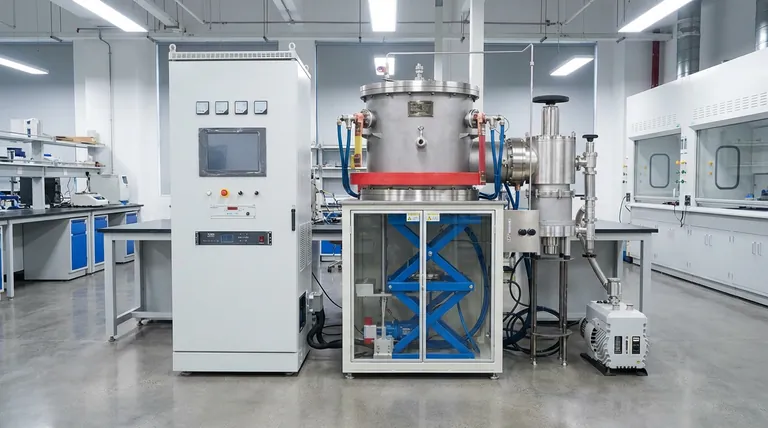
Precision Environmental Control
Eliminating Chemical Interference
The defining feature of this experimental condition is the creation of a high vacuum environment, specifically around 1.2 x 10^-4 Pa.
At this pressure level, the presence of oxygen is negligible. This prevents the unintended oxidation of metal thin films, which would otherwise obscure the true thermal limits of the material being tested.
High-Temperature Stress Testing
The furnace provides a controlled heating range up to 800 °C.
This high thermal energy is necessary to accelerate kinetic processes within the material. It forces the system to reach its activation energy for potential failure modes without the sample burning or corroding due to air exposure.
Investigating Failure Mechanisms
Enabling Long-Duration Observation
The stability provided by the high vacuum allows for long-duration controlled annealing.
Because the environment is non-reactive, researchers can expose materials to heat for extended periods. This is critical for identifying slow-acting degradation processes that might not appear in short-term tests.
Visualizing Structural Breakdown
The primary utility of these conditions is to observe specific physical changes, such as dewetting behavior and interfacial diffusion.
For example, in studies involving platinum films on silicon dioxide, this setup allows researchers to see exactly when and how the film begins to detach or diffuse into the substrate. This observation verifies the actual endurance limits of the barrier layer.
Understanding the Constraints
Idealized vs. Operational Conditions
While a high vacuum is excellent for fundamental physics, it represents an idealized environment.
Testing in a vacuum removes oxidation, which is beneficial for studying diffusion, but it may not predict how a barrier will perform if the final device is meant to operate in an oxygen-rich atmosphere.
The Focus on Intrinsic Stability
This method specifically targets intrinsic thermal stability, not chemical resistance.
If your failure mechanism relies on the interaction between the barrier and the atmosphere, this experimental setup will suppress that mechanism, potentially yielding false positives regarding the barrier's total robustness.
Making the Right Choice for Your Goal
To determine if high vacuum annealing is the correct approach for your diffusion barrier assessment, consider your specific objectives:
- If your primary focus is fundamental mechanism study: Use this setup to isolate physical failures like dewetting and diffusion without the noise of surface chemistry changes.
- If your primary focus is pure thermal endurance: Rely on the high vacuum to prevent oxidation, ensuring that any degradation observed is strictly caused by the heat load (up to 800 °C).
This experimental approach provides the clarity needed to distinguish between a material that fails due to heat and one that fails due to chemistry.
Summary Table:
| Parameter | Specification/Condition | Benefit for Diffusion Barrier Testing |
|---|---|---|
| Vacuum Level | ~1.2 x 10^-4 Pa | Prevents unintended oxidation and chemical interference. |
| Max Temperature | Up to 800 °C | Accelerates kinetic processes to identify failure thresholds. |
| Atmosphere | Inert/Non-reactive | Decouples thermal stress from environmental contamination. |
| Observation Focus | Long-duration annealing | Visualizes slow-acting dewetting and interfacial diffusion. |
| Failure Type | Intrinsic Thermal | Isolates structural integrity issues from chemical resistance. |
Elevate Your Materials Research with KINTEK Precision
Unlock the full potential of your thermal stability studies with KINTEK’s advanced high-temperature furnace solutions. Backed by expert R&D and world-class manufacturing, we provide high-performance Vacuum, Muffle, Tube, Rotary, and CVD systems tailored to the rigorous demands of material science.
Whether you require precise vacuum control for thin-film testing or customizable heating cycles for diffusion barrier assessment, KINTEK delivers the reliability your lab needs to ensure accurate, repeatable results.
Ready to optimize your experimental setup? Contact our technical experts today to discuss how our customizable laboratory furnaces can support your unique innovation goals.
References
- E. Akbarnejad, Alfred Ludwig. Enabling High‐Temperature Atomic‐Scale Investigations with Combinatorial Processing Platforms Using Improved Thermal SiO<sub>2</sub> Diffusion and Reaction Barriers. DOI: 10.1002/admi.202400138
This article is also based on technical information from Kintek Furnace Knowledge Base .
Related Products
- 2200 ℃ Tungsten Vacuum Heat Treat and Sintering Furnace
- High Pressure Laboratory Vacuum Tube Furnace
- 9MPa Air Pressure Vacuum Heat Treat and Sintering Furnace
- 1400℃ Controlled Inert Nitrogen Atmosphere Furnace
- Molybdenum Vacuum Heat Treat Furnace
People Also Ask
- How does a tungsten-heated vacuum sintering furnace prepare (TbxY1-x)2O3 ceramics? Achieve 99%+ Density & Purity
- How do compaction pressure and vacuum sintering optimize porous ceramics? Maximize Density & Toughness
- What wear-resistance enhancements are achieved by powder coating? The Role of Vacuum Sintering Furnaces
- What role does a high-temperature vacuum sintering furnace play in the densification of WC-10(Ni, Ni/Co) alloys?
- What core role does a high-temperature vacuum sintering furnace play in Sm:YAG ceramics? Mastering Optical Clarity



















