
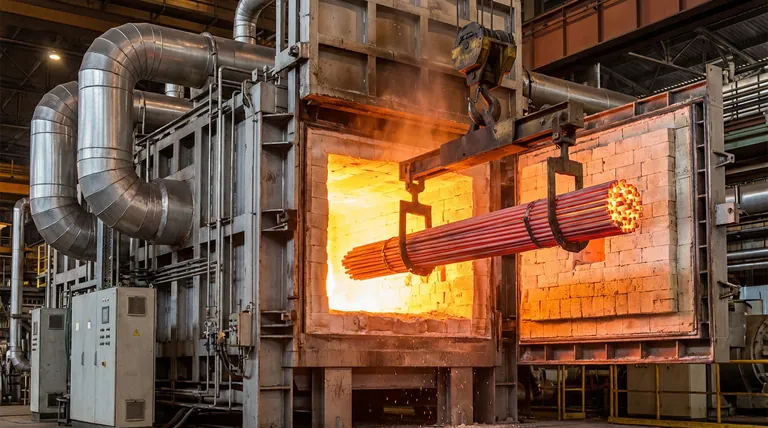
The primary function of a soaking furnace is to provide a strictly controlled high-temperature environment essential for processes like annealing, stress-relieving, and softening annealing. Specifically designed for circular steel rod bundles, these furnaces facilitate complex heat transfer to alter the material structure at a molecular level, ensuring the steel meets precise mechanical specifications.
The soaking furnace is not simply a heating unit; it is a critical determinant of material quality. Its ability to maintain precise temperature control over a complex, porous charge directly dictates the final microstructure and mechanical reliability of the steel.
The Role of the Soaking Furnace in Metallurgy
Enabling Essential Heat Treatments
The soaking furnace is the operational hub for specific thermal processes. It is primarily used for annealing, stress-relieving, and softening annealing.
These processes require sustained, high temperatures to relax the internal stresses of the steel. This "soaking" period allows the material to reach a state of equilibrium, preparing it for further processing or final use.
Handling the "Porous Charge"
Unlike solid slabs, steel rod bundles present a unique challenge known as a porous charge. The furnace is designed to penetrate this non-solid mass effectively.
Because the bundles contain gaps and air pockets, the furnace must drive heat evenly through the entire volume, not just the outer surface.
Mechanisms of Action
Complex Heat Transfer
Heating within a soaking furnace is not a singular action. It relies on a combination of conduction and radiation mechanisms.
Radiation transfers heat from the furnace elements to the rod bundles, while conduction helps distribute that heat internally among the rods. The furnace must balance these mechanisms to prevent hot spots or cold cores within the bundle.
Defining Microstructure
The ultimate goal of the soaking furnace is to control the final microstructure of the steel.
By manipulating the temperature and the duration of the soak, the furnace induces structural changes at a molecular level. This directly impacts mechanical properties such as ductility, hardness, and tensile strength.
Understanding the Operational Trade-offs
Precision vs. Throughput
Achieving perfect temperature uniformity often requires longer cycle times. Rushing the heating process to increase throughput can lead to uneven heating across the porous charge.
Energy Efficiency vs. Control
High-precision temperature control often demands significant energy input. Operators must balance the need for heating efficiency with the absolute necessity of maintaining strict thermal parameters to avoid compromising the steel's properties.
Making the Right Choice for Your Goal
To optimize your heat treatment strategy, consider your specific end-product requirements:
- If your primary focus is mechanical reliability: Prioritize temperature control precision over speed to ensure a uniform microstructure throughout the porous rod bundles.
- If your primary focus is operational efficiency: Evaluate the furnace's heating mechanisms to maximize radiation and conduction transfer rates without sacrificing essential soak times.
The effectiveness of your soaking furnace is the single most significant factor in transforming raw steel rods into high-performance industrial material.
Summary Table:
| Feature | Description | Impact on Steel Quality |
|---|---|---|
| Primary Function | Annealing & Stress-Relieving | Relaxes internal stresses and softens material |
| Charge Type | Porous Rod Bundles | Requires deep heat penetration through gaps |
| Heat Mechanism | Convection & Radiation | Ensures uniform temperature across the bundle |
| Outcome | Microstructure Control | Defines ductility, hardness, and tensile strength |
Elevate Your Metallurgical Precision with KINTEK
Don't let uneven heating compromise your product integrity. KINTEK provides industry-leading thermal solutions backed by expert R&D and world-class manufacturing. Whether you need Muffle, Tube, Rotary, Vacuum, or CVD systems, our high-temp furnaces are fully customizable to handle complex porous charges like steel rod bundles with unmatched precision.
Partner with KINTEK to achieve superior material microstructure and operational efficiency.
Contact Our Engineering Team Today
References
- Rafał Wyczółkowski, M. Gała. Computational Model of the Effective Thermal Conductivity of a Bundle of Round Steel Bars. DOI: 10.3390/ma18020373
This article is also based on technical information from Kintek Furnace Knowledge Base .
Related Products
- Vacuum Heat Treat Sintering and Brazing Furnace
- Vacuum Heat Treat Sintering Furnace with Pressure for Vacuum Sintering
- Small Vacuum Heat Treat and Tungsten Wire Sintering Furnace
- High Temperature Muffle Oven Furnace for Laboratory Debinding and Pre Sintering
- Vacuum Heat Treat Sintering Furnace Molybdenum Wire Vacuum Sintering Furnace
People Also Ask
- What are the benefits of using vacuum heat treating furnaces for metal alloys? Achieve Superior Metal Properties and Performance
- What is one of the most important uses of vacuum heat treating furnaces in aerospace? Achieve Superior Strength in Aircraft Alloys
- How does vacuum heat treating affect the grain structure of metal alloys? Achieve Precise Microstructure Control
- What is the temperature of a vacuum furnace brazing? Optimize Your Joint Strength and Cleanliness
- What are the steps involved in a typical vacuum brazing treatment? Master the Process for Strong, Clean Joints



















