
The core function of a vertical vacuum furnace in recycling waste magnesium alloys is to create a precisely controlled environment of high temperature and low pressure. This unique environment forces the magnesium to vaporize (sublimate) at a much lower temperature than normal, allowing it to physically separate from less volatile impurities like aluminum and iron. The purified magnesium gas is then collected by condensing it back into a solid on a cooled surface.
The furnace doesn't chemically change the materials; it manipulates the physical laws of pressure and temperature to exploit the different vaporization points of metals. This makes it an elegant and effective platform for physical separation and purification.
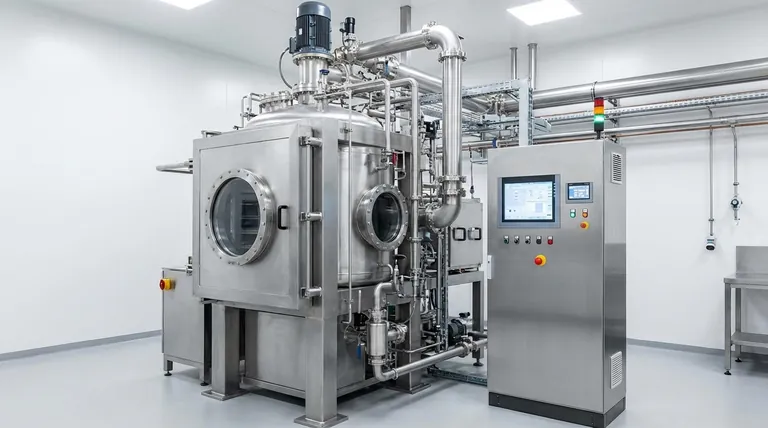
The Physics of Separation: Temperature and Pressure
To understand how the furnace works, you must first understand the two critical environmental conditions it creates and why they matter.
The Critical Role of High Vacuum
A deep vacuum, typically between 1-15 Pa, is the first and most important condition established in the furnace.
Reducing the ambient pressure dramatically lowers the boiling or sublimation temperature of a substance. For magnesium, this means it can be turned into a vapor at around 700°C instead of its atmospheric boiling point of 1090°C.
The Role of Precise Heating
The furnace's heating system provides the energy required for this phase change, precisely raising the temperature of the waste alloy.
By carefully controlling the heat, the system ensures that only the magnesium (and other high-vapor-pressure elements like zinc) receives enough energy to vaporize, while impurities with higher boiling points remain behind as a solid or liquid residue.
Leveraging Vapor Pressure Differences
The entire process hinges on the significant difference in saturated vapor pressure between magnesium and its common contaminants.
At the operating temperature and pressure, magnesium's vapor pressure is high, meaning it readily turns into a gas. In contrast, impurities like aluminum, iron, and silicon have very low vapor pressures and remain stable, enabling a clean separation.
A Step-by-Step Look Inside the Furnace
The separation process follows a clear, physical pathway within the furnace's controlled environment.
Step 1: Evacuation and Heating
First, the crucible containing the scrap magnesium alloy is placed inside the furnace. The vacuum system then evacuates the chamber to remove reactive gases and achieve the target low pressure. The heating system then brings the material to the optimal sublimation temperature.
Step 2: Selective Vaporization
As the alloy heats up under vacuum, the magnesium begins to vaporize, turning into a gas. This vapor fills the furnace chamber, leaving the less volatile impurities behind in the crucible as a slag.
Step 3: Condensation and Collection
The purified magnesium vapor migrates away from the hot zone towards a designated cooler area. Here, an internal, water-cooled condensation crystallization disc provides a cold surface.
When the hot magnesium vapor contacts this cold surface, it rapidly cools and desublimates—turning directly from a gas back into a high-purity solid. This crystalline magnesium is then harvested, completing the recycling process.
Understanding the Trade-offs and Critical Factors
While effective, the process requires careful management of several key variables to ensure both purity and efficiency.
The Problem of Contamination
Scrap magnesium is often contaminated with cutting oils and other organic compounds from its previous life. If not removed, these substances will crack at high temperatures, forming carbon that contaminates the final product.
This necessitates a pre-treatment de-oiling step, often conducted in a vacuum furnace at a moderate temperature, to vaporize and extract these oils before the primary sublimation stage begins.
The Necessity of Preventing Oxidation
At high temperatures, magnesium is extremely reactive with oxygen. The furnace's vacuum system is therefore crucial not only for lowering the sublimation point but also for removing reactive gases. This prevents severe oxidation that would compromise the purity and yield of the final product.
How to Apply This to Your Goal
Your primary objective will determine which aspect of the furnace's function you should focus on.
- If your primary focus is maximizing purity: Your success depends on maintaining the deepest possible vacuum and ensuring a significant temperature difference between the crucible and the condenser.
- If your primary focus is process efficiency: Precise and stable control over the heating temperature is paramount to ensure a consistent vaporization rate without wasting energy.
- If your primary focus is product quality: You must carefully control the condenser's temperature, as this directly influences the density and crystalline structure of the final magnesium product.
Ultimately, the vertical vacuum furnace provides a highly controlled platform to make the physical properties of metals work in your favor.
Summary Table:
| Function | Key Condition | Outcome |
|---|---|---|
| Lower Sublimation Point | High Vacuum (1-15 Pa) | Magnesium vaporizes at ~700°C instead of 1090°C |
| Selective Vaporization | Precise Heating | Magnesium vaporizes; impurities (Al, Fe) remain as slag |
| Purification & Collection | Water-Cooled Condenser | Pure magnesium gas condenses into solid crystals for harvest |
Ready to achieve superior purity and efficiency in your metal recycling processes?
KINTEK's vertical vacuum furnaces are engineered to provide the precise high-temperature, low-pressure environment essential for effective vacuum sublimation. Backed by expert R&D and manufacturing, KINTEK offers Muffle, Tube, Rotary, Vacuum, and CVD systems, all customizable for your unique needs.
Contact us today to discuss how our solutions can optimize your magnesium alloy recycling and enhance your product quality!
Visual Guide

Related Products
- Custom Made Versatile CVD Tube Furnace Chemical Vapor Deposition CVD Equipment Machine
- Vertical Laboratory Quartz Tube Furnace Tubular Furnace
- Vacuum Hot Press Furnace Machine Heated Vacuum Press
- 600T Vacuum Induction Hot Press Vacuum Heat Treat and Sintering Furnace
- Vacuum Induction Melting Furnace
People Also Ask
- Why are CVD tube furnace sintering systems indispensable for 2D material research and production? Unlock Atomic-Scale Precision
- What is a CVD tube furnace and what is its primary function? Discover Precision Thin-Film Deposition
- How does CVD tube furnace sintering enhance graphene growth? Achieve Superior Crystallinity and High Electron Mobility
- Which industries and research fields benefit from CVD tube furnace sintering systems for 2D materials? Unlock Next-Gen Tech Innovations
- What are the key application fields of CVD tube furnaces? Unlock Precision in Thin-Film Synthesis



















