
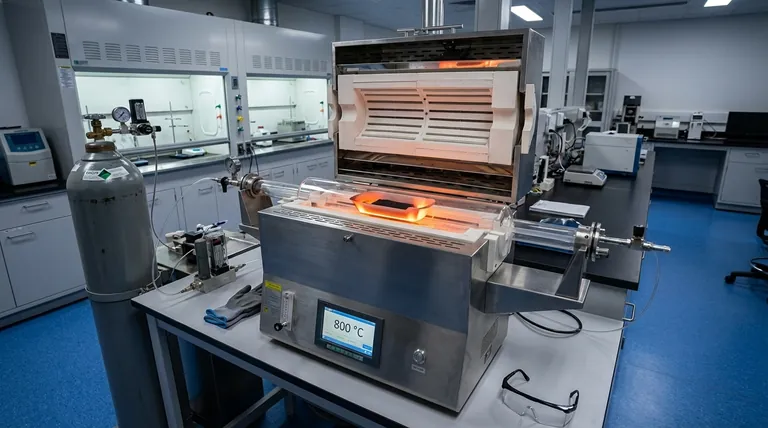
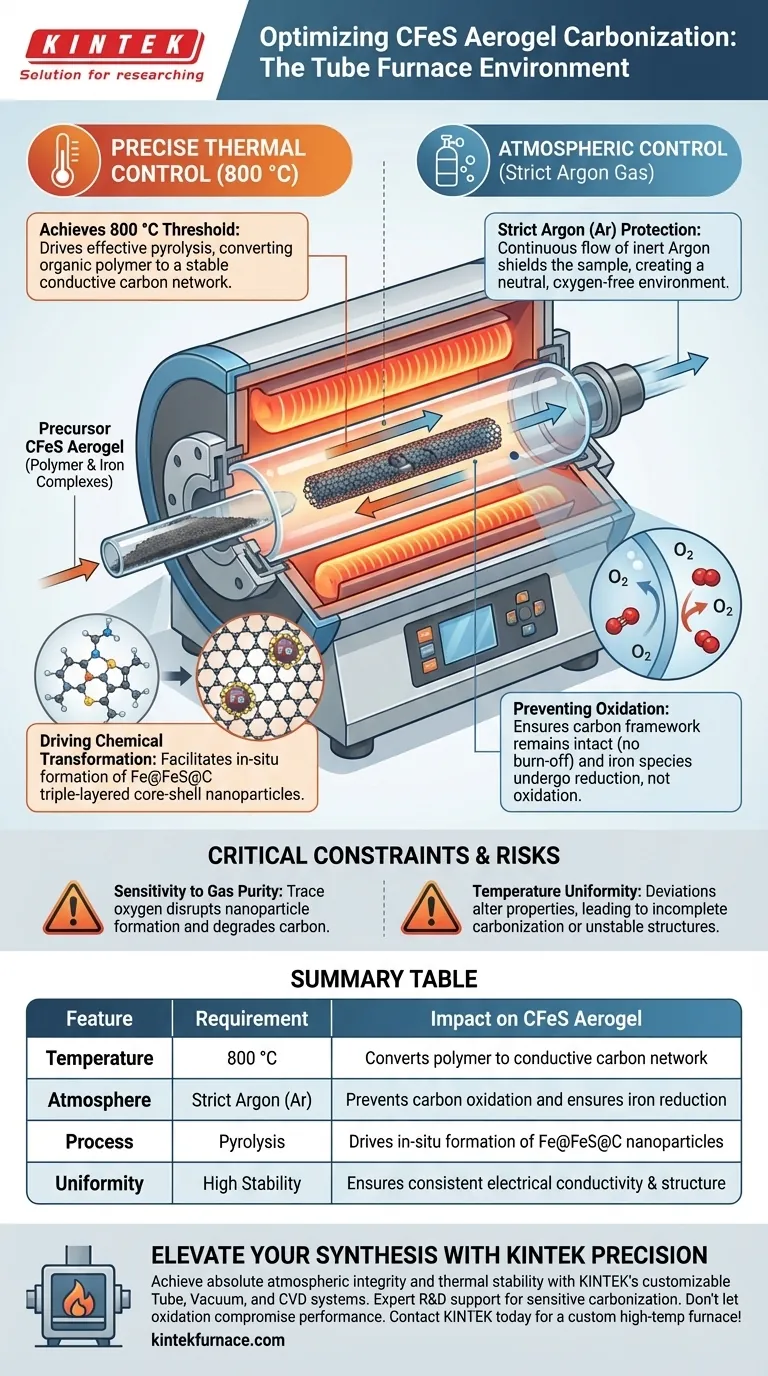
Precise thermal and atmospheric control is the defining contribution of a tube furnace in the synthesis of CFeS aerogels. Specifically, the furnace provides a rigorous high-temperature environment of 800 °C while maintaining a strict blanket of inert argon (Ar) gas to protect the material during processing.
The tube furnace creates an oxygen-free, high-heat environment that simultaneously converts the polymer framework into a conductive carbon network and drives the in-situ transformation of iron complexes into high-performance Fe@FeS@C nanoparticles.
The Role of the Thermal Environment
Achieving the 800 °C Threshold
For CFeS aerogels, the tube furnace must maintain a stable temperature of 800 °C.
This specific thermal energy is required to drive the pyrolysis process effectively. Lower temperatures may not provide sufficient energy for the necessary structural changes.
Driving Chemical Transformation
The high heat facilitates two simultaneous transformations.
First, it converts the organic polymer framework into a stable carbon network.
Second, it enables the in-situ transformation of iron complexes. This results in the formation of specific Fe@FeS@C triple-layered core-shell nanoparticles, which are critical for the material's final performance.
The Importance of Atmospheric Control
Strict Argon (Ar) Protection
The tube furnace isolates the sample from the ambient atmosphere using a continuous flow of argon gas.
Argon acts as an inert shield. Because it is a noble gas, it does not react with the sample, ensuring the chemical environment remains neutral.
Preventing Oxidation
At 800 °C, carbon materials are highly susceptible to oxidation.
If oxygen were present, the carbon framework would burn off as carbon dioxide rather than graphitizing.
The argon atmosphere ensures the carbon remains intact and that the iron species undergo reduction rather than oxidation.
Critical Constraints and Risks
Sensitivity to Gas Purity
The success of this process relies heavily on the "strict" nature of the argon protection.
Even trace amounts of oxygen can disrupt the formation of the core-shell nanoparticles or degrade the carbon skeleton. The tube furnace's ability to seal and purge the chamber is paramount.
Temperature Uniformity
While 800 °C is the target, deviations can alter the material properties.
Incomplete heating may leave behind non-conductive polymer chains. Conversely, uncontrolled fluctuations could destabilize the crystalline phases of the iron complexes.
Making the Right Choice for Your Goal
To ensure the CFeS aerogels achieve the desired reduction performance and electrical conductivity, you must prioritize the stability of the furnace environment.
- If your primary focus is Electrical Conductivity: Ensure the furnace holds 800 °C consistently to guarantee the complete conversion of the polymer into a conductive carbon network.
- If your primary focus is Chemical Structure (Nanoparticles): Prioritize the purity of the argon gas flow to facilitate the precise in-situ reduction of Fe complexes into Fe@FeS@C shells without oxidation.
By strictly adhering to these parameters, you ensure the successful synthesis of high-performance CFeS aerogels.
Summary Table:
| Feature | Requirement | Impact on CFeS Aerogel |
|---|---|---|
| Temperature | 800 °C | Converts polymer to conductive carbon network |
| Atmosphere | Strict Argon (Ar) | Prevents carbon oxidation and ensures iron reduction |
| Process | Pyrolysis | Drives in-situ formation of Fe@FeS@C nanoparticles |
| Uniformity | High Stability | Ensures consistent electrical conductivity & structure |
Elevate Your Aerogel Synthesis with KINTEK Precision
Achieving the perfect 800 °C environment for CFeS aerogels requires more than just heat—it requires absolute atmospheric integrity and thermal stability. KINTEK delivers high-performance Tube, Vacuum, and CVD systems designed for the most sensitive carbonization processes.
Backed by expert R&D and manufacturing, our customizable lab furnaces provide the strict argon shielding and precise temperature uniformity your research demands. Don't let oxidation compromise your core-shell nanoparticles.
Ready to optimize your material performance? Contact KINTEK today for a custom high-temp furnace solution!
Visual Guide
References
- Jianzheng Yang, Jinming Zhang. Superior‐Selective and Complete Recycling of Trace Precious Metals From Wastewater by Magnetic Trilayer Carbon‐Aerogels. DOI: 10.1002/advs.202500858
This article is also based on technical information from Kintek Furnace Knowledge Base .
Related Products
- Vertical Laboratory Quartz Tube Furnace Tubular Furnace
- Multi Heating Zones CVD Tube Furnace Machine for Chemical Vapor Deposition Equipment
- Custom Made Versatile CVD Tube Furnace Chemical Vapor Deposition CVD Equipment Machine
- 1200℃ Controlled Inert Nitrogen Atmosphere Furnace
- 1700℃ High Temperature Laboratory Tube Furnace with Alumina Tube
People Also Ask
- What are the key differences between single-zone and multi-zone vertical tube furnaces? Choose the Right Furnace for Your Lab
- How are wafers loaded and unloaded in a vertical tube furnace? Achieve Precision and Purity in Wafer Processing
- Why is a vertical tube furnace preferred for quenching tests? Achieve Rapid, Repeatable Cooling for Accurate Results
- How does a vertical single-temperature zone tube furnace facilitate the growth of high-quality PdSe2 single crystals?
- How do heat treatment processes influence the configuration of a vertical tube furnace? Optimize for Quenching, Annealing, and More



















