
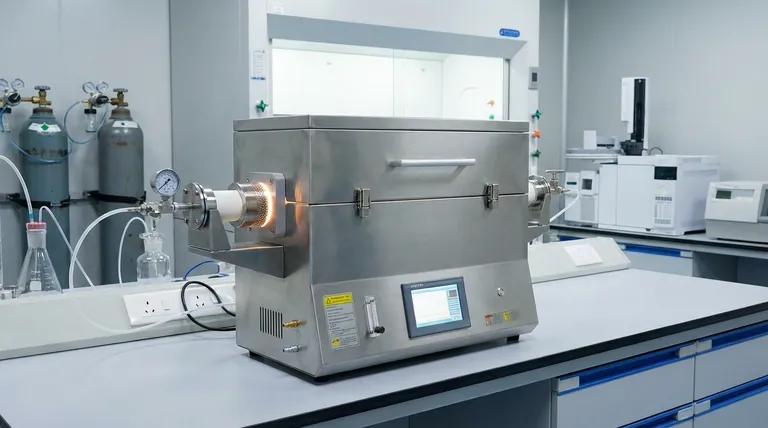
A tube atmosphere furnace provides a strictly controlled, anaerobic environment essential for the precise carbonization of functionalized mesoporous carbon (fMC). Specifically, it maintains a continuous nitrogen-protected atmosphere while executing a slow, regulated thermal profile—typically a heating rate of 2°C/min up to a constant temperature of 450°C. This combination ensures the thermal decomposition of fructose precursors occurs without structural collapse or oxidative degradation.
The primary function of this equipment is to decouple thermal decomposition from oxidation. By enforcing an inert nitrogen atmosphere and regulating heating kinetics, the furnace allows for the precise "sculpting" of mesoporous structures while preventing the chemical loss of the carbon skeleton.
The Critical Role of Atmosphere Control
Preventing Oxidative Loss
The most fundamental condition provided by the furnace is a strict nitrogen protection environment.
This inert atmosphere is non-negotiable; it prevents oxygen from interacting with the carbon material at high temperatures. Without this protection, the carbon backbone would simply combust, resulting in ash or significant material loss rather than a structured solid.
Inhibiting Over-Oxidation
Beyond preventing total combustion, the nitrogen flow inhibits partial or "over-oxidation" of the functional groups.
This control ensures that the chemical integrity of the material is preserved. It allows the researcher to achieve a specific surface chemistry rather than an uncontrolled, oxidized surface.
Facilitating Anaerobic Decomposition
The furnace creates the ideal conditions for the fructose precursors to undergo thermal decomposition.
Because oxygen is excluded, the precursor breaks down based solely on thermal energy. This pathway is critical for forming the desired mesoporous framework.
Precision Thermal Management
Controlled Heating Kinetics
For fMC, the furnace delivers a specific, slow heating rate, typically set at 2°C/min.
This slow ramp serves a structural purpose: it prevents the rapid release of volatiles that could shatter the delicate pore structure. A controlled rate ensures the pores form uniformly and remain stable.
Target Temperature Stability
The equipment maintains a constant carbonization temperature, specifically 450°C for this application.
Holding this temperature precisely is vital for completing the carbonization process. It ensures the material is fully processed without reaching temperatures that might induce graphitization or collapse the pores.
Understanding the Trade-offs
Throughput vs. Precision
While a tube furnace offers exceptional control over atmosphere and temperature, it is inherently limited by sample volume.
The confined geometry of the tube restricts the amount of fMC that can be processed in a single batch. This makes it ideal for high-precision laboratory work but potentially bottlenecked for larger-scale production.
Sensitivity to Gas Purity
The success of the process is entirely dependent on the purity of the nitrogen supply.
Even minor leaks in the sealing system or impurities in the gas source can compromise the anaerobic condition. This sensitivity requires rigorous monitoring of gas flow rates and seal integrity.
Optimizing Your Carbonization Protocol
To maximize the quality of your functionalized mesoporous carbon, align your furnace settings with your specific material goals.
- If your primary focus is Structural Integrity: Adhere strictly to the slow heating rate (2°C/min) to prevent thermal shock and pore collapse during volatile release.
- If your primary focus is Surface Chemistry: Ensure a continuous, stable flow of high-purity nitrogen to flush out volatile byproducts and prevent re-deposition or surface contamination.
True control over your processing environment is the only way to guarantee the reproducibility of your advanced carbon materials.
Summary Table:
| Process Parameter | Requirement for fMC | Core Function/Objective |
|---|---|---|
| Atmosphere Type | High-Purity Nitrogen | Prevents oxidation and combustion of carbon backbone |
| Heating Rate | 2°C/min (Slow Ramp) | Protects delicate pore structure from volatile pressure |
| Carbonization Temp | Constant 450°C | Ensures full decomposition without structural collapse |
| Gas Flow Control | Continuous & Stable | Flushes volatiles and prevents surface contamination |
Elevate Your Material Synthesis with KINTEK Precision
Precise carbonization of functionalized mesoporous carbon requires absolute control over thermal kinetics and atmospheric purity. KINTEK provides industry-leading Tube, Muffle, Vacuum, and CVD systems engineered to deliver the stability your research demands.
Backed by expert R&D and manufacturing, our high-temp furnaces are fully customizable to meet your unique laboratory needs—ensuring reproducible results every time.
Ready to optimize your carbonization protocol? Contact our technical experts today to find the perfect furnace solution.
References
- Thabo Matthews, Nobanathi Wendy Maxakato. Pd/fMC−NiO Synergistic, Promotional Effect and Cooperation Induced Electrocatalysis towards Ethylene Glycol Electrooxidation: Experimental Approach and DFT Calculations. DOI: 10.1002/celc.202300564
This article is also based on technical information from Kintek Furnace Knowledge Base .
Related Products
- 1200℃ Controlled Inert Nitrogen Atmosphere Furnace
- Mesh Belt Controlled Atmosphere Furnace Inert Nitrogen Atmosphere Furnace
- Multi Zone Laboratory Quartz Tube Furnace Tubular Furnace
- 1700℃ Controlled Inert Nitrogen Atmosphere Furnace
- Slide PECVD Tube Furnace with Liquid Gasifier PECVD Machine
People Also Ask
- What controlled-atmosphere furnace conditions are required for sintering powder metallurgy copper alloy compacts? Ideal Setup
- What are the four main types of controlled atmospheres used in these furnaces? Optimize Your Heat Treatment Processes
- Why is a controlled atmosphere furnace required for 316L debinding? Ensure Structural Integrity & Zero Cracks
- How do surface oxide layers on ceramic powders like silicon nitride affect sintering? Master Atmosphere Control
- How Sintering Temp Affects Density & Resistivity of Cu-Oxide Composites



















