
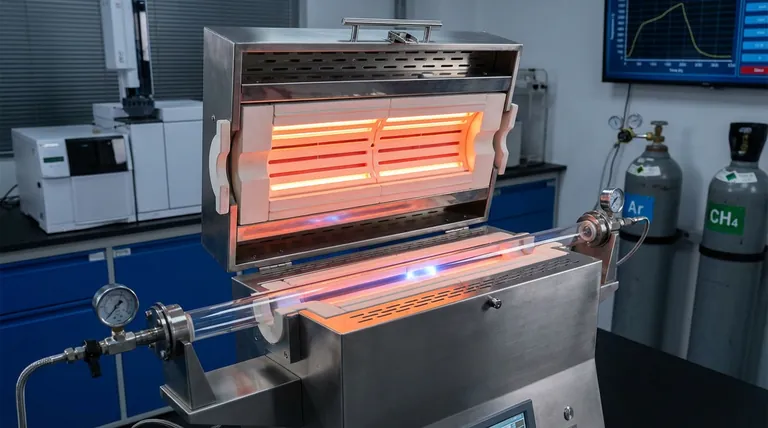
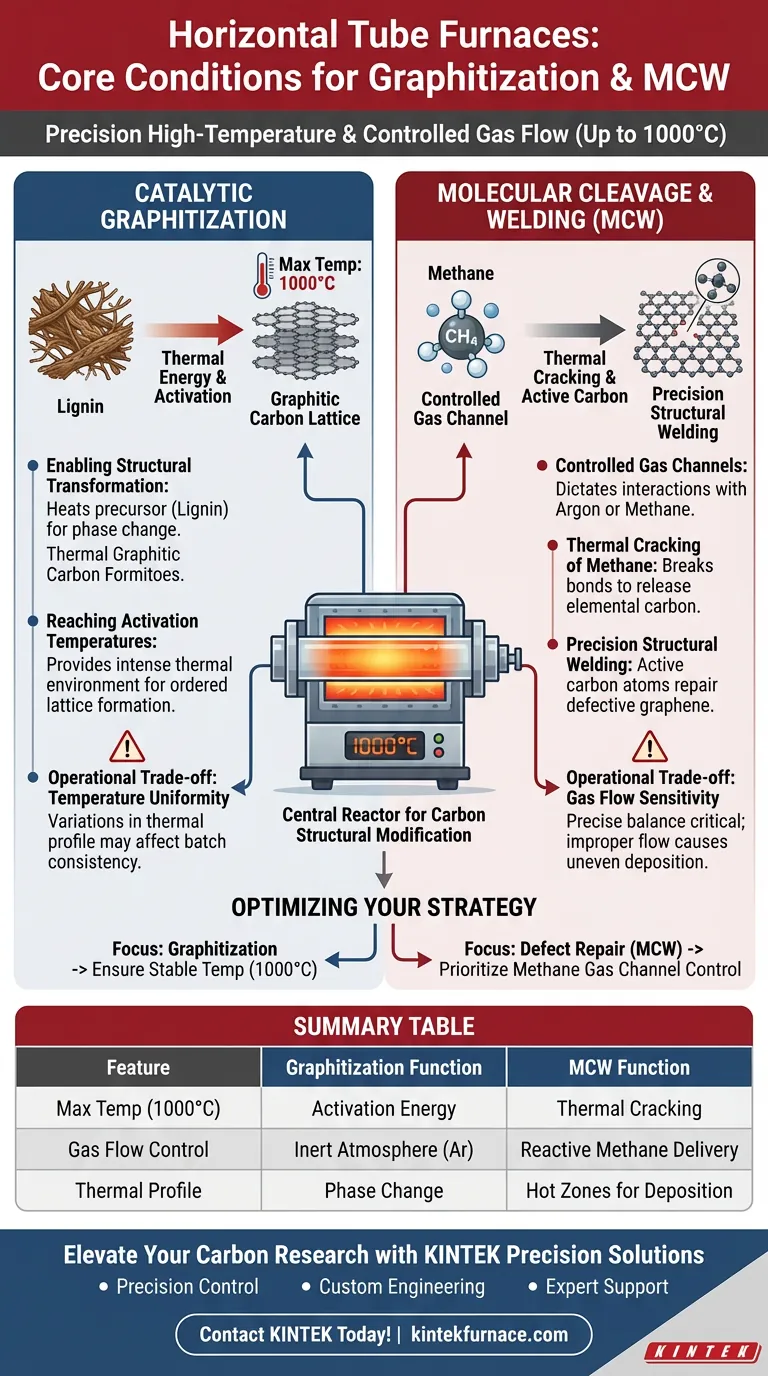
Horizontal tube furnaces provide a precise high-temperature environment reaching up to 1000°C combined with controlled gas flow channels. These systems are essential for supplying the thermal energy required to transform lignin into graphitic carbon and for maintaining the reactive atmosphere necessary to crack methane for molecular repair.
The horizontal tube furnace acts as the central reactor for carbon structural modification, simultaneously providing the heat for graphitization and the specific atmospheric control required for Molecular Cleavage and Welding (MCW).
The Critical Role of Thermal Management
Enabling Structural Transformation
The primary function of the furnace during the graphitization stage is energy supply. The system heats the precursor material, specifically lignin, to facilitate a phase change.
Reaching Activation Temperatures
To successfully achieve a graphitic carbon structure, the furnace must reach temperatures up to 1000°C. This intense thermal environment provides the activation energy necessary to rearrange the atomic structure of the lignin into an ordered lattice.
Facilitating Molecular Cleavage and Welding (MCW)
Controlled Gas Channels
Beyond simple heating, the furnace provides specific flow channels for processing gases. This creates a controlled environment using gases such as Argon (inert) or Methane (reactive) to dictate chemical interactions.
Thermal Cracking of Methane
During the MCW stage, the furnace maintains the high temperatures required to thermally crack methane molecules. This process breaks the hydrocarbon bonds to release elemental carbon.
Precision Structural Welding
The cracking process produces active carbon atoms within the hot zone. These atoms "weld" onto defective graphite layers, allowing for the precise modification and repair of multilayer graphene structures.
Understanding Operational Trade-offs
Temperature Uniformity
While horizontal tube furnaces excel at reaching high temperatures, maintaining perfect uniformity along the length of the tube can be difficult. Variations in the thermal profile may affect the consistency of the graphitization across the sample batch.
Gas Flow Sensitivity
The success of the MCW process relies heavily on the precise balance of gas flow and temperature. If the flow of Methane is not perfectly calibrated with the cracking temperature, it can lead to uneven carbon deposition or incomplete structural welding.
Optimizing Your Processing Strategy
To effectively utilize a horizontal tube furnace for carbon processing, align your parameters with your specific end goal:
- If your primary focus is Graphitization: Ensure the furnace can sustain stable temperatures up to 1000°C to maximize the conversion of lignin into a graphitic structure.
- If your primary focus is Defect Repair (MCW): Prioritize precise control over the methane gas channels to generate the active carbon atoms needed for effective molecular welding.
Mastering the balance between high-thermal energy and controlled atmospheric conditions is the key to engineering high-quality graphitic structures.
Summary Table:
| Feature | Function in Graphitization | Function in MCW (Molecular Cleavage) |
|---|---|---|
| Max Temp (1000°C) | Supplies activation energy for lignin-to-carbon transformation. | Provides thermal energy to crack methane molecules. |
| Gas Flow Control | Maintains inert Argon atmosphere for structural stability. | Delivers reactive methane for precision atomic welding. |
| Thermal Profile | Facilitates phase change to ordered graphitic lattice. | Creates hot zones for active carbon deposition on defects. |
Elevate Your Carbon Research with KINTEK Precision
Are you looking to master complex processes like catalytic graphitization or molecular cleavage? KINTEK provides state-of-the-art thermal solutions tailored for high-stakes laboratory research. Backed by expert R&D and world-class manufacturing, we offer a comprehensive range of Muffle, Tube, Rotary, Vacuum, and CVD systems, all fully customizable to meet your unique processing temperatures and atmospheric requirements.
Why choose KINTEK?
- Precision Control: Achieve the exact thermal profiles needed for structural welding and defect repair.
- Custom Engineering: Our furnaces are designed to handle specific gas flow channels for Methane, Argon, and more.
- Expert Support: Benefit from our deep understanding of high-temp lab applications to optimize your batch consistency.
Contact KINTEK Today to Customize Your High-Temperature Furnace!
Visual Guide
References
- Qiangu Yan, Zhiyong Cai. Tuning thermal and graphitization behaviors of lignin <i>via</i> complexation with transition metal ions for the synthesis of multilayer graphene-based materials. DOI: 10.1039/d3ra05881f
This article is also based on technical information from Kintek Furnace Knowledge Base .
Related Products
- Vertical Laboratory Quartz Tube Furnace Tubular Furnace
- Vacuum Sealed Continuous Working Rotary Tube Furnace Rotating Tube Furnace
- Split Multi Heating Zone Rotary Tube Furnace Rotating Tube Furnace
- High Pressure Laboratory Vacuum Tube Furnace
- Multi Zone Laboratory Quartz Tube Furnace Tubular Furnace
People Also Ask
- What are the key differences between single-zone and multi-zone vertical tube furnaces? Choose the Right Furnace for Your Lab
- How do heat treatment processes influence the configuration of a vertical tube furnace? Optimize for Quenching, Annealing, and More
- What are the main characteristics of vertical tube furnaces? Optimize Your Lab with Space-Saving, Uniform Heating
- What is the purpose of using an industrial-grade vertical tube furnace in phosphorus recovery? High-Fidelity Simulation
- How are wafers loaded and unloaded in a vertical tube furnace? Achieve Precision and Purity in Wafer Processing



















