Spark Plasma Sintering (SPS) fundamentally outperforms traditional pressureless sintering for silicon carbide (SiC) by replacing external radiative heating with internal pulsed current heating and simultaneous mechanical pressure. This combination allows SiC to reach full densification in minutes rather than hours, inhibiting grain growth and yielding a ceramic that is significantly harder and tougher while consuming far less energy.
The Core Takeaway While traditional sintering relies on long exposure to high heat to fuse particles—often leading to coarse, brittle structures—SPS utilizes high-amperage pulsed current and axial pressure to achieve rapid densification at the micro-level. For SiC production, this results in a superior fine-grained microstructure and reduces processing time from hours to mere minutes.
The Mechanisms of Enhanced Densification
Internal vs. External Heating
Traditional pressureless furnaces rely on external heating elements to radiate heat onto the material surface, which then slowly conducts inward.
SPS generates heat internally. By passing a pulsed electric current directly through the graphite mold and the SiC powder, the system utilizes Joule heating. This ensures uniform thermal distribution and rapid temperature elevation.
The Role of Pulsed Current
The pulsed current does more than just heat the bulk material. It generates plasma discharges and high localized temperatures specifically at the contact points between particles.
This mechanism cleans particle surfaces and activates the sintering neck formation. Consequently, the material can begin densifying at lower bulk temperatures compared to traditional methods.
Synchronous Pressure Induction
Unlike pressureless sintering, SPS applies significant axial pressure (up to 60 MPa) throughout the thermal cycle.
This mechanical force acts as an additional driving force for sintering. It physically rearranges particles and aids plastic flow, allowing SiC to reach near-theoretical density much faster than thermal energy alone could achieve.
Structural and Performance Advantages
Inhibition of Grain Growth
The defining challenge in sintering SiC is preventing grains from growing too large (coarsening), which reduces mechanical strength.
Because SPS achieves heating rates of up to 100°C per minute and requires holding times as short as 10 minutes, there is insufficient time for abnormal grain growth to occur.
Fine-Grained Microstructure
The rapid process locks the SiC structure in a "fine-grained" state. The resulting ceramic possesses an isotropic micro-nano structure.
This is a direct contrast to pressureless sintering, where long dwell times often result in coarse, uneven grain structures that compromise material integrity.
Superior Mechanical Properties
The fine-grained structure directly translates to performance. SPS-produced SiC exhibits significantly higher hardness and fracture toughness.
By minimizing defects and maintaining a dense, fine microstructure, the material is more resistant to cracking and wear than its conventionally sintered counterparts.
Operational Efficiency
Drastic Reduction in Cycle Time
Traditional SiC sintering cycles can last many hours or even days. SPS dramatically shortens this timeline.
SiC can reach full densification at 1800°C in approximately 10 minutes of holding time. This allows for rapid prototyping and faster feedback loops during material development.
Energy Consumption
Because the heat is generated internally and the cycle times are short, the total energy required per run is substantially lower.
This makes SPS a more energy-efficient option for high-performance ceramic production, reducing the overall carbon footprint of the manufacturing process.
Understanding the Trade-offs
Geometry Limitations
While SPS excels in material properties, it is limited by the use of graphite molds.
The process is generally restricted to simple shapes like discs, cylinders, or blocks. Producing complex, near-net-shape components is difficult compared to pressureless sintering, which can accommodate intricate geometries formed by injection molding or slip casting.
Scalability Constraints
SPS is typically a batch process, often producing one sample at a time.
While excellent for high-value components or research, it may struggle to match the high-volume throughput of continuous belt furnaces or large batch pressureless furnaces used for mass production.
Making the Right Choice for Your Goal
To decide between SPS and pressureless sintering, evaluate your specific requirements regarding material performance versus production volume.
- If your primary focus is Maximum Mechanical Performance: Choose SPS to achieve the highest possible hardness and fracture toughness through fine-grain retention.
- If your primary focus is Complex Geometry: Choose traditional pressureless sintering, as SPS is limited to simple shapes defined by the graphite die.
- If your primary focus is R&D Speed: Choose SPS to iterate rapidly, as densification occurs in minutes rather than hours.
SPS is the superior choice for high-performance SiC where material strength is paramount, whereas pressureless sintering remains the standard for mass-producing complex shapes.
Summary Table:
| Feature | Spark Plasma Sintering (SPS) | Traditional Pressureless Sintering |
|---|---|---|
| Heating Mechanism | Internal Joule heating (Pulsed current) | External radiative heating |
| Sintering Time | Minutes (e.g., 10-min hold) | Hours to Days |
| Microstructure | Fine-grained, micro-nano structure | Coarse, uneven grain growth |
| Mechanical Strength | Superior hardness & fracture toughness | Standard mechanical integrity |
| Energy Efficiency | High (Internal heat, short cycles) | Lower (Long heating cycles) |
| Shape Complexity | Simple geometries (discs, cylinders) | High (Complex, near-net shapes) |
Elevate Your Ceramic Manufacturing with KINTEK
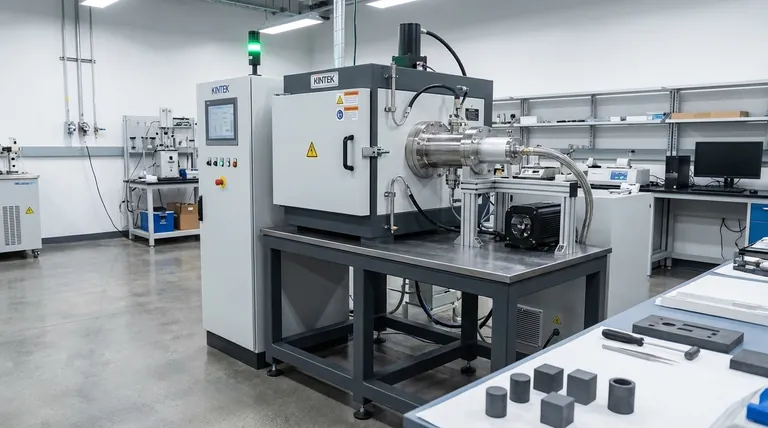
Ready to transform your material performance? KINTEK provides state-of-the-art Spark Plasma Sintering (SPS) systems alongside our comprehensive range of Muffle, Tube, Rotary, and Vacuum furnaces.
Backed by expert R&D and manufacturing, we offer fully customizable high-temperature lab solutions designed to meet the unique needs of researchers and industrial manufacturers alike. Whether you need the rapid densification of SPS or the versatility of CVD systems, our experts are here to help you select the perfect equipment for your specific SiC applications.
Unlock superior material properties today — Contact our experts now!
References
- Zipeng Li, Zhiqing Liang. Preparation of Aluminum Matrix Composites Reinforced with Hybrid MAX–MXene Particles for Enhancing Mechanical Properties and Tribological Performance. DOI: 10.3390/jcs9100552
This article is also based on technical information from Kintek Furnace Knowledge Base .
Related Products
- Spark Plasma Sintering SPS Furnace
- Silicon Carbide SiC Thermal Heating Elements for Electric Furnace
People Also Ask
- Why is it necessary to maintain a high vacuum environment during the SPS of SiC? Key to High-Density Ceramics
- How does the heating mechanism of Spark Plasma Sintering (SPS) function? Enhance TiC/SiC Composite Fabrication
- What are the technical advantages of using an SPS sintering furnace? Elevate Al2O3-TiC Material Performance
- What are the steps in the discharge plasma sintering process? Master Fast, High-Density Material Consolidation
- What are the advantages of spark plasma sintering (SPS) over traditional forging? Precision Microstructural Control