
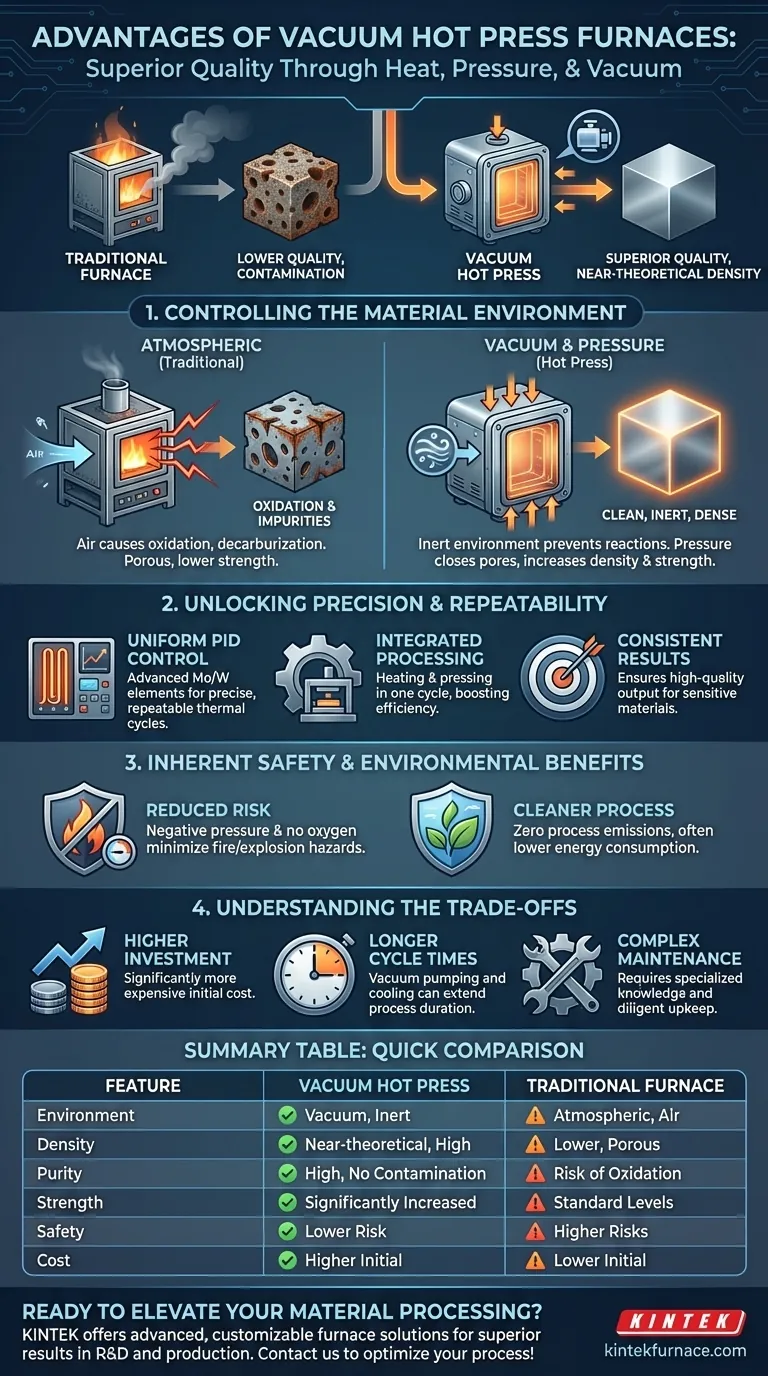
In short, vacuum hot press furnaces produce materials with fundamentally superior quality. By combining high heat, mechanical pressure, and a vacuum environment in a single process, they create components with significantly improved density, purity, and mechanical strength compared to those made in traditional atmospheric furnaces.
The core advantage is the synergy of a vacuum environment with applied pressure. This combination prevents contamination while actively forcing material consolidation, resulting in parts with near-theoretical density and exceptional properties that are often unattainable with traditional methods.
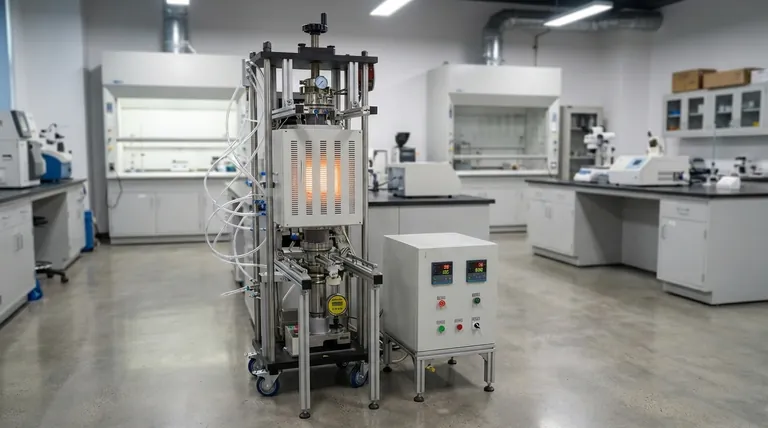
The Core Advantage: Controlling the Material Environment
The primary distinction of a vacuum hot press furnace lies in its ability to manipulate the processing environment to an unparalleled degree. This control directly translates to higher-quality finished materials.
Eliminating Atmospheric Contamination
Traditional furnaces operate in the presence of air, which contains oxygen, nitrogen, and moisture. These elements can react with materials at high temperatures, causing oxidation, decarburization, and other forms of contamination that degrade material integrity.
A vacuum furnace removes the atmosphere from the heating chamber. This inert environment prevents these unwanted chemical reactions, resulting in a clean, bright, and uncontaminated surface finish and preserving the material's intrinsic purity.
Achieving Superior Material Density
The simultaneous application of high temperature and mechanical pressure is the defining feature of hot pressing. Heat softens the material, while the applied pressure physically closes internal voids and porosity.
This process results in components with exceptionally high density, often approaching 100% of the material's theoretical maximum. This densification minimizes internal defects and refines the material's grain structure, which are critical for high-performance applications.
Enhancing Final Material Properties
The outcome of this controlled process is a dramatic improvement in mechanical properties. By eliminating porosity and achieving high purity, materials exhibit significantly increased strength, hardness, and fracture toughness.
Unlocking Precision and Repeatability
Beyond the environment, these furnaces offer a level of process control that ensures consistent, repeatable results.
Uniform and Precise Temperature Control
Vacuum hot press furnaces utilize advanced heating elements, often made of molybdenum or tungsten, within insulated heating zones. These are managed by sophisticated PID (Proportional-Integral-Derivative) control systems.
This setup ensures extremely uniform heat distribution across the part and allows for precise, repeatable thermal cycles. This is critical for processing sensitive advanced materials where slight temperature deviations can ruin the final product.
Integrated and Efficient Processing
Combining heating and pressing into a single, automated cycle increases production efficiency. It removes the need to transfer hot components between a furnace and a separate press, which saves time and reduces the risk of contamination or thermal shock.
Understanding the Trade-offs
While powerful, this technology is not the universal solution for every heating application. Objectivity requires acknowledging its specific operational context.
Higher Initial Investment
The sophisticated vacuum systems, high-pressure frameworks, and advanced control electronics make vacuum hot press furnaces significantly more expensive to acquire than traditional atmospheric furnaces.
Potentially Longer Cycle Times
The process of pulling a deep vacuum before heating and the need to cool the part under vacuum or in a controlled backfill environment can extend the overall cycle time compared to simpler atmospheric processes.
Increased Maintenance Complexity
Maintaining a vacuum-tight system requires diligent upkeep of seals, flanges, and pumps. The high-performance heating elements and internal components also demand specialized maintenance knowledge and a stricter service schedule.
Inherent Safety and Environmental Benefits
The fundamental design of a vacuum furnace offers significant advantages in operational safety and environmental impact.
Mitigating Risks of Fire and Explosion
By removing oxygen, the vacuum environment inherently minimizes the risk of fire. Furthermore, operating at a negative pressure eliminates the possibility of a dangerous explosion from over-pressurization, a known risk in some conventional pressure vessels.
A Cleaner, More Efficient Process
These furnaces do not produce combustion byproducts, leading to zero process emissions and a much cleaner workplace. Their modern insulation and efficient heating elements often result in lower overall energy consumption compared to older, less efficient traditional furnaces.
Making the Right Choice for Your Application
Selecting the correct furnace technology depends entirely on the desired outcome for your material and your operational priorities.
- If your primary focus is maximum material performance and purity: The vacuum hot press is the definitive choice for developing advanced ceramics, powder metallurgy parts, and diffusion-bonded components where near-full density is non-negotiable.
- If your primary focus is high-volume, cost-sensitive production: A traditional atmospheric furnace may be more economical for materials that do not suffer significant degradation from environmental exposure.
- If your primary focus is process safety and R&D flexibility: The inherent safety features and precise control of a vacuum hot press make it a superior and more versatile tool for research and the production of high-value components.
Ultimately, choosing a vacuum hot press is an investment in achieving material properties that are simply beyond the reach of conventional heating methods.
Summary Table:
| Feature | Vacuum Hot Press Furnace | Traditional Furnace |
|---|---|---|
| Environment | Vacuum, inert | Atmospheric, air present |
| Density | Near-theoretical, high | Lower, more porous |
| Purity | High, no contamination | Risk of oxidation, contamination |
| Strength | Significantly increased | Standard levels |
| Safety | Lower fire/explosion risk | Higher risks |
| Cost | Higher initial investment | Lower initial cost |
Ready to elevate your material processing with precision and purity? At KINTEK, we leverage exceptional R&D and in-house manufacturing to provide advanced high-temperature furnace solutions tailored for your lab. Our product line includes Muffle, Tube, Rotary Furnaces, Vacuum & Atmosphere Furnaces, and CVD/PECVD Systems, all backed by strong deep customization capabilities to meet your unique experimental needs. Whether you're working with advanced ceramics, powder metallurgy, or high-value components, our vacuum hot press furnaces can help you achieve superior density, strength, and safety. Contact us today to discuss how we can optimize your processes and deliver exceptional results!
Visual Guide
Related Products
- Vacuum Hot Press Furnace Machine for Lamination and Heating
- 600T Vacuum Induction Hot Press Vacuum Heat Treat and Sintering Furnace
- Vacuum Hot Press Furnace Machine Heated Vacuum Press Tube Furnace
- Vacuum Hot Press Furnace Machine Heated Vacuum Press
- High Pressure Laboratory Vacuum Tube Furnace
People Also Ask
- What are the primary components of a vacuum hot press furnace? Master the Core Systems for Precise Material Processing
- What safety features are incorporated in vacuum hot press furnaces? Ensure Operator and Equipment Protection
- What are the benefits of the vacuum environment system in a vacuum hot press furnace? Unlock High-Density Sintering
- What industries benefit from the use of vacuum hot press furnaces? Unlock High-Performance Materials for Your Industry
- Why is a high vacuum environment crucial when preparing copper-carbon nanotube composites in a vacuum hot press furnace? Achieve Superior Composite Integrity



















