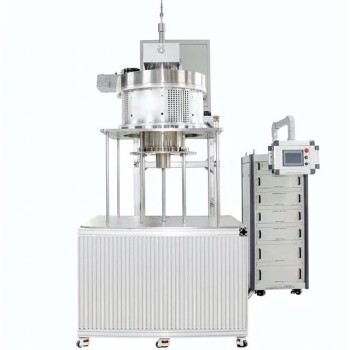
Vacuum Spark Plasma Sintering (SPS) systems fundamentally outperform traditional hot-pressing through the use of pulsed current direct heating combined with synchronous pressurization. Unlike traditional methods that rely on external heating elements, SPS generates heat internally within the mold and sample. This allows for extremely rapid heating rates and shorter sintering times, resulting in superior material properties for silicon carbide (SiC) ceramics.
Core Takeaway By utilizing direct Joule heating and a high-vacuum environment, SPS achieves near-theoretical density while inhibiting abnormal grain growth. This unique mechanism produces SiC ceramics with finer microstructures, significantly enhancing hardness, fracture toughness, and thermal conductivity compared to conventional methods.
The Mechanism of Rapid Densification
Pulsed Current Direct Heating
Traditional furnaces heat samples from the outside in, which is a slow process. In contrast, SPS systems send high-current pulses directly through the graphite mold and the SiC powder.
This generates internal Joule heat, allowing for heating rates of hundreds of degrees per minute. This internal generation of heat ensures highly efficient energy transfer.
Bypassing Grain Coarsening
In traditional hot pressing, long dwell times at intermediate temperatures often lead to uncontrolled grain growth. The rapid heating capability of SPS allows the material to quickly bypass these critical temperature zones.
By minimizing the time spent in these coarsening stages, the process preserves a fine and uniform microcrystalline structure.
Impact on Material Properties
Enhanced Mechanical Performance
The microstructure of a ceramic dictates its strength. Because SPS effectively inhibits abnormal grain growth during high-temperature stages, the resulting SiC ceramic retains a fine-grained structure.
This directly translates to significantly improved hardness and fracture toughness. The material is not just denser; it is structurally more robust at a microscopic level.
Superior Thermal Conductivity
Beyond mechanical strength, the structural uniformity achieved by SPS benefits thermal properties.
The reduction of defects and the high density of the composite ceramics lead to improved thermal conductivity, a critical factor for high-performance SiC applications.
The Critical Role of the Vacuum Environment
Prevention of Oxidation
High temperatures usually pose a risk of oxidation for Silicon Carbide. The high-vacuum environment creates a protective atmosphere that prevents the SiC powder from reacting with oxygen.
This environment also protects the graphite molds from oxidative wear, extending their lifespan and ensuring consistent pressure application.
Maximizing Density
Achieving "theoretical density" (zero porosity) is the ultimate goal of sintering. The vacuum environment actively facilitates the removal of gases and impurities adsorbed on the powder surface.
It also aids in the discharge of micro-pores during the sintering process. This ensures the final product achieves an extremely high density, very close to the theoretical limit.
Operational Considerations and Trade-offs
Process Speed vs. Control
While the speed of SPS is a massive advantage, it introduces a different operational dynamic than traditional furnaces. The process moves from powder to dense solid in a very short duration.
This requires precise control over pressure and current to ensure the rapid densification happens uniformly without inducing thermal shock, although the intrinsic nature of SPS generally supports uniform heating.
Equipment Complexity
SPS systems are more complex than standard muffle or tube furnaces due to the integration of high-current power supplies, vacuum systems, and hydraulic presses.
Users must balance the need for superior material properties against the requirement for more sophisticated equipment management compared to the simpler, albeit slower, traditional hot-pressing methods.
Making the Right Choice for Your Goal
When deciding between SPS and traditional methods for Silicon Carbide, consider your specific performance targets:
- If your primary focus is maximum mechanical strength: Choose SPS to leverage the fine-grained microstructure for superior hardness and fracture toughness.
- If your primary focus is process efficiency: Choose SPS to utilize rapid heating rates that reduce cycle times from hours to minutes.
- If your primary focus is material purity: Choose SPS for its vacuum capabilities that effectively remove adsorbed gases and prevent oxidation.
Ultimately, Vacuum SPS is not just a faster method; it is a microstructural engineering tool that pushes Silicon Carbide ceramics closer to their theoretical performance limits.
Summary Table:
| Feature | Vacuum Spark Plasma Sintering (SPS) | Traditional Hot-Pressing |
|---|---|---|
| Heating Mechanism | Internal Pulsed Current (Joule Heating) | External Heating Elements |
| Heating Rate | Hundreds of degrees per minute | Slow/Gradual |
| Sintering Time | Minutes (Rapid) | Hours (Extended) |
| Grain Structure | Fine & Uniform (Inhibits Coarsening) | Coarse (Due to long dwell times) |
| Material Density | Near-Theoretical Density | High, but limited by porosity |
| Key Performance | Superior Hardness & Thermal Conductivity | Standard Mechanical Properties |
Elevate Your Materials Engineering with KINTEK
Ready to push your Silicon Carbide ceramics to their theoretical limits? KINTEK provides industry-leading Vacuum Spark Plasma Sintering (SPS) systems designed for researchers and manufacturers who demand precision.
Backed by expert R&D and manufacturing, we offer a full suite of high-temperature solutions—including Muffle, Tube, Rotary, Vacuum, and CVD systems—all fully customizable to meet your unique sintering requirements.
Unlock superior hardness and fracture toughness for your materials today.
Contact our specialists to discuss your custom furnace needs
References
- Mohamed Salaheldeen, А. Zhukov. Dependence of Magnetic Properties of As-Prepared Nanocrystalline Ni2MnGa Glass-Coated Microwires on the Geometrical Aspect Ratio. DOI: 10.3390/s24113692
This article is also based on technical information from Kintek Furnace Knowledge Base .
Related Products
- Spark Plasma Sintering SPS Furnace
- Vacuum Heat Treat Sintering Furnace with Pressure for Vacuum Sintering
- 9MPa Air Pressure Vacuum Heat Treat and Sintering Furnace
- 600T Vacuum Induction Hot Press Vacuum Heat Treat and Sintering Furnace
- Small Vacuum Heat Treat and Tungsten Wire Sintering Furnace
People Also Ask
- How does the heating mechanism of Spark Plasma Sintering (SPS) function? Enhance TiC/SiC Composite Fabrication
- Why is it necessary to maintain a high vacuum environment during the SPS of SiC? Key to High-Density Ceramics
- What are the technical advantages of using an SPS sintering furnace? Elevate Al2O3-TiC Material Performance
- What are the steps in the discharge plasma sintering process? Master Fast, High-Density Material Consolidation
- What are the advantages of spark plasma sintering (SPS) over traditional forging? Precision Microstructural Control