
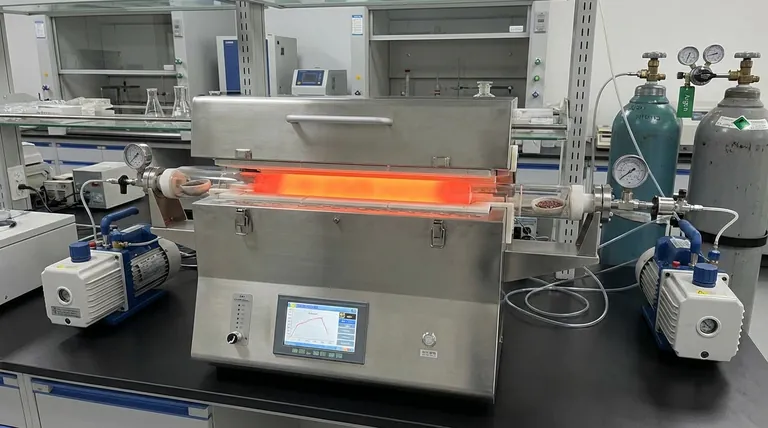
The definitive technical advantage of using a Tube Furnace for solid-state battery materials lies in its superior sealing performance and the ability to maintain a precise, controlled atmosphere. Unlike standard laboratory box furnaces, a Tube Furnace is specifically engineered to isolate the heating zone, allowing you to create high-quality vacuum environments or introduce specific inert gases to protect reactive materials.
Core Takeaway In solid-state battery research, the processing environment is just as critical as the temperature profile. A Tube Furnace acts as a hermetic containment system, preventing oxidation and moisture contamination to ensure the material's chemical composition and microstructure remain exactly as designed.
Mastering the Processing Environment
For solid-state electrolytes and active materials, the presence of air is often detrimental. The Tube Furnace solves this through mechanical design differences compared to standard furnaces.
Achieving Superior Sealing
Standard furnaces often rely on door insulation that is difficult to seal completely against the ambient atmosphere.
A Tube Furnace utilizes a continuous work tube—usually quartz or alumina—sealed at both ends with dedicated flanges. This design creates a closed system that effectively isolates the sample from the outside laboratory environment.
Precise Atmosphere Control
Once sealed, the architecture of the Tube Furnace facilitates strict environmental control.
You can easily connect vacuum pumps to evacuate air from the tube before heating begins. Furthermore, the system allows for the controlled flow of inert gases (such as Argon or Nitrogen) throughout the thermal cycle, maintaining positive pressure to keep contaminants out.
Preventing Material Degradation
The primary reason for using a Tube Furnace in this field is the chemical sensitivity of the materials involved.
Managing Moisture and Oxygen Sensitivity
Many solid-state battery components, particularly active materials used in Lithium-Sulfur (Li-S) batteries, are highly reactive.
Exposure to trace amounts of moisture or oxygen at high temperatures can cause immediate degradation. The Tube Furnace effectively prevents this interaction, ensuring the material does not react with the atmosphere during the critical sintering or annealing phases.
Preserving Chemical Composition
When a material oxidizes, its fundamental chemical makeup changes, rendering it useless for battery applications.
By creating a vacuum or inert environment, the Tube Furnace ensures the stoichiometry of the material remains intact. This guarantees that the final product retains the specific electrochemical properties intended by the researcher.
Ensuring Microstructural Integrity
The performance of a solid-state battery is heavily dependent on the microstructure of its components.
Uncontrolled atmospheric reactions can lead to surface impurities or grain boundary defects. By stabilizing the environment, the Tube Furnace ensures the microstructure develops uniformly, meeting precise design specifications.
Understanding the Trade-offs
While the Tube Furnace offers superior control, it is important to recognize the limitations inherent in its design.
Sample Volume Limitations
The geometry of a Tube Furnace is restrictive.
The work area is defined by the diameter of the tube, which limits the volume of material you can process in a single batch compared to the spacious chamber of a box furnace.
Complexity of Operation
Achieving a perfect atmosphere adds operational overhead.
You must manage vacuum pumps, gas cylinders, and flow controllers. Additionally, the flange seals require regular maintenance and careful assembly to ensure they remain vacuum-tight over repeated heating cycles.
Making the Right Choice for Your Goal
Selecting the right furnace depends on the sensitivity of your materials and the scale of your operation.
- If your primary focus is Material Purity and Performance: Use a Tube Furnace to guarantee zero oxidation and precise microstructural control, especially for Li-S or sulfide-based electrolytes.
- If your primary focus is High Throughput of Inert Materials: A standard box furnace may suffice, but only if the materials are chemically stable in air at processing temperatures.
Ultimately, for high-performance solid-state batteries, the atmosphere is a reagent; the Tube Furnace is the only tool that allows you to control it.
Summary Table:
| Feature | Tube Furnace | Standard Box Furnace |
|---|---|---|
| Sealing Capability | Hermetic seal with flanges | Basic door insulation |
| Atmosphere Control | High vacuum & inert gas flow | Limited to ambient air |
| Material Protection | Prevents oxidation/moisture | Risk of contamination |
| Ideal Application | Reactive & sensitive materials | High-throughput stable materials |
| Batch Volume | Limited by tube diameter | High capacity chamber |
Elevate Your Battery Material Innovation with KINTEK
Don't let oxidation compromise your research. Backed by expert R&D and manufacturing, KINTEK offers high-performance Tube, Muffle, Rotary, Vacuum, and CVD systems—all fully customizable to meet the rigorous demands of solid-state battery synthesis. Whether you are working with sensitive lithium-sulfur electrolytes or advanced thin-film coatings, our precision thermal solutions ensure your materials maintain perfect stoichiometry and microstructural integrity.
Ready to optimize your heat treatment process? Contact us today to discuss your unique needs with our technical specialists.
Visual Guide

References
- Jian Ouyang, Zenglin Wang. Tungsten Carbide/Tungsten Oxide Catalysts for Efficient Electrocatalytic Hydrogen Evolution. DOI: 10.3390/molecules30010084
This article is also based on technical information from Kintek Furnace Knowledge Base .
Related Products
- Vertical Laboratory Quartz Tube Furnace Tubular Furnace
- Multi Zone Laboratory Quartz Tube Furnace Tubular Furnace
- High Pressure Laboratory Vacuum Tube Furnace
- Magnesium Extraction and Purification Condensing Tube Furnace
- Laboratory Quartz Tube Furnace RTP Heating Tubular Furnace
People Also Ask
- What are the key differences between single-zone and multi-zone vertical tube furnaces? Choose the Right Furnace for Your Lab
- How do heat treatment processes influence the configuration of a vertical tube furnace? Optimize for Quenching, Annealing, and More
- What are the main characteristics of vertical tube furnaces? Optimize Your Lab with Space-Saving, Uniform Heating
- How are wafers loaded and unloaded in a vertical tube furnace? Achieve Precision and Purity in Wafer Processing
- How does a vertical tube furnace achieve precise temperature control? Unlock Superior Thermal Stability for Your Lab



















