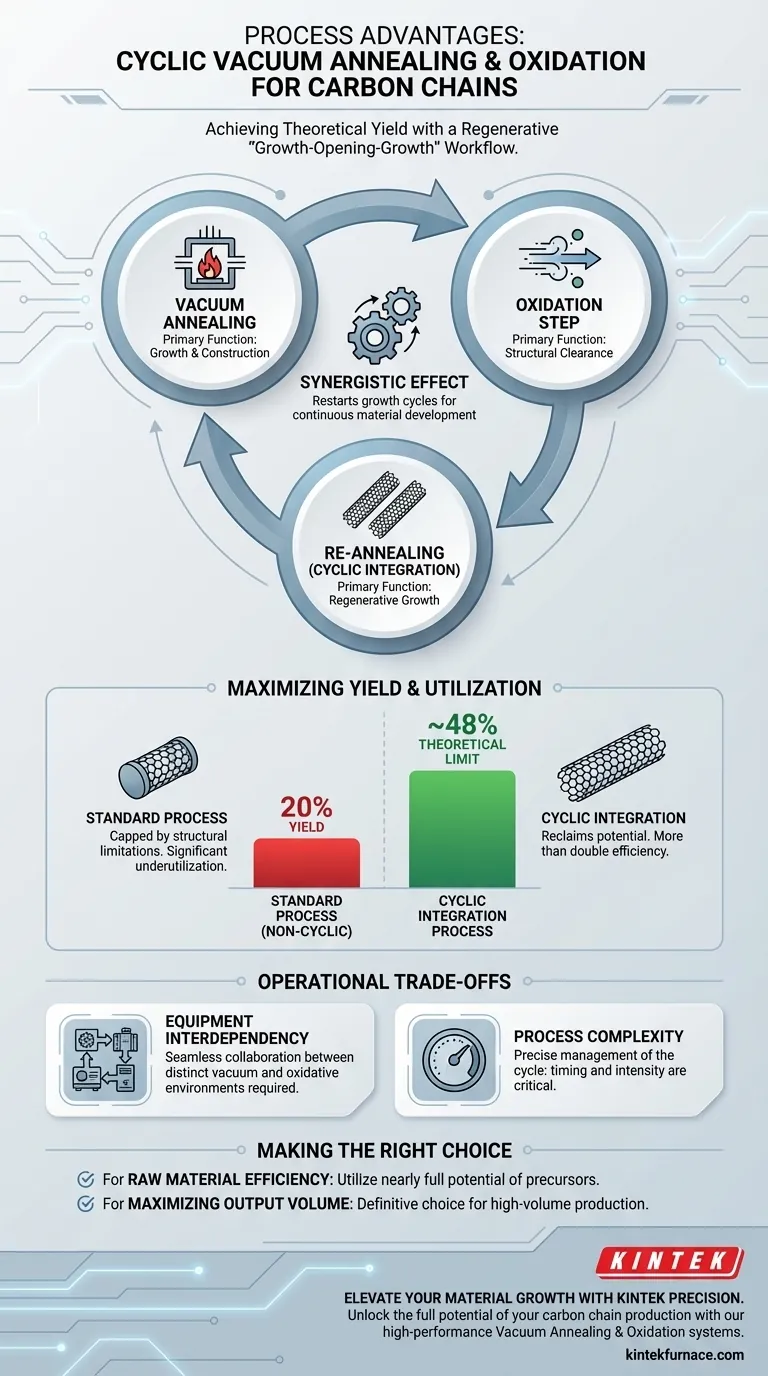
Systematic process integration is key. The primary process advantage of combining cyclic vacuum annealing with oxidation equipment lies in creating a regenerative "growth-opening-growth" workflow. While vacuum annealing drives the initial construction of carbon chains, oxidation intervenes to remove structural obstructions, allowing subsequent annealing cycles to fully utilize the potential of the raw materials.
This collaborative process resolves the limitations of single-step production, boosting the yield of carbon chains in 1.45 nm arc-discharge carbon nanotubes from roughly 20 percent to the theoretical limit of 48 percent.
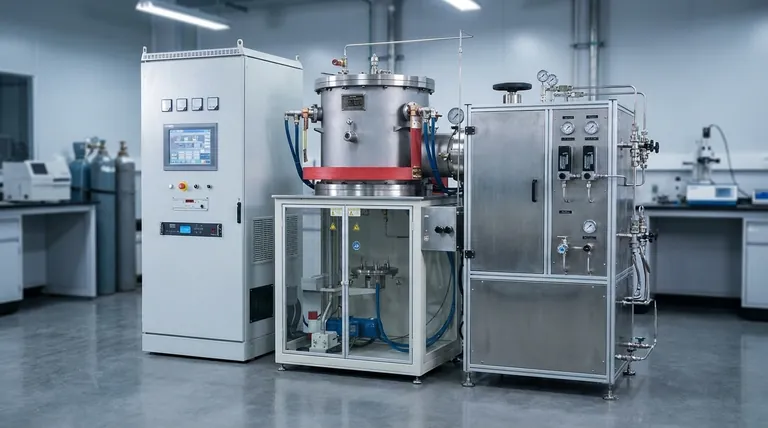
The Mechanics of the Cyclic Workflow
The Role of Vacuum Annealing
The foundation of this process is the vacuum annealing equipment. Its primary function is to facilitate the initial construction of the carbon chains within the nanotubes. This step is responsible for the physical growth phase of the material.
The Role of Oxidation
Growth often stalls due to obstructions, such as closed caps on the nanotubes. The oxidation equipment resolves this by chemically removing these obstructions. By "opening caps," this step exposes the interior, providing new active sites for precursors.
The Synergistic Effect
The true process advantage emerges from the cycle: annealing for growth, oxidation for opening, and re-annealing for further growth. This repetition ensures that growth does not permanently stop at the first obstacle. Instead, the process restarts, allowing for continuous elongation and material development.
Maximizing Yield and Utilization
Breaking the 20% Barrier
In standard, non-cyclic processes, yield is often capped by structural limitations. For 1.45 nm arc-discharge carbon nanotubes, a single-step approach typically results in a yield of approximately 20 percent. This low figure represents a significant underutilization of raw materials.
Reaching the Theoretical Limit
By introducing the cyclic oxidation step, the process reclaims the potential of the raw materials. The removal of obstructions allows the re-annealing phase to drive production near the theoretical limit of 48 percent. This represents a more than double increase in efficiency compared to standard methods.
Understanding the Operational Trade-offs
Equipment Interdependency
This method relies on the seamless collaboration between two distinct types of equipment. Unlike a linear production line, this requires a workflow that can alternate between vacuum environments and oxidative atmospheres.
Process Complexity
Achieving the theoretical limit requires precise management of the "growth-opening-growth" cycle. Operators must ensure that the oxidation phase is sufficient to open caps without damaging the existing chains, and that annealing is reintroduced at the exact right moment to resume growth.
Making the Right Choice for Your Goal
When evaluating this equipment combination for your production line, consider your specific targets:
- If your primary focus is raw material efficiency: This combination is essential, as it allows you to utilize nearly the full potential of your precursors rather than discarding them after a single growth phase.
- If your primary focus is maximizing output volume: The ability to move from a 20% yield to a 48% yield makes this cyclic process the definitive choice for high-volume carbon chain production.
By leveraging the alternating forces of construction and clearance, you transform a stagnant chemical process into a dynamic, high-yield production system.
Summary Table:
| Process Phase | Primary Function | Key Advantage |
|---|---|---|
| Vacuum Annealing | Growth & Construction | Initial formation of carbon chains within nanotubes |
| Oxidation Step | Structural Clearance | Opens nanotube caps and removes growth obstructions |
| Cyclic Integration | Regenerative Growth | Restarts growth cycles to reach theoretical yield limits |
| Yield Comparison | Efficiency Optimization | Boosts raw material utilization from 20% to ~48% |
Elevate Your Material Growth with KINTEK Precision
Unlock the full potential of your carbon chain production with high-performance thermal systems from KINTEK. Our advanced Vacuum Annealing and Oxidation systems provide the precise environment needed to master the "growth-opening-growth" cycle, helping you surpass traditional yield barriers and reach theoretical limits.
Backed by expert R&D and manufacturing, KINTEK offers a comprehensive range of Muffle, Tube, Rotary, Vacuum, and CVD systems. Whether you need standard lab high-temperature furnaces or fully customizable solutions tailored to your unique research needs, we deliver the reliability your project demands.
Ready to optimize your yield? Contact KINTEK today to discuss your custom furnace requirements.
Visual Guide
References
- Clara Freytag, Thomas Pichler. Systematic Optimization of the Synthesis of Confined Carbyne. DOI: 10.1002/smtd.202500075
This article is also based on technical information from Kintek Furnace Knowledge Base .
Related Products
- Custom Made Versatile CVD Tube Furnace Chemical Vapor Deposition CVD Equipment Machine
- Vacuum Hot Press Furnace Machine for Lamination and Heating
- Multi Heating Zones CVD Tube Furnace Machine for Chemical Vapor Deposition Equipment
- Vacuum Induction Melting Furnace
- Vacuum Sealed Continuous Working Rotary Tube Furnace Rotating Tube Furnace
People Also Ask
- What is a CVD tube furnace and what is its primary function? Discover Precision Thin-Film Deposition
- Why are CVD tube furnace sintering systems indispensable for 2D material research and production? Unlock Atomic-Scale Precision
- Which industries and research fields benefit from CVD tube furnace sintering systems for 2D materials? Unlock Next-Gen Tech Innovations
- How does CVD tube furnace sintering enhance graphene growth? Achieve Superior Crystallinity and High Electron Mobility
- What improvements can be made to the bonding force of gate dielectric films using a CVD tube furnace? Enhance Adhesion for Reliable Devices