
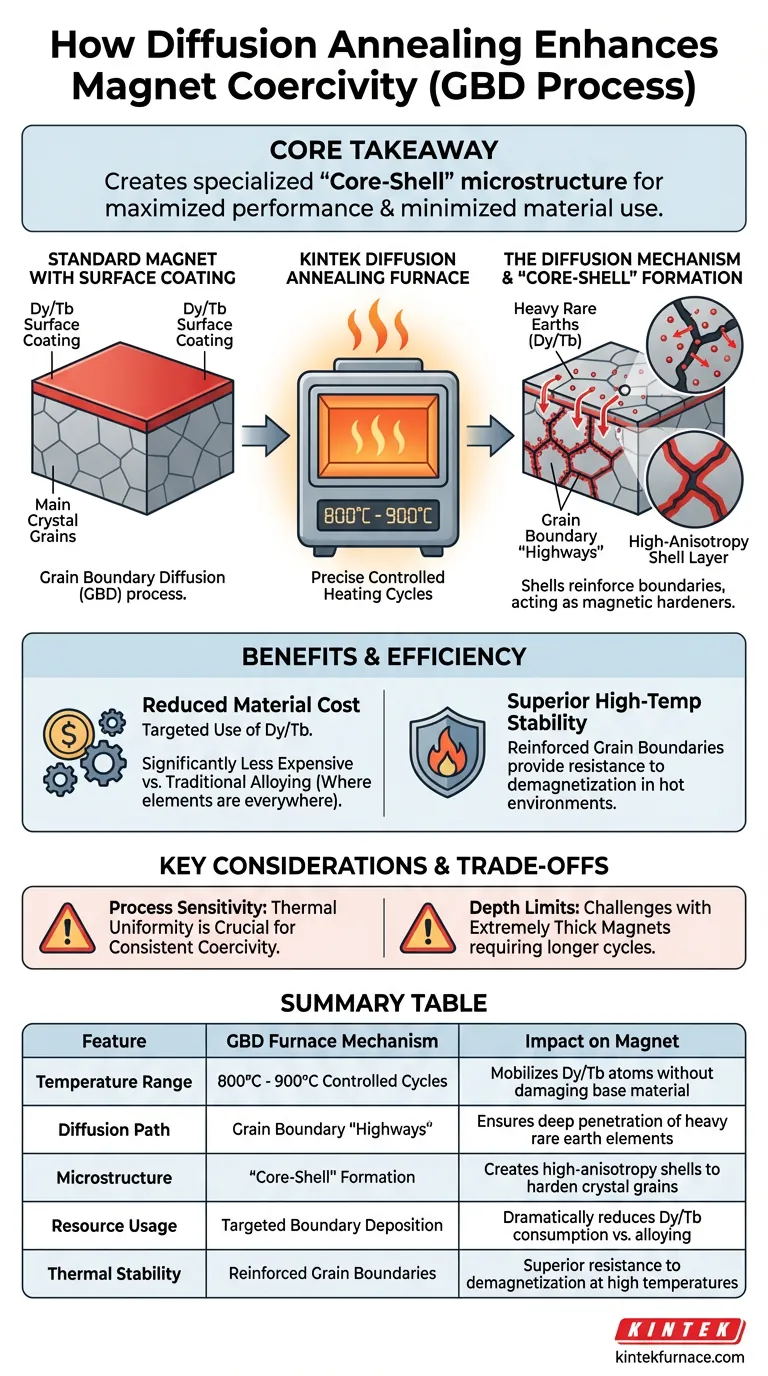
A diffusion annealing furnace enhances coercivity by executing precise heating cycles, typically in the range of 800°C to 900°C. This controlled thermal environment drives heavy rare earth elements, such as dysprosium or terbium, from the magnet's surface coating into the interior structure via the grain boundaries.
Core Takeaway The diffusion annealing furnace is the catalyst for creating a specialized "core-shell" microstructure. By concentrating heavy rare earth elements specifically at the grain boundaries rather than alloying them throughout the entire magnet, the process maximizes magnetic performance while minimizing material consumption.
The Mechanism of Diffusion
Controlled Heating Cycles
The primary function of the furnace is to maintain a strict temperature range of 800-900°C.
This specific thermal window is critical. It provides enough energy to mobilize the heavy rare earth atoms without melting the base magnet or damaging its primary magnetic phase.
Penetration via Grain Boundaries
Under this heat, the coating materials—dysprosium (Dy) or terbium (Tb)—migrate from the surface into the magnet's body.
Crucially, these elements travel along the grain boundaries. These boundaries act as "highways" for the atoms, allowing them to penetrate deep into the material rather than staying trapped on the exterior.
The Microstructural Transformation
Formation of the High-Anisotropy Shell
As the Dy or Tb atoms travel along the boundaries, they interact with the main crystal grains of the magnet.
This interaction forms a high-anisotropy shell layer that wraps around the individual crystal grains. This "shell" acts as a magnetic hardener, specifically reinforcing the areas most vulnerable to demagnetization.
Enhanced Stability
The presence of this shell significantly improves the magnet's high-temperature stability.
By reinforcing the grain boundaries, the furnace treatment ensures the magnet retains its strength even when exposed to the thermal stress of operating environments.
Efficiency and Resource Management
Minimizing Rare Earth Usage
Traditional methods involve alloying heavy rare earths throughout the entire volume of the magnet.
The GBD process, facilitated by the furnace, uses a minimal amount of these expensive elements. Because the elements are targeted only where they are needed—the boundaries—the total volume of Dy or Tb required is drastically reduced.
Understanding the Trade-offs
Process Sensitivity
The success of this enhancement relies entirely on thermal precision.
If the furnace fails to maintain the 800-900°C range uniformly, the diffusion will be uneven. This can lead to magnets with inconsistent coercivity levels, where the core remains weak while the surface is hardened.
Depth Limitations
While the furnace drives penetration, it is ultimately a diffusion-based process.
There are physical limits to how deep the elements can travel efficiently. For extremely thick magnets, achieving a uniform high-anisotropy shell throughout the entire center volume requires longer cycle times or optimized furnace atmospheres.
Making the Right Choice for Your Goal
To determine if this process aligns with your manufacturing requirements, consider your primary constraints:
- If your primary focus is Cost Reduction: This process allows you to achieve high performance using significantly less expensive heavy rare earth material (Dy/Tb) than traditional alloying.
- If your primary focus is High-Temperature Performance: The formation of the high-anisotropy shell offers superior resistance to demagnetization in hot operating environments compared to standard magnets.
By leveraging the diffusion annealing furnace, you transform a standard magnet into a high-performance component through targeted microstructural engineering.
Summary Table:
| Feature | GBD Furnace Mechanism | Impact on Magnet |
|---|---|---|
| Temperature Range | 800°C - 900°C Controlled Cycles | Mobilizes Dy/Tb atoms without damaging base material |
| Diffusion Path | Grain Boundary "Highways" | Ensures deep penetration of heavy rare earth elements |
| Microstructure | "Core-Shell" Formation | Creates high-anisotropy shells to harden crystal grains |
| Resource Usage | Targeted Boundary Deposition | Dramatically reduces Dy/Tb consumption vs. alloying |
| Thermal Stability | Reinforced Grain Boundaries | Superior resistance to demagnetization at high temperatures |
Maximize Magnet Performance with KINTEK Precision
Unlock the full potential of Grain Boundary Diffusion with KINTEK’s advanced diffusion annealing furnaces. Backed by expert R&D and world-class manufacturing, we provide specialized Muffle, Tube, Rotary, Vacuum, and CVD systems designed to deliver the precise 800°C–900°C thermal stability required for high-anisotropy shell formation.
Whether you are looking to reduce material costs by minimizing heavy rare earth usage or need to enhance high-temperature coercivity for demanding applications, our lab and industrial furnaces are fully customizable to meet your unique metallurgical needs.
Ready to optimize your magnetic materials? Contact our experts today to find your perfect high-temp solution!
Visual Guide
References
- Finks, Christopher. Technical Analysis: Magnet-to-Magnet Rare Earth Recycling Without Solvent Extraction (M2M-Δ Architecture) - Defense Supply Chain Resilience. DOI: 10.5281/zenodo.17625286
This article is also based on technical information from Kintek Furnace Knowledge Base .
Related Products
- Controlled Inert Nitrogen Hydrogen Atmosphere Furnace
- Mesh Belt Controlled Atmosphere Furnace Inert Nitrogen Atmosphere Furnace
- 1200℃ Controlled Inert Nitrogen Atmosphere Furnace
- Laboratory Muffle Oven Furnace with Bottom Lifting
- High Temperature Muffle Oven Furnace for Laboratory Debinding and Pre Sintering
People Also Ask
- How does hydrogen furnace annealing assist in preparing mechanically alloyed powders for compaction?
- How does atmospheric annealing in a controlled hydrogen furnace affect the cold compaction behavior of metal powders?
- What are the characteristics and uses of hydrogen atmospheres in furnaces? Unlock Clean Metal Processing
- What are the characteristics and uses of hydrogen atmosphere in furnaces? Achieve Superior Surface Purity and Bonding
- What controlled-atmosphere furnace conditions are required for sintering powder metallurgy copper alloy compacts? Ideal Setup



















