
High-purity alumina crucibles and quartz sleeve encapsulation function as a dual-layer containment system designed to preserve chemical purity and control atmospheric conditions. The alumina crucible acts as the primary vessel, utilizing exceptional chemical inertness to prevent reaction with the perrhenate melt at temperatures exceeding 750 °C. Simultaneously, the quartz sleeve encapsulation creates a vacuum-sealed "micro-closed-loop" environment that shields the sample from oxygen and moisture, particularly during the critical high-temperature annealing and extended cooling phases.
Core Takeaway: Successful synthesis of calcium-based perrhenates relies on decoupling physical containment from atmospheric control. The alumina crucible handles the thermal load and prevents chemical leaching, while the quartz sleeve locks in a vacuum environment to stabilize the rhenium oxidation state.
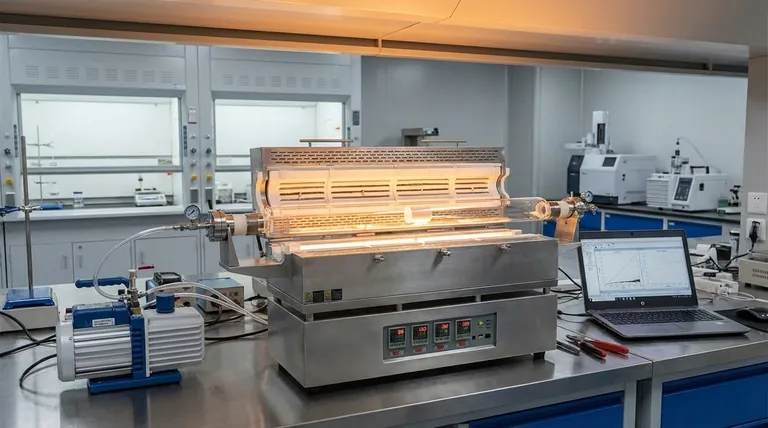
The Role of High-Purity Alumina Crucibles
Ensuring Chemical Inertness
The primary function of the alumina crucible is to serve as a chemically neutral barrier between the reactants and the furnace environment.
At synthesis temperatures exceeding 750 °C, lesser materials often degrade or react with the molten sample. High-purity alumina resists this, preventing the crucible material itself from contaminating the perrhenate melt.
Providing a Stable Reaction Space
During the solid-phase synthesis, the raw material powders (oxide or carbonate precursors) require a dimensionally stable vessel.
The crucible withstands the physical stress of repeated heating cycles. This stability is essential for maintaining the integrity of the sample through the grinding and sintering stages necessary for material synthesis.
The Function of Quartz Sleeve Encapsulation
Creating a Controlled Micro-Environment
Quartz encapsulation is used to establish a vacuum-sealed, micro-closed-loop environment around the alumina crucible.
By evacuating the vessel to approximately 30 mTorr (4 Pa), the system eliminates residual atmospheric gases. This isolation is critical for preventing external impurities from interfering with the reaction dynamics.
Preserving the Rhenium Oxidation State
The specific chemistry of perrhenates requires maintaining rhenium in its high oxidation state (Re VII).
The vacuum environment provided by the quartz sleeve prevents oxidation side reactions during the 560–750 °C annealing phase. Without this barrier, oxygen or moisture would destabilize the rhenium, leading to impurity phases rather than high-quality single crystals.
Protection During Extended Cooling
The synthesis process involves a prolonged cooling period, often lasting up to 50 hours.
The quartz sleeve acts as a shield during this vulnerable window. It ensures that atmospheric moisture and oxygen cannot re-enter the system and degrade the sample as it slowly returns to room temperature.
Understanding the Operational Constraints
The Complexity of Vacuum Management
While necessary, reliance on quartz encapsulation introduces the need for a robust high-vacuum pump system.
Achieving the required 30 mTorr pressure is non-negotiable for purity. Any failure in the quartz seal or the pumping system will compromise the Re VII state, rendering the synthesis unsuccessful.
Material Compatibility and Thermal Limits
While alumina and quartz are robust, they function within specific thermal windows.
The alumina is chosen specifically for the 800–1000 °C range where it remains inert. Operators must ensure the thermal expansion coefficients of the materials do not cause mechanical failure during the rapid temperature changes of the annealing process.
Making the Right Choice for Your Synthesis
To ensure the production of high-quality calcium-based perrhenates, you must align your equipment choices with your chemical requirements.
- If your primary focus is preventing melt contamination: Prioritize high-purity alumina crucibles to ensure the vessel does not leach impurities into the sample at temperatures >750 °C.
- If your primary focus is stabilizing the Re VII oxidation state: Ensure rigorous quartz sleeve encapsulation under vacuum to eliminate oxygen and moisture during annealing and cooling.
By combining the thermal resistance of alumina with the atmospheric isolation of quartz, you create the precise conditions required for single-phase crystal growth.
Summary Table:
| Component | Primary Function | Key Benefit |
|---|---|---|
| Alumina Crucible | Chemical containment | Prevents melt contamination at temperatures >750 °C |
| Quartz Sleeve | Vacuum encapsulation | Maintains Re VII oxidation state and blocks moisture |
| Vacuum Environment | Atmospheric control | Eliminates oxygen interference during 50-hour cooling |
Elevate Your Material Synthesis with KINTEK Expertise
Precise solid-phase synthesis demands equipment that can withstand extreme thermal loads while maintaining absolute atmospheric purity. Backed by expert R&D and manufacturing, KINTEK offers a comprehensive range of high-performance solutions, including Muffle, Tube, Rotary, Vacuum, and CVD systems, along with specialized lab high-temp furnaces—all customizable for your unique research needs.
Don't let contamination or oxidation compromise your results. Partner with KINTEK to access the reliable heating technology and precision vessels required for high-quality single-crystal growth. Contact our technical team today to find the perfect furnace configuration for your laboratory.
References
- New calcium perrhenates: synthesis and crystal structures of Ca(ReO<sub>4</sub>)<sub>2</sub> and K<sub>2</sub>Ca<sub>3</sub>(ReO<sub>4</sub>)<sub>8</sub>·4H<sub>2</sub>O. DOI: 10.1515/zkri-2025-0008
This article is also based on technical information from Kintek Furnace Knowledge Base .
Related Products
- 1400℃ High Temperature Laboratory Tube Furnace with Alumina Tube
- 1700℃ High Temperature Laboratory Tube Furnace with Alumina Tube
- Magnesium Extraction and Purification Condensing Tube Furnace
- Vacuum Induction Melting Furnace
People Also Ask
- How does zone-melting in tube furnaces synthesize bismuth micro-wires? Master Single-Crystal Thermoelectric Growth
- How do high-temperature laboratory tube furnaces ensure environmental stability? Precision Thermal Reduction Tips
- How are high-temperature laboratory tube furnaces applied in long-term vacuum homogenization heat treatments for intermetallic samples?
- How are high-temp tube furnaces used to measure diffusion coefficients per Fick's law? Master Precision Annealing
- How are high-temperature tube furnaces applied in testing ceramic-supported alloy membranes? Insights



