
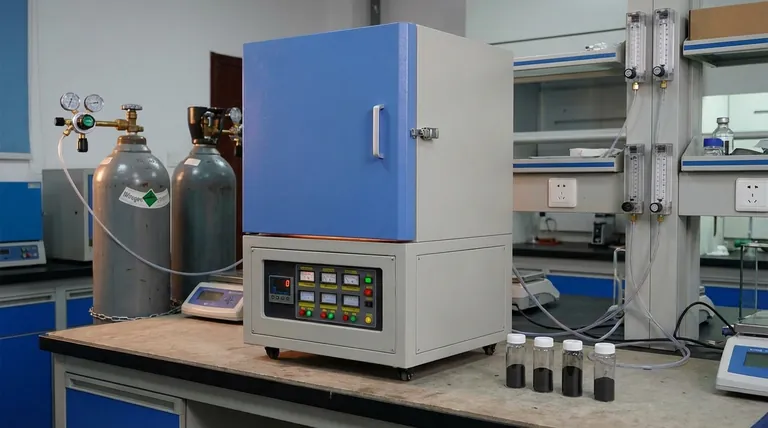
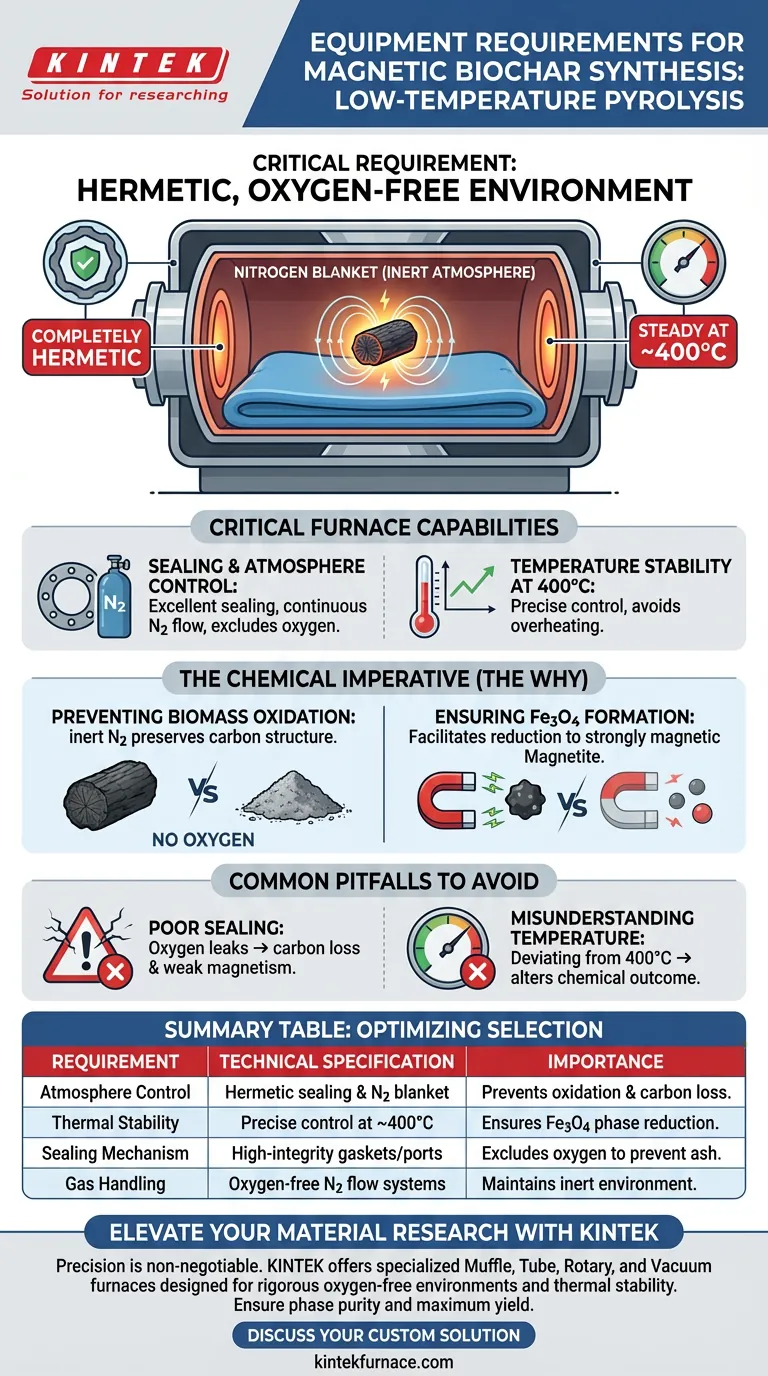
The critical equipment requirement for high-temperature furnaces in magnetic biochar synthesis is the capability to establish and maintain a completely hermetic, oxygen-free environment. Whether employing a box furnace or a tube furnace, the equipment must feature superior sealing mechanisms and precise atmosphere control to sustain a nitrogen blanket at operating temperatures of approximately 400°C.
The success of magnetic biochar synthesis is defined not just by heat, but by the exclusion of oxygen. Your furnace must guarantee an inert environment to prevent carbon loss and ensure iron oxides reduce specifically to the strongly magnetic Fe3O4 phase.
Critical Furnace Capabilities
To achieve successful low-temperature pyrolysis, the hardware must go beyond simple heating. It must serve as a reactor that strictly controls the chemical environment.
Sealing and Atmosphere Control
The furnace must possess excellent sealing capabilities. Standard furnaces with leaky door gaskets or unsealed ports are unsuitable for this process.
The system must support the continuous introduction of oxygen-free nitrogen. This creates an inert atmosphere that is maintained throughout the entire heating duration.
Temperature Stability at 400°C
While the equipment is classified as a "high-temperature furnace," this specific process requires stability at a lower range, typically around 400°C.
The furnace must be able to hold this temperature consistently. This thermal stability is required to drive the pyrolysis reaction without overheating the material or causing unwanted phase changes.
The Chemical Imperative
Understanding the "why" behind these equipment specs helps in selecting the right tool. The equipment requirements are dictated strictly by the chemical reactions needed to create magnetic properties.
Preventing Biomass Oxidation
If the furnace allows oxygen ingress, the biomass carbon will be consumed by oxidation.
Instead of forming biochar, the material will combust into ash. A strictly inert nitrogen environment preserves the carbon structure of the biomass.
Ensuring Fe3O4 Formation
The defining characteristic of magnetic biochar is the presence of Fe3O4 (Magnetite).
The furnace environment must facilitate the reduction of iron oxides into this specific strongly magnetic phase. If the atmosphere is uncontrolled, the process may yield non-magnetic impurities instead.
Common Pitfalls to Avoid
Even with high-quality equipment, overlooking the specific requirements of magnetic biochar synthesis can lead to failure.
The Risk of Poor Sealing
Using a furnace with degraded seals is the most common failure point. Even a small amount of oxygen can disrupt the reduction process.
This leads to the formation of weak magnetic phases or the total loss of the carbon matrix.
Misunderstanding Temperature Impact
Setting the temperature significantly higher or lower than the 400°C target can alter the chemical outcome.
Precision in the thermal setpoint is necessary to hit the specific reduction window for Magnetite.
Optimizing Your Equipment Selection
When evaluating furnaces for this application, prioritize atmospheric integrity over maximum temperature capabilities.
- If your primary focus is Phase Purity: Ensure the furnace has a verified, high-integrity sealing system to guarantee the formation of Fe3O4 rather than non-magnetic oxides.
- If your primary focus is Yield: Prioritize precise nitrogen flow controls to prevent oxidation and strictly preserve the biomass carbon mass.
The right furnace acts as a protective vessel, shielding the delicate chemical transformation of iron and carbon from the destructive effects of oxygen.
Summary Table:
| Requirement | Technical Specification | Importance in Magnetic Biochar Synthesis |
|---|---|---|
| Atmosphere Control | Hermetic sealing & Nitrogen blanket | Prevents biomass oxidation and carbon loss. |
| Thermal Stability | Precise control at ~400°C | Ensures reduction of iron oxides to magnetic Fe3O4 phase. |
| Sealing Mechanism | High-integrity gaskets/ports | Excludes oxygen to prevent combustion into ash. |
| Gas Handling | Oxygen-free N2 flow systems | Maintains the inert environment throughout the process. |
Elevate Your Material Research with KINTEK
Precision is non-negotiable in magnetic biochar synthesis. Backed by expert R&D and manufacturing, KINTEK offers specialized Muffle, Tube, Rotary, and Vacuum furnaces designed to deliver the rigorous oxygen-free environments and thermal stability your synthesis requires. Whether you need standard CVD systems or fully customizable high-temperature solutions, our equipment ensures phase purity and maximum yield for your lab's unique needs.
Ready to optimize your pyrolysis process? Contact KINTEK today to discuss your custom furnace solution!
Visual Guide
References
- Ruixiang Wu, Qianwei Ke. Preparation and characterization of Ru-TiO<sub>2</sub>/PC/Fe<sub>3</sub>O<sub>4</sub> composite catalyst with enhanced photocatalytic performance and magnetic recoverability under simulated solar light. DOI: 10.1039/d4ra07712a
This article is also based on technical information from Kintek Furnace Knowledge Base .
Related Products
- 1700℃ High Temperature Muffle Oven Furnace for Laboratory
- 1800℃ High Temperature Muffle Oven Furnace for Laboratory
- 1400℃ High Temperature Laboratory Tube Furnace with Alumina Tube
- High Temperature Muffle Oven Furnace for Laboratory Debinding and Pre Sintering
- 1200℃ Muffle Oven Furnace for Laboratory
People Also Ask
- What is the primary function of a high-temperature laboratory muffle furnace in chemical synthesis? Achieve Precision.
- How does a high-temperature laboratory muffle furnace affect material properties? Transform Anodic Oxide Films Fast
- What role does a muffle furnace play in BCZY712 electrolyte powder production? Achieve Perfect Phase Purity
- How does a muffle furnace impact Ni/MgAl2O4 catalysts? Optimize Stability and Catalytic Performance
- What role does a muffle furnace play in sintering photocathodes? Enhance Electrode Conductivity & Catalytic Activity



















