
A multimode cavity microwave furnace dramatically outperforms traditional heating by utilizing instantaneous volumetric heating to reach synthesis temperatures (up to 1400 °C) rapidly. Unlike conventional methods that rely on slow external heat conduction, this approach accelerates the generation of critical gas phases, significantly shortening the growth cycle while improving the yield of B-doped SiC nanowires.
By coupling rapid volumetric heating with graphite auxiliary support, this technology creates an ideal, stable thermal environment for the Vapor-Liquid-Solid (VLS) mechanism. This results in a faster, more efficient synthesis process that enhances both the quantity and quality of nanowire production.
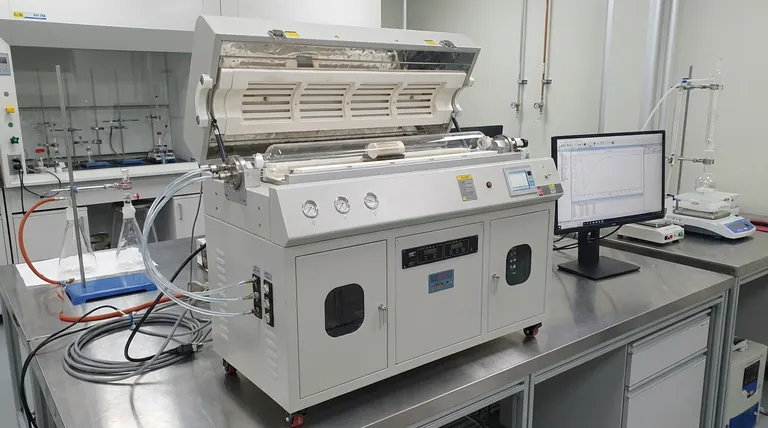
The Mechanics of Superior Efficiency
Instantaneous Volumetric Heating
Traditional furnaces typically use resistive heating elements that heat the environment first, relying on thermal conduction to eventually heat the sample.
In contrast, a multimode microwave furnace uses electromagnetic waves to act directly on the reactant molecules. This results in volumetric heating, where the material heats internally and instantaneously, rather than waiting for heat to penetrate from the surface.
Drastic Reduction in Cycle Time
Because the heating is direct and immediate, the SiO2-C precursor can reach the target temperature of 1400 °C in a very short period.
This rapid ramp-up capability significantly shortens the overall growth cycle. While traditional methods often require long pre-heating and stabilization phases, microwave heating reduces processing time substantially—in some related material processes, time reductions of over 90 percent have been observed.
Optimizing Reaction Kinetics
Accelerated Gas Phase Generation
The synthesis of SiC nanowires relies heavily on the presence of specific gas phases. The rapid thermal rise provided by the microwave furnace accelerates the generation of SiO and CO gas phases.
By producing these precursors quickly and in high concentrations, the system ensures that the raw materials are available exactly when the catalyst requires them.
Stable VLS Growth Environment
For B-doped SiC nanowires, the growth usually follows the Vapor-Liquid-Solid (VLS) mechanism, catalyzed by B2O3.
When the microwave field is combined with graphite plate auxiliary heating, it creates a highly stable thermal environment. This stability is critical for maintaining the VLS mechanism, directly contributing to a higher yield of nanowires compared to unstable or uneven heating methods.
Understanding the Trade-offs
Dependence on Auxiliary Heating
While microwave heating is efficient, multimode cavities can sometimes produce uneven electromagnetic field distributions.
To counteract this, the process relies on graphite plate auxiliary heating to ensure thermal uniformity. Without this hybrid approach, the pure microwave field might not provide the stable environment necessary for consistent nanowire quality.
Complexity of Control
Microwave heating introduces variables that are different from standard thermal dynamics, such as dielectric property changes during heating.
Achieving the precise "hierarchical pore structure" or specific nanowire morphology requires precise control over the electromagnetic input. This can be more complex to calibrate than simply setting a thermostat on a resistive furnace.
Making the Right Choice for Your Goal
To determine if a multimode microwave furnace is the right tool for your synthesis project, consider your specific priorities:
- If your primary focus is maximizing throughput: Leverage the rapid heating rates to drastically cut down the growth cycle and increase the daily yield of SiC nanowires.
- If your primary focus is reaction stability: Ensure your setup includes graphite auxiliary heating to stabilize the thermal environment and support the B2O3-catalyzed VLS mechanism.
By shifting from conductive to volumetric heating, you not only save time but create a more reactive environment that fundamentally improves the yield of B-doped SiC nanostructures.
Summary Table:
| Feature | Traditional Heating | Multimode Microwave Furnace |
|---|---|---|
| Heating Mechanism | External conduction & radiation | Instantaneous volumetric heating |
| Heating Speed | Slow ramp-up times | Rapid reaching of 1400 °C |
| Process Efficiency | Long growth cycles | Significantly shortened cycles |
| Precursor Generation | Slower gas phase (SiO/CO) release | Accelerated gas phase generation |
| Yield Stability | Dependent on external uniformity | Enhanced by graphite auxiliary support |
Unlock High-Performance Material Synthesis with KINTEK
Ready to transform your laboratory's productivity? At KINTEK, we specialize in cutting-edge heating solutions designed for the most demanding applications. Backed by expert R&D and manufacturing, we offer high-precision Muffle, Tube, Rotary, Vacuum, and CVD systems, as well as advanced microwave furnaces—all fully customizable to meet your unique B-doped SiC nanowire or material research needs.
Maximize your yield and minimize cycle times today. Contact our technical experts to discover how our tailored high-temperature systems can elevate your research outcomes.
References
- Tensile Strength and Electromagnetic Wave Absorption Properties of B-Doped SiC Nanowire/Silicone Composites. DOI: 10.3390/nano15171298
This article is also based on technical information from Kintek Furnace Knowledge Base .
Related Products
- Multi Heating Zones CVD Tube Furnace Machine for Chemical Vapor Deposition Equipment
- Multi Zone Laboratory Quartz Tube Furnace Tubular Furnace
- Split Multi Heating Zone Rotary Tube Furnace Rotating Tube Furnace
- Spark Plasma Sintering SPS Furnace
- Slide PECVD Tube Furnace with Liquid Gasifier PECVD Machine
People Also Ask
- What is the function of a multi-zone tube furnace in CVD synthesis? Master 2D In2Se3 Nanosheet Precision
- Why are multi zone tube furnaces particularly useful for nanomaterial research? Unlock Precise Thermal Control for Advanced Synthesis
- What temperature-related capabilities make multi zone tube furnaces valuable for research? Unlock Precision Thermal Control
- What environmental protection applications utilize multi zone tube furnaces? Unlock Precision in Waste Treatment and Green Tech
- What role do multi zone tube furnaces play in new energy research? Unlock Precise Thermal Control for Innovation














