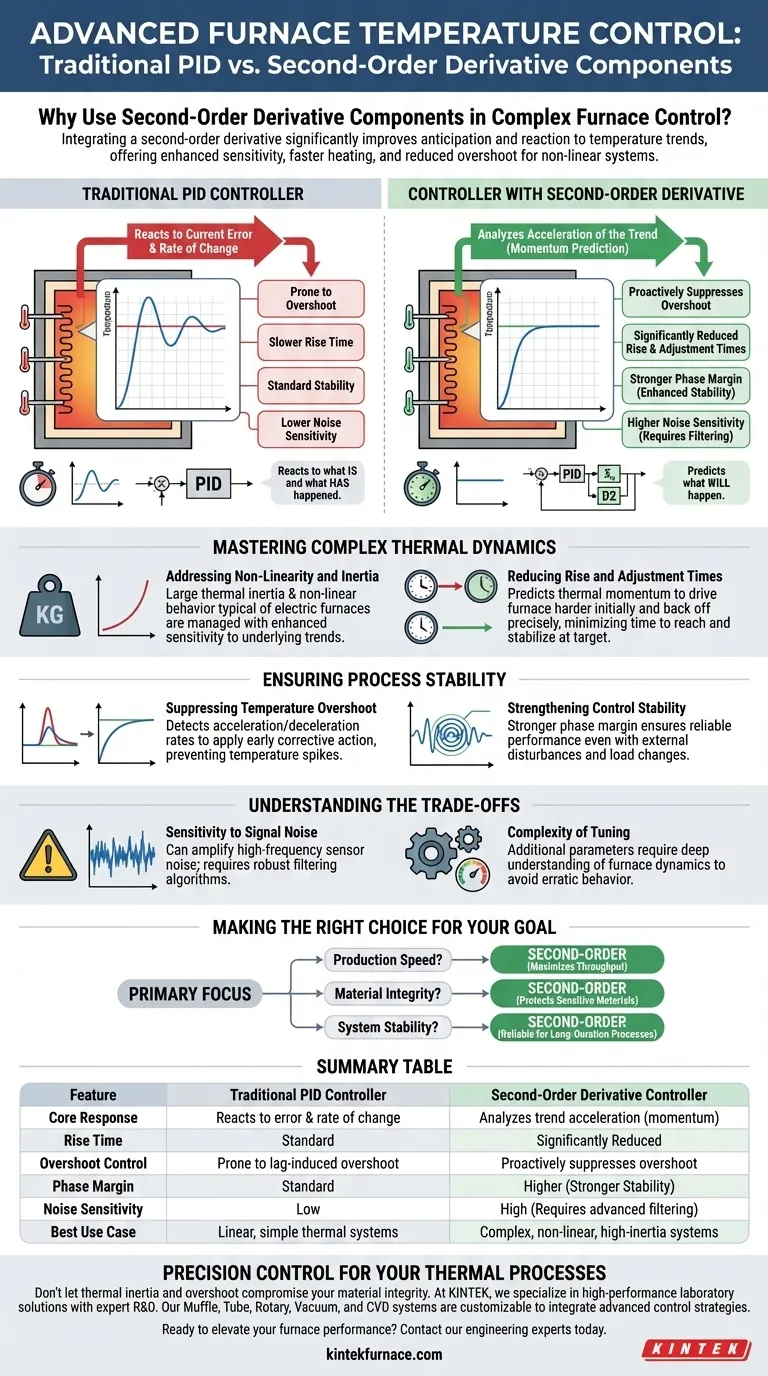
Integrating a second-order derivative component into a furnace controller significantly improves the system's ability to anticipate and react to temperature trends. Compared to a traditional PID controller, this advanced structure offers enhanced sensitivity, resulting in faster heating times and a substantial reduction in overshoot for complex, non-linear systems.
While traditional PID controllers react to current errors and rates of change, adding a second-order derivative allows the system to analyze the acceleration of the trend. This added layer of prediction effectively counteracts the massive thermal inertia typical of electric furnaces, ensuring stability where standard controllers might oscillate.

Mastering Complex Thermal Dynamics
Addressing Non-Linearity and Inertia
Electric furnace systems are characterized by large inertia, meaning they are slow to respond to energy input and slow to cool down. They are also often non-linear, behaving differently at various temperature ranges.
A controller with second-order derivative components and filters provides enhanced sensitivity to these complex behaviors. It looks beyond simple error correction to understand the underlying trend of the temperature change.
Reducing Rise and Adjustment Times
In a production environment, time is a critical resource. The primary advantage of this advanced control structure is its ability to significantly reduce rise time (how long it takes to reach the target).
It also minimizes adjustment time (how long it takes to stabilize once near the target). By predicting the thermal momentum, the controller can drive the furnace harder initially and back off precisely at the right moment.
Ensuring Process Stability
Suppressing Temperature Overshoot
One of the greatest risks in furnace control is overshoot, where the temperature exceeds the setpoint, potentially damaging the product or the heating elements.
Standard PID controllers often struggle to brake the heating process in time due to thermal lag. The second-order component effectively suppresses overshoot by detecting the rate at which the temperature rise is accelerating or decelerating, applying corrective action much earlier.
Strengthening Control Stability
For continuous production processes, consistent performance is non-negotiable. This advanced controller structure provides a stronger phase margin.
A higher phase margin directly correlates to better system stability. This ensures that even amidst external disturbances or load changes, the control loop remains tight and predictable.
Understanding the Trade-offs
Sensitivity to Signal Noise
While enhanced sensitivity is an asset for tracking temperature, it can be a liability regarding signal noise.
Second-order derivatives can amplify high-frequency noise inherent in sensor readings. Effective implementation usually requires robust filtering algorithms to ensure the controller reacts to actual temperature changes, not sensor static.
Complexity of Tuning
Moving beyond standard PID introduces additional parameters to configure.
Achieving the optimal balance between the proportional, integral, and first/second derivative terms requires a deeper understanding of the specific furnace's dynamics. Improper tuning can lead to erratic behavior rather than improved control.
Making the Right Choice for Your Goal
To determine if this advanced control strategy is right for your application, consider your specific operational constraints:
- If your primary focus is Production Speed: The second-order controller is superior for its ability to reduce rise and adjustment times, maximizing throughput.
- If your primary focus is Material Integrity: This method is ideal due to its ability to suppress overshoot, protecting sensitive materials from heat damage.
- If your primary focus is System Stability: The stronger phase margin offers the most reliable choice for long-duration, continuous processes.
By leveraging second-order derivative control, you transform your furnace from a reactive system into a predictive instrument capable of handling the most demanding thermal challenges.
Summary Table:
| Feature | Traditional PID Controller | Second-Order Derivative Controller |
|---|---|---|
| Core Response | Reacts to error and rate of change | Analyzes trend acceleration (momentum) |
| Rise Time | Standard | Significantly Reduced |
| Overshoot Control | Prone to lag-induced overshoot | Proactively suppresses overshoot |
| Phase Margin | Standard | Higher (Stronger Stability) |
| Noise Sensitivity | Low | High (Requires advanced filtering) |
| Best Use Case | Linear, simple thermal systems | Complex, non-linear, high-inertia systems |
Precision Control for Your Thermal Processes
Don't let thermal inertia and overshoot compromise your material integrity. At KINTEK, we specialize in high-performance laboratory solutions backed by expert R&D and precision manufacturing.
Whether you require Muffle, Tube, Rotary, Vacuum, or CVD systems, our lab high-temperature furnaces are fully customizable to integrate advanced control strategies that maximize your throughput and stability.
Ready to elevate your furnace performance? Contact our engineering experts today to discuss your unique needs and find the perfect heating solution for your lab.
Visual Guide
References
- Serdar Ekinci, Євген Зайцев. Efficient control strategy for electric furnace temperature regulation using quadratic interpolation optimization. DOI: 10.1038/s41598-024-84085-w
This article is also based on technical information from Kintek Furnace Knowledge Base .
Related Products
- 1200℃ Controlled Inert Nitrogen Atmosphere Furnace
- 1700℃ Controlled Inert Nitrogen Atmosphere Furnace
- Mesh Belt Controlled Atmosphere Furnace Inert Nitrogen Atmosphere Furnace
- 1800℃ High Temperature Muffle Oven Furnace for Laboratory
- 1700℃ High Temperature Laboratory Tube Furnace with Alumina Tube
People Also Ask
- What controlled-atmosphere furnace conditions are required for sintering powder metallurgy copper alloy compacts? Ideal Setup
- What are the advantages of a controlled atmosphere furnace over tube furnaces? Superior Process Control for Sensitive Materials
- How do surface oxide layers on ceramic powders like silicon nitride affect sintering? Master Atmosphere Control
- What are the four main types of controlled atmospheres used in these furnaces? Optimize Your Heat Treatment Processes
- What are the key benefits of precise temperature control in a controlled atmosphere furnace? Unlock Superior Quality and Efficiency