
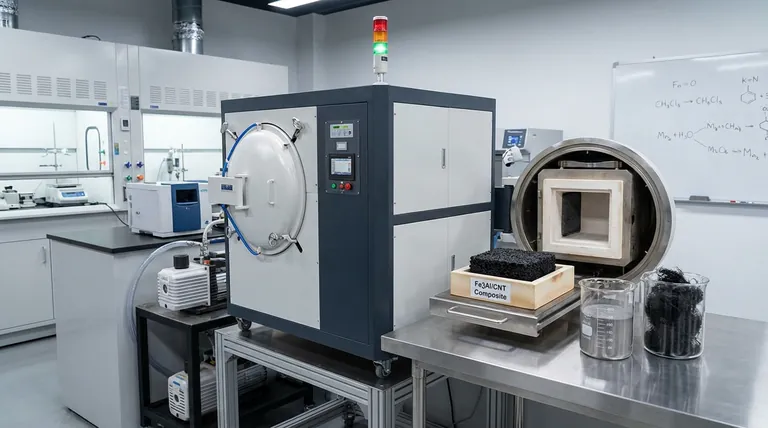
A vacuum drying oven creates a protective, low-pressure environment that fundamentally alters the drying kinetics of your Fe3Al and Carbon Nanotube (CNT) composite. By reducing ambient pressure, it lowers the boiling point of residual moisture and solvents, allowing for rapid evaporation at significantly lower temperatures than a standard oven requires.
The Core Takeaway Standard thermal drying poses a high risk of oxidizing fine metallic powders and degrading carbon nanostructures. The definitive advantage of a vacuum oven is its ability to preserve the chemical and structural stability of the Fe3Al/CNT composite by removing moisture in an oxygen-deprived, low-temperature environment.
Preserving Chemical Stability
The primary danger during the drying phase of Fe3Al/CNT composites is chemical alteration due to heat and oxygen exposure.
Preventing Oxidation of Fe3Al
Fine metallic powders like Fe3Al are highly susceptible to oxidation when heated in the presence of air. A standard oven creates a high-temperature, oxygen-rich environment that can degrade the powder before it dries. A vacuum environment eliminates oxygen, ensuring the metallic phase remains pure.
Protecting CNT Integrity
Carbon Nanotubes can undergo performance degradation when exposed to high-temperature air. Vacuum drying allows you to operate at lower temperatures, preventing thermal degradation. This preserves the specific electrical and mechanical properties of the CNTs that are critical to the composite's function as a microwave absorber.
Enhancing Microstructural Quality
Beyond chemical composition, the physical arrangement of your composite materials is vital for performance.
Eliminating Airflow Disturbances
Standard ovens often rely on convection (air movement) to distribute heat. This airflow can displace or blow away ultra-fine powders and CNTs. Vacuum drying is static; it eliminates airflow interference, preventing powder loss and ensuring the material distribution remains uniform.
Deep Pore Moisture Removal
CNTs and agglomerated powders create complex, porous structures where moisture can become trapped. The negative pressure in a vacuum oven actively draws solvents out from these internal pores and agglomerates. This ensures thorough drying without requiring excessive heat that might collapse the material's structure.
Operational Efficiency
The vacuum process offers distinct process control advantages over standard thermal drying.
Accelerated Drying Cycles
By lowering the boiling point of water and solvents, a vacuum oven achieves faster evaporation rates. This shortens the overall processing time required to reach a dry state.
Low-Temperature Processing
Because evaporation occurs more easily, you can set the oven to a much lower target temperature. This reduces the thermal stress placed on the composite, minimizing the risk of cracking or structural fatigue during the drying phase.
Understanding the Trade-offs
While vacuum drying is technically superior for this application, it is important to acknowledge the operational differences.
Throughput and Complexity
Vacuum ovens generally operate as batch processes and may have smaller capacities than large industrial conveyor ovens. They require vacuum pumps and tighter seal maintenance, introducing a layer of mechanical complexity that standard ovens do not have.
Heat Transfer Limitations
Because there is no air to convey heat (convection), vacuum ovens rely on conduction (via shelf contact) and radiation. This requires careful loading of the material to ensure the slurry or powder has adequate contact with the heated shelves for uniform drying.
Making the Right Choice for Your Goal
If your primary focus is Material Performance:
- Choose the vacuum drying oven to guarantee the Fe3Al and CNTs remain unoxidized and the microstructure remains intact for maximum microwave absorption.
If your primary focus is Throughput Speed:
- While vacuum drying is faster per batch due to lower boiling points, verify that the batch size capacity of your vacuum equipment meets your production volume requirements compared to a continuous standard oven.
The vacuum drying oven is not just a drying tool; it is a preservation method that ensures your high-performance composite retains the properties you engineered it to have.
Summary Table:
| Feature | Vacuum Drying Oven | Standard Convection Oven |
|---|---|---|
| Environment | Oxygen-free / Low pressure | Oxygen-rich / Atmospheric pressure |
| Oxidation Risk | Extremely Low (Preserves Fe3Al) | High (Risk of metallic degradation) |
| Temperature | Lower (Protects CNT integrity) | Higher (Risk of thermal stress) |
| Material Loss | None (Static environment) | Risk (Airflow may displace fine powders) |
| Drying Depth | Deep pore extraction | Surface-level evaporation |
| Heat Transfer | Conduction & Radiation | Convection |
Maximize Your Material Performance with KINTEK
Don't compromise the integrity of your Fe3Al and Carbon Nanotube composites with standard drying methods. KINTEK’s precision vacuum drying systems are engineered to prevent oxidation and preserve delicate nanostructures, ensuring your microwave-absorbing materials achieve peak performance.
Backed by expert R&D and world-class manufacturing, KINTEK offers a full suite of Muffle, Tube, Rotary, Vacuum, and CVD systems. Whether you need a standard solution or a system fully customized for your unique laboratory needs, our technical team is ready to assist.
Ready to elevate your lab’s efficiency? Contact us today to find the perfect thermal solution!
References
- Xixi Luo, Ziyan Liu. Enhanced microwave absorption performance of Fe<sub>3</sub>Al flakes by optimizing the carbon nanotube coatings. DOI: 10.1039/d4ra00955j
This article is also based on technical information from Kintek Furnace Knowledge Base .
Related Products
- Vacuum Heat Treat Sintering and Brazing Furnace
- Vacuum Heat Treat Sintering Furnace Molybdenum Wire Vacuum Sintering Furnace
- Dental Porcelain Zirconia Sintering Ceramic Vacuum Press Furnace
- Molybdenum Vacuum Heat Treat Furnace
- Vacuum Hot Press Furnace Machine Heated Vacuum Press
People Also Ask
- What are the benefits of using vacuum heat treating furnaces for metal alloys? Achieve Superior Metal Properties and Performance
- What is one of the most important uses of vacuum heat treating furnaces in aerospace? Achieve Superior Strength in Aircraft Alloys
- How does vacuum heat treating affect the grain structure of metal alloys? Achieve Precise Microstructure Control
- What is the temperature of a vacuum furnace brazing? Optimize Your Joint Strength and Cleanliness
- What are the steps involved in a typical vacuum brazing treatment? Master the Process for Strong, Clean Joints












