
Surface-induced nucleation dictates the final structure of lithium carbonate crystals. In conventional preparation processes, the surfaces of stirrer blades and reaction vessel walls act as the primary, yet inefficient, sites for crystal formation. This lack of controlled nucleation leads to non-uniform grain coalescence, ultimately producing needle-like primary particles and secondary particles with highly inconsistent size distributions.
The surface states of reaction hardware serve as the limiting factor in lithium carbonate morphology when nucleation mediators are absent. Inefficient surface nucleation forces the material into undesirable needle-like shapes and prevents the achievement of a uniform particle size distribution.
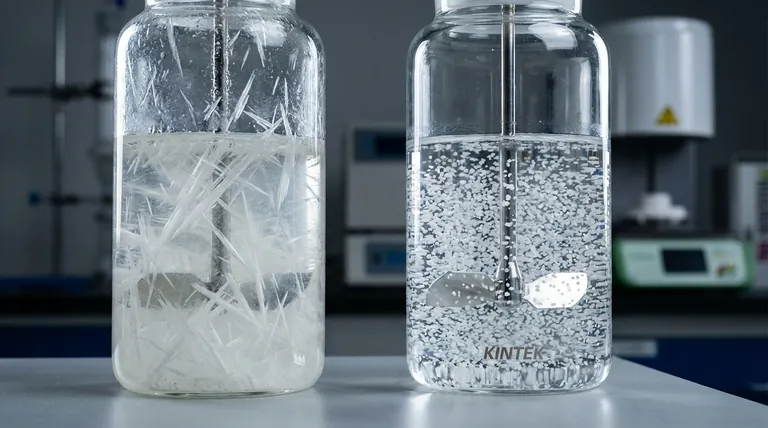
The Mechanism of Surface-Driven Nucleation
Slow Nucleation on Reaction Substrates
In standard lithium salt preparation, lithium carbonate does not crystallize easily within the bulk liquid. Instead, it tends to nucleate slowly on the physical surfaces of the stirrer blades and the reaction vessel walls.
Because these surfaces are not optimized for crystallization, the formation of initial "seeds" is sluggish and sparse. This localized growth pattern creates a foundation for poor structural development.
The Impact of Sparse Growth Sites
A deficiency of adequate growth sites means that the few grains that do form must absorb all available solute. This lack of distributed nucleation points prevents the system from creating a balanced, homogeneous crystal population.
Morphological Consequences of Surface States
The Formation of Needle-Like Primary Particles
When nucleation is restricted and slow, the resulting primary particles often develop into needle-like shapes. This morphology is a direct result of the uncontrolled growth kinetics found on unmediated stirrer and vessel surfaces.
These elongated structures are generally less desirable for downstream applications compared to spherical or granular forms. They can lead to poor flowability and lower packing density in the final product.
Non-Uniform Coalescence and Secondary Particles
The initial grains formed on these surfaces undergo non-uniform coalescence. Because the growth is not synchronized across the batch, the primary particles clump together haphazardly.
This results in secondary particles with an extremely uneven particle size distribution. Such inconsistency can cause significant challenges in industrial processes that require precise material specifications.
Common Pitfalls in Conventional Processing
Relying on Passive Surface Interaction
A common mistake is assuming that standard vessel geometry or stirring speeds can compensate for poor nucleation chemistry. Without addressing the surface state or adding mediators, the physical agitation often just promotes further non-uniformity.
Overlooking Surface-to-Volume Ratios
In larger reaction batches, the ratio of surface area (walls/stirrers) to the liquid volume changes. If the morphology is tied strictly to surface nucleation, scaling up a process can lead to unpredictable shifts in particle size and shape.
How to Optimize Crystal Morphology
Recommendations for Process Control
- If your primary focus is uniform particle size: You must move beyond reliance on vessel surfaces by introducing nucleation mediators to provide distributed growth sites.
- If your primary focus is eliminating needle-like structures: Ensure that the reaction environment promotes rapid, bulk nucleation rather than slow, localized growth on stirrer blades.
- If your primary focus is batch-to-batch consistency: Standardize the surface condition of your reaction vessels and stirrers to ensure the nucleation energy barrier remains constant.
Proper management of surface interactions is the definitive factor in transforming lithium carbonate from irregular needles into high-quality, uniform crystals.
Summary Table:
| Factor | Impact on Morphology | Resulting Crystal State |
|---|---|---|
| Stirrer/Wall Surfaces | Act as inefficient nucleation sites | Localized, sparse grain growth |
| Nucleation Speed | Slow and unmediated kinetics | Development of needle-like primary particles |
| Grain Coalescence | Non-uniform clumping/merging | Highly inconsistent secondary particle sizes |
| Scale-up Physics | Surface-to-volume ratio shifts | Unpredictable shifts in particle shape/distribution |
Elevate Your Chemical Processing with KINTEK Precision
Is inconsistent crystal morphology hindering your production quality? KINTEK provides the advanced thermal and chemical processing solutions needed to master complex reactions. Backed by expert R&D and world-class manufacturing, we offer high-performance Muffle, Tube, Rotary, Vacuum, and CVD systems, as well as other lab high-temperature furnaces—all fully customizable to meet your unique research and industrial requirements.
Don't let surface-driven inefficiencies compromise your lithium carbonate quality. Contact KINTEK today to discover how our specialized equipment can help you achieve uniform particle distribution and optimized crystal structures.
References
- Gogwon Choe, Yong‐Tae Kim. Re-evaluation of battery-grade lithium purity toward sustainable batteries. DOI: 10.1038/s41467-024-44812-3
This article is also based on technical information from Kintek Furnace Knowledge Base .
Related Products
People Also Ask
- What are the essential components of an MPCVD reactor system? Build a Pristine Environment for High-Purity Materials
- How does pressure affect the MPCVD growth process? Master Plasma Control for Superior Film Quality
- How do carbon-containing groups contribute to diamond growth in the MPCVD method? Unlock High-Quality Diamond Synthesis
- Why is temperature control important in the MPCVD growth process? Ensure High-Quality, Reliable Diamond Film Deposition
- What are the key components of an MPCVD system? Unlock High-Purity Crystal Growth
