
The muffle furnace functions as a precision thermal reactor in the synthesis of C3N4 nanosheets, executing a specific two-stage heating protocol to transform raw melamine. It provides a controlled environment to ramp the material to 550 °C for initial polymerization, followed by a stabilization phase at 520 °C to trigger the exfoliation required for high-surface-area nanostructures.
Core Takeaway The muffle furnace is not merely a heating source but a tool for controlled thermal polymerization and exfoliation. By isolating the melamine and adhering to a strict two-stage temperature profile, it converts the precursor into nanosheets with optimized structural integrity and specific surface area.
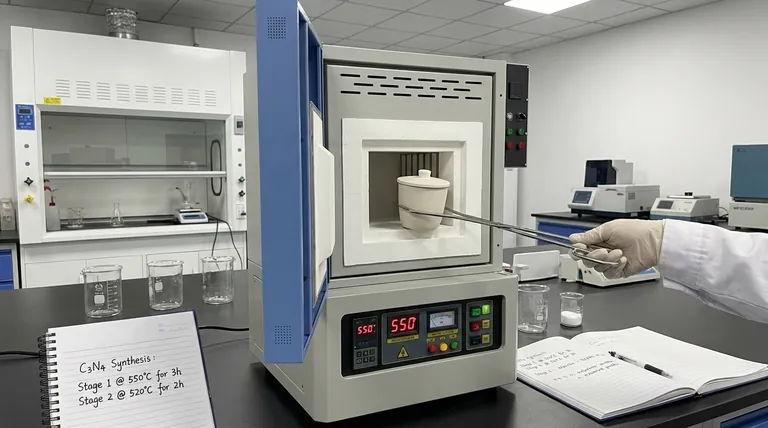
The Two-Stage Calcination Protocol
Stage One: Thermal Polymerization
The first stage focuses on initiating the chemical transformation of the precursor. The muffle furnace heats the melamine, typically placed in a covered crucible, at a controlled ramp rate of 5 °C/min.
Once the furnace reaches 550 °C, it holds this temperature for 3 hours. This high-energy phase is responsible for the bulk thermal polymerization of the melamine molecules.
Stage Two: Thermal Exfoliation and Stabilization
Following the initial high-heat phase, the process shifts to a secondary stage to refine the material structure. The temperature is adjusted to 520 °C and maintained for 2 hours.
This stage is critical for the exfoliation of the bulk material. The sustained heat facilitates the breakdown of bulk layered structures into thinner nanosheets, significantly increasing the specific surface area.
Why the Muffle Furnace Environment Matters
Isolation from Combustion Byproducts
A defining feature of a muffle furnace is its ability to separate the workload from the fuel source and combustion byproducts. This isolation ensures the melamine is heated in a clean, stable air atmosphere.
This purity is essential for preventing external contamination that could disrupt the formation of the carbon nitride lattice.
Controlled Heating Rates
The specific ramp rate of 5 °C/min provided by the furnace is as important as the final temperature. A controlled increase prevents thermal shock and ensures uniform heating throughout the crucible.
Rapid, uncontrolled heating could lead to uneven polymerization or incomplete conversion of the precursor material.
Achieving High Specific Surface Area
The ultimate goal of using this furnace profile is to maximize the surface area of the resulting C3N4. The thermal energy provided triggers the physical exfoliation necessary to create nanosheets.
High specific surface area is the key performance metric, as it directly correlates to the material's reactivity and efficiency in future applications.
Understanding the Trade-offs
Temperature Precision vs. Material Integrity
There is a narrow window for success in this process. If the furnace temperature exceeds the 550 °C target significantly, you risk thermal decomposition of the C3N4 structure itself.
Conversely, if the temperature is too low or the hold times are shortened, the polymerization will be incomplete, resulting in bulk material rather than exfoliated nanosheets.
Crucible Configuration Impacts
While the furnace provides the heat, the covered crucible plays a massive role in the outcome. A completely sealed environment might build up too much pressure, while an open crucible may lead to excessive loss of precursor via sublimation before polymerization occurs.
The muffle furnace relies on the operator to balance the atmosphere inside the crucible with the thermal stability provided outside it.
Making the Right Choice for Your Goal
To ensure consistent results when preparing C3N4 nanosheets, align your furnace operation with your specific objectives:
- If your primary focus is Structural Homogeneity: Strictly adhere to the 5 °C/min ramp rate to ensure the melamine heats evenly, preventing localized defects in the crystal lattice.
- If your primary focus is Maximizing Surface Area: Ensure the second stage at 520 °C is held for the full duration, as this is the critical phase for effective exfoliation of the layers.
Success in this process relies on treating the muffle furnace as a precision instrument for chemical synthesis, not just a heat source.
Summary Table:
| Process Stage | Target Temperature | Duration | Key Function |
|---|---|---|---|
| Stage 1 | 550 °C | 3 Hours | Bulk thermal polymerization of melamine |
| Stage 2 | 520 °C | 2 Hours | Thermal exfoliation into high-surface-area nanosheets |
| Ramp Rate | 5 °C/min | N/A | Prevention of thermal shock and ensuring uniformity |
Elevate Your Nanomaterial Synthesis with KINTEK
Precise temperature control and atmospheric purity are non-negotiable for high-quality C3N4 nanosheet production. Backed by expert R&D and world-class manufacturing, KINTEK provides high-performance Muffle, Tube, Rotary, Vacuum, and CVD systems—all fully customizable to meet your specific research or industrial requirements.
Whether you need strict ramp rate control or specialized crucible environments, our lab high-temp furnaces ensure repeatable, high-yield results.
Ready to optimize your thermal processes? Contact KINTEK today to discuss your unique needs with our technical specialists.
Visual Guide

References
- Ting Cheng, Fei Wu. Construction of Advanced S-Scheme Heterojunction Interface Composites of Bimetallic Phosphate MnMgPO4 with C3N4 Surface with Remarkable Performance in Photocatalytic Hydrogen Production and Pollutant Degradation. DOI: 10.3390/coatings15010103
This article is also based on technical information from Kintek Furnace Knowledge Base .
Related Products
- 1400℃ Muffle Oven Furnace for Laboratory
- 1700℃ High Temperature Muffle Oven Furnace for Laboratory
- 1800℃ High Temperature Muffle Oven Furnace for Laboratory
- 1200℃ Muffle Oven Furnace for Laboratory
- High Temperature Muffle Oven Furnace for Laboratory Debinding and Pre Sintering
People Also Ask
- What is the primary function of a high-temperature laboratory muffle furnace in chemical synthesis? Achieve Precision.
- How does a high-temperature laboratory muffle furnace affect material properties? Transform Anodic Oxide Films Fast
- What function does a muffle furnace perform in perovskite formation? Optimize Your Thermal Synthesis
- What role does a muffle furnace play in refractory bricks? Enhance Performance and Durability Testing
- How is a laboratory high-temperature muffle furnace utilized to achieve the specific crystalline structure of LaFeO3 catalysts?



















