
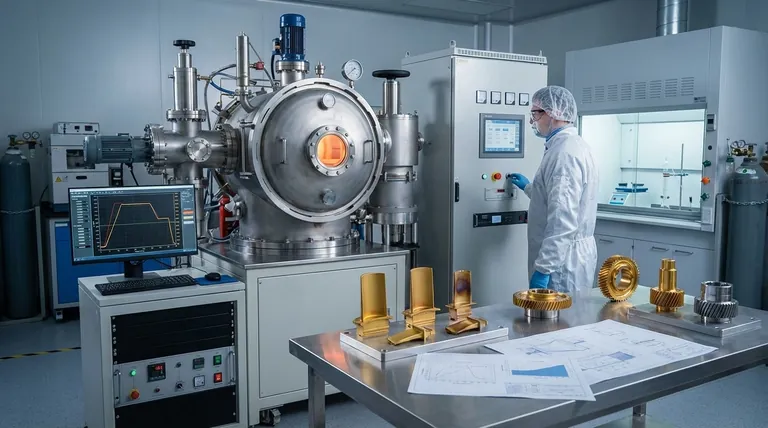
A high-temperature resistance furnace evaluates TiN (Titanium Nitride) coating reliability by subjecting components to cyclic oxidation testing. This method simulates the harsh, operational thermal cycles that aerospace and mechanical parts endure, often maintaining temperatures as high as 700 degrees Celsius for extended periods. This controlled exposure allows engineers to predict how the coating will perform under the stress of alternating heat and cold before the component is ever installed.
By forcing the coating and substrate to interact under extreme heat, this testing method reveals critical data regarding thermal expansion compatibility and chemical stability. It is the definitive way to verify if a coating will adhere or fail during actual service.
Simulating Real-World Environments
Replicating Operational Cycles
In aerospace and high-performance mechanics, components rarely operate at a static temperature. The high-temperature resistance furnace is designed to mimic actual working cycles.
By heating the component to specific set points (e.g., 700°C) and holding it there, the test replicates the thermal load of an engine or machine in operation.
Testing Chemical Stability
High temperatures accelerate chemical reactions. The furnace environment tests the chemical stability of the TiN coating.
If the coating is chemically unstable at high heat, it may degrade or oxidize rapidly. This test ensures the coating maintains its integrity even when pushed to its thermal limits.
Identifying Critical Failure Modes
Detecting Delamination and Spalling
The primary goal of this evaluation is to observe physical failure. Engineers look specifically for delamination (peeling) or spalling (chipping) of the coating.
If these defects appear after the heating cycle, it indicates a failure in the bond between the coating and the base material.
Verifying Thermal Expansion Compatibility
Failures in the furnace often point to a mismatch in thermal expansion. As the part heats up, the substrate and the TiN coating expand.
If they expand at significantly different rates, shear stress builds up at the interface. The furnace test effectively screens out material combinations that cannot expand and contract together without separating.
Optimizing the Manufacturing Process
Refining the Nitriding Process
Data from the resistance furnace is used to fine-tune production. It helps identify the optimal nitriding process required to achieve a robust bond.
By adjusting process parameters and re-testing in the furnace, manufacturers can engineer a coating application method that withstands extreme environmental variances.
Understanding the Trade-offs
Thermal Stress vs. Mechanical Stress
While a resistance furnace is excellent for testing thermal endurance, it primarily isolates thermal stress.
It does not simultaneously apply mechanical loads, such as vibration or friction, which are also present in aerospace applications. Therefore, while it proves thermal reliability, it should be part of a broader testing suite that includes mechanical stress testing.
Accelerated Testing Limitations
Furnace testing is often an accelerated lifecycle test. While it provides immediate feedback on alternating heat and cold, it is a simulation.
Real-world factors, such as rapid airflow or debris impact in an aerospace environment, may introduce variables that a static furnace cannot perfectly replicate.
Making the Right Choice for Your Goal
To utilize high-temperature resistance furnace testing effectively, align your testing parameters with your specific objectives:
- If your primary focus is Process Development: Use the furnace to compare different nitriding parameters to find the specific setup that eliminates spalling at 700°C.
- If your primary focus is Material Selection: Use the test to verify that the coefficient of thermal expansion of your chosen substrate is compatible with the TiN coating.
- If your primary focus is Quality Assurance: Implement cyclic testing on sample batches to ensure consistency in chemical stability across production runs.
Ultimately, the high-temperature resistance furnace provides the thermal "stress test" necessary to guarantee that critical components will not peel or fail when heat and pressure rise.
Summary Table:
| Evaluation Metric | Testing Purpose | Failure Indicators |
|---|---|---|
| Oxidation Testing | Simulates operational heat (up to 700°C) | Rapid degradation or chemical breakdown |
| Thermal Cycling | Replicates alternating heat/cold cycles | Delamination, peeling, or spalling |
| Interface Stability | Tests bond between coating and substrate | Shear stress failure at the interface |
| Process Tuning | Optimizes nitriding parameters | Inconsistent coating thickness or bonding |
Maximize Your Material Reliability with KINTEK
Precision testing requires precision equipment. KINTEK provides the high-performance thermal solutions necessary for rigorous aerospace and mechanical evaluations.
Why partner with KINTEK?
- Expert R&D & Manufacturing: Our systems are built to simulate the harshest operational environments.
- Comprehensive Selection: Choose from Muffle, Tube, Rotary, Vacuum, and CVD systems tailored for advanced material research.
- Fully Customizable: We design our lab high-temp furnaces to meet your unique thermal profile and substrate requirements.
Don't leave your coating integrity to chance. Contact KINTEK today to find the perfect furnace for your quality assurance needs!
References
- Zhen Liu, Yun Zhang. A Comparison Study on the Microstructure, Mechanical Features, and Tribological Characteristics of TiN Coatings on Ti6Al4V Using Different Deposition Techniques. DOI: 10.3390/coatings14020156
This article is also based on technical information from Kintek Furnace Knowledge Base .
Related Products
- 1400℃ High Temperature Laboratory Tube Furnace with Alumina Tube
- 1700℃ High Temperature Laboratory Tube Furnace with Alumina Tube
- 1700℃ Controlled Inert Nitrogen Atmosphere Furnace
- 1700℃ High Temperature Muffle Oven Furnace for Laboratory
- 1800℃ High Temperature Muffle Oven Furnace for Laboratory
People Also Ask
- How are high-temperature laboratory tube furnaces applied in long-term vacuum homogenization heat treatments for intermetallic samples?
- How are high-temp tube furnaces used to measure diffusion coefficients per Fick's law? Master Precision Annealing
- How do high-temperature laboratory tube furnaces ensure environmental stability? Precision Thermal Reduction Tips
- How are high-temperature tube furnaces applied in testing ceramic-supported alloy membranes? Insights
- What is the function of a furnace in CuAlMn alloy treatment? Achieve Perfect Microstructural Homogenization



















