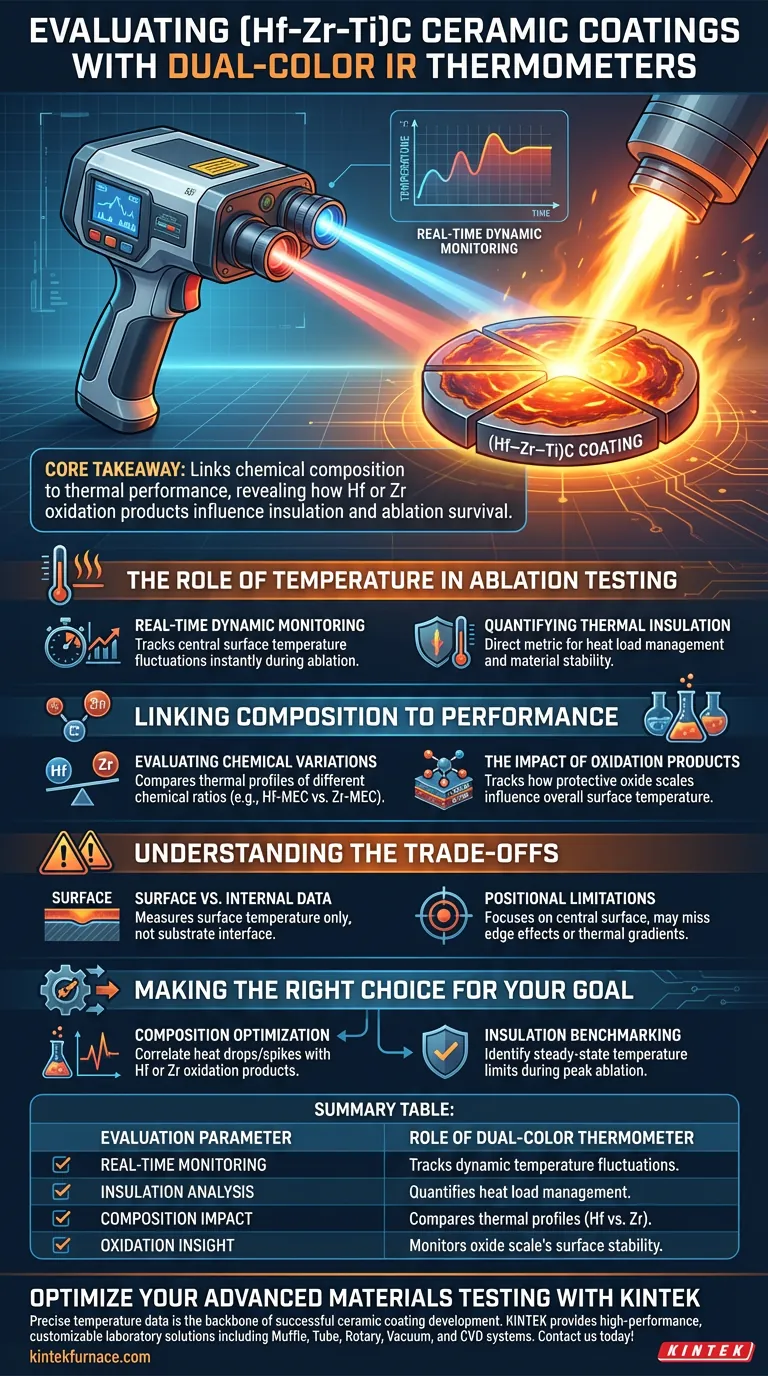
A dual-color infrared thermometer is utilized for the real-time dynamic monitoring of the central surface temperature of (Hf─Zr─Ti)C coatings during high-stress ablation testing. This device provides the critical data needed to quantify the coating's thermal insulation performance and evaluate how the material's surface evolves under extreme heat.
Core Takeaway By continuously tracking surface temperature, the dual-color infrared thermometer serves as the primary tool for linking chemical composition to thermal performance. It reveals how specific oxidation products—generated by elements like Hafnium or Zirconium—directly influence the coating's ability to insulate and survive ablation.

The Role of Temperature in Ablation Testing
Real-Time Dynamic Monitoring
The primary function of the thermometer is to track the central surface temperature of the ceramic coating while it is subjected to ablation.
Rather than providing a single data point, the device offers dynamic monitoring. This allows researchers to observe temperature fluctuations instantly as the test progresses.
Quantifying Thermal Insulation
The temperature data collected serves as a direct metric for thermal insulation performance.
By analyzing the surface temperature, researchers can infer how effectively the coating is managing heat load. A controlled or stabilized surface temperature often indicates effective insulation and material stability.
Linking Composition to Performance
Evaluating Chemical Variations
The thermometer is essential for comparing different chemical compositions, such as Hf-MEC versus Zr-MEC.
It allows researchers to empirically test how replacing specific elements (like substituting Zirconium for Hafnium) alters the thermal profile of the coating.
The Impact of Oxidation Products
The device does not just measure heat; it indirectly monitors chemical reactions.
As the coating oxidizes, it forms specific oxidation products on the surface. The thermometer tracks how these new surface layers affect the overall temperature, providing insight into the protective capabilities of the oxide scale.
Understanding the Trade-offs
Surface vs. Internal Data
It is important to note that this method measures surface temperature only.
While it effectively evaluates the outer defense of the coating, it does not directly measure the temperature at the substrate interface. This requires inference or additional instrumentation.
Positional Limitations
The measurement focuses on the central surface of the sample.
This provides a consistent baseline for comparison but may not capture edge effects or thermal gradients occurring at the periphery of the ablation zone.
Making the Right Choice for Your Goal
To effectively use this data for your materials engineering projects, consider your specific testing objectives:
- If your primary focus is Composition Optimization: Use the temperature data to correlate specific drops or spikes in heat with the presence of Hf or Zr oxidation products.
- If your primary focus is Insulation Benchmarking: Rely on the dynamic monitoring trends to identify the steady-state temperature limits of the coating during peak ablation.
Precise thermometry converts raw heat data into a clear understanding of material longevity and chemical stability.
Summary Table:
| Evaluation Parameter | Role of Dual-Color Thermometer |
|---|---|
| Real-Time Monitoring | Tracks dynamic temperature fluctuations during high-stress ablation. |
| Insulation Analysis | Quantifies how effectively the coating manages extreme heat loads. |
| Composition Impact | Compares thermal profiles between different chemical ratios (e.g., Hf vs. Zr). |
| Oxidation Insight | Monitors how the formation of oxide scales influences surface heat stability. |
Optimize Your Advanced Materials Testing with KINTEK
Precise temperature data is the backbone of successful ceramic coating development. Whether you are benchmarking insulation or optimizing chemical compositions for extreme environments, KINTEK provides the high-performance laboratory solutions you need.
Backed by expert R&D and manufacturing, KINTEK offers Muffle, Tube, Rotary, Vacuum, and CVD systems, along with specialized lab high-temp furnaces—all fully customizable to meet your unique research requirements. Our systems ensure the thermal stability and precision necessary to validate your most innovative materials.
Ready to elevate your thermal analysis? Contact us today to discuss your custom furnace needs!
Visual Guide
References
- Jiachen Li, Hejun Li. Twin Toughening‐Driven Martensitic Transformation Strategy Synergistic Improvement for Plasticity‐Thermal Shock Resistance of (Hf─Zr─Ti)C Ceramic Coating in Severe Thermal Environments. DOI: 10.1002/advs.202503226
This article is also based on technical information from Kintek Furnace Knowledge Base .
Related Products
- Multi Zone Laboratory Quartz Tube Furnace Tubular Furnace
- Multi Heating Zones CVD Tube Furnace Machine for Chemical Vapor Deposition Equipment
- High Temperature Muffle Oven Furnace for Laboratory Debinding and Pre Sintering
- Vertical Laboratory Quartz Tube Furnace Tubular Furnace
- Laboratory Quartz Tube Furnace RTP Heating Tubular Furnace
People Also Ask
- Why are multi zone tube furnaces particularly useful for nanomaterial research? Unlock Precise Thermal Control for Advanced Synthesis
- What temperature-related capabilities make multi zone tube furnaces valuable for research? Unlock Precision Thermal Control
- What environmental protection applications utilize multi zone tube furnaces? Unlock Precision in Waste Treatment and Green Tech
- What role do multi zone tube furnaces play in new energy research? Unlock Precise Thermal Control for Innovation
- What are the main applications of multi zone tube furnaces in university laboratories? Unlock Precision in Material Science and Energy Research