
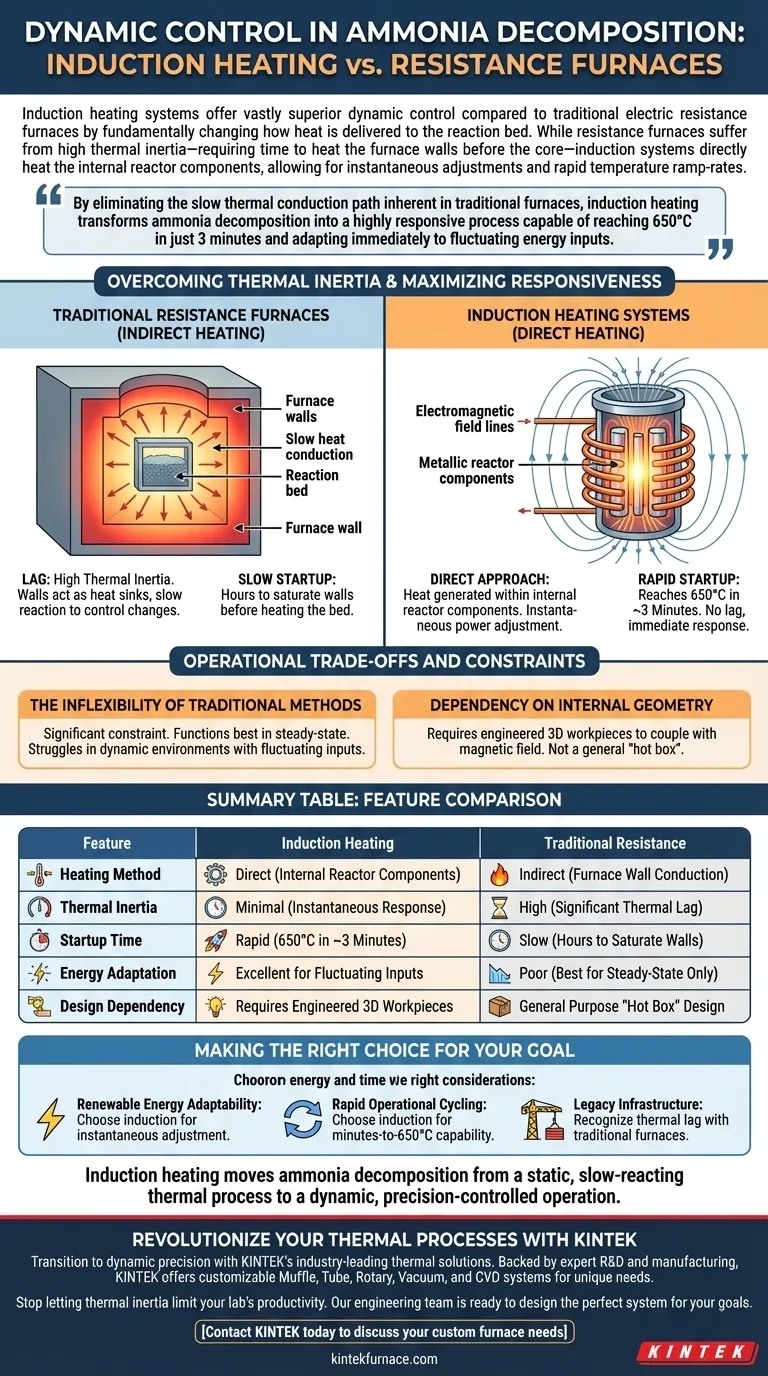
Induction heating systems offer vastly superior dynamic control compared to traditional electric resistance furnaces by fundamentally changing how heat is delivered to the reaction bed. While resistance furnaces suffer from high thermal inertia—requiring time to heat the furnace walls before the core—induction systems directly heat the internal reactor components, allowing for instantaneous adjustments and rapid temperature ramp-rates.
By eliminating the slow thermal conduction path inherent in traditional furnaces, induction heating transforms ammonia decomposition into a highly responsive process capable of reaching 650°C in just 3 minutes and adapting immediately to fluctuating energy inputs.
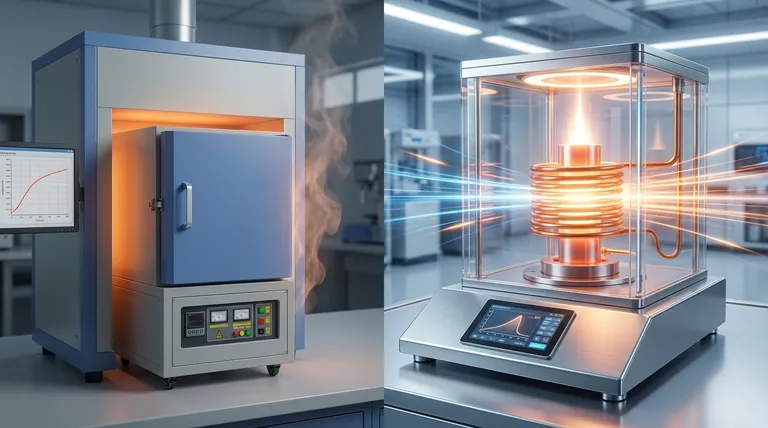
Overcoming Thermal Inertia
The Lag of Resistance Furnaces
Traditional electric resistance furnaces operate on an indirect heating principle. The system must first heat the massive furnace walls, which then slowly transfer heat to the reaction bed via conduction.
This process creates high thermal inertia. The furnace walls act as a heat sink, preventing the system from reacting quickly to changes in control settings.
The Direct Approach of Induction
In contrast, induction heating systems bypass the furnace structure entirely. They generate heat directly within the internal reactor components (the 3D workpieces).
This eliminates the need to heat the containment vessel first. By removing the slow thermal conduction path, energy is delivered exactly where it is needed without delay.
Speed and Responsiveness
Rapid Startup Capabilities
The most tangible benefit of direct heating is the dramatic reduction in startup time. Because the system does not need to saturate the furnace walls with heat, it reaches operating temperature quickly.
Specifically, an induction system can ramp from room temperature to 650°C in approximately 3 minutes.
Instantaneous Power Adjustment
Control in an induction system is virtually instantaneous. Because the heat is generated inside the workpiece, the thermal output is directly locked to the power input.
When the power input changes, the heat generation changes immediately. There is no lag time while waiting for heating elements or walls to cool down or warm up.
Operational Trade-offs and Constraints
The Inflexibility of Traditional Methods
The high thermal inertia of resistance furnaces acts as a significant operational constraint. They function best in steady-state operations where variables rarely change.
They struggle significantly in dynamic environments. If energy input drops or process requirements shift, the system responds too slowly to maintain optimal conditions.
Dependency on Internal Geometry
Induction systems rely on specific internal reactor components to function. The efficiency cited—such as the 3-minute startup—is dependent on these 3D workpieces being designed to couple effectively with the magnetic field.
Unlike a resistance furnace which acts as a general "hot box," induction requires an engineered approach to the internal reaction bed to achieve these results.
Making the Right Choice for Your Goal
To select the correct heating methodology for your ammonia decomposition application, consider your operational constraints:
- If your primary focus is adaptability to renewable energy: Choose induction heating, as its ability to instantaneously adjust to power input allows you to handle fluctuating energy sources effectively.
- If your primary focus is rapid operational cycling: Choose induction heating to leverage the capability of reaching 650°C in minutes rather than hours.
- If your primary focus is utilizing legacy infrastructure: Recognize that traditional resistance furnaces will limit your ability to react to process changes due to their inherent thermal lag.
Induction heating moves ammonia decomposition from a static, slow-reacting thermal process to a dynamic, precision-controlled operation.
Summary Table:
| Feature | Induction Heating Systems | Traditional Resistance Furnaces |
|---|---|---|
| Heating Method | Direct (Internal Reactor Components) | Indirect (Furnace Wall Conduction) |
| Thermal Inertia | Minimal (Instantaneous Response) | High (Significant Thermal Lag) |
| Startup Time | Rapid (650°C in ~3 Minutes) | Slow (Hours to Saturate Walls) |
| Energy Adaptation | Excellent for Fluctuating Inputs | Poor (Best for Steady-State Only) |
| Design Dependency | Requires Engineered 3D Workpieces | General Purpose "Hot Box" Design |
Revolutionize Your Thermal Processes with KINTEK
Transition from static heating to dynamic precision with KINTEK’s industry-leading thermal solutions. Backed by expert R&D and world-class manufacturing, KINTEK offers a comprehensive range of Muffle, Tube, Rotary, Vacuum, and CVD systems, along with other specialized lab high-temp furnaces—all fully customizable to meet your unique ammonia decomposition and material science requirements.
Stop letting thermal inertia limit your lab's productivity. Whether you need rapid operational cycling or adaptability to renewable energy sources, our engineering team is ready to design the perfect system for your goals.
Contact KINTEK today to discuss your custom furnace needs
Visual Guide
References
- Débora de Figueiredo Luiz, Jurriaan Boon. Use of a 3D Workpiece to Inductively Heat an Ammonia Cracking Reactor. DOI: 10.3390/suschem6040043
This article is also based on technical information from Kintek Furnace Knowledge Base .
Related Products
- 600T Vacuum Induction Hot Press Vacuum Heat Treat and Sintering Furnace
- Vacuum Induction Melting Furnace
- Electric Rotary Kiln Continuous Working Small Rotary Furnace Kiln for Pyrolysis Plant Heating
- Multi Heating Zones CVD Tube Furnace Machine for Chemical Vapor Deposition Equipment
- Vacuum Heat Treat Furnace with Ceramic Fiber Liner
People Also Ask
- Why use Vacuum Hot Press (VHP) for ZnS Ceramics? Achieve Superior IR Transparency and Mechanical Strength
- How does a vacuum hot press sintering furnace mitigate copper sintering swelling? Solve Fe-Cu Expansion Issues
- What are the benefits of using a vacuum hot press sintering furnace for the preparation of SiCw/2024 aluminum matrix composites? Achieve High-Performance Aerospace Materials
- What are the key advantages of vacuum hot press sintering furnaces? Achieve Superior Density and Purity in Materials
- How does the vacuum environment in a vacuum hot press sintering furnace protect chromium-containing ceramics? Find out.





