
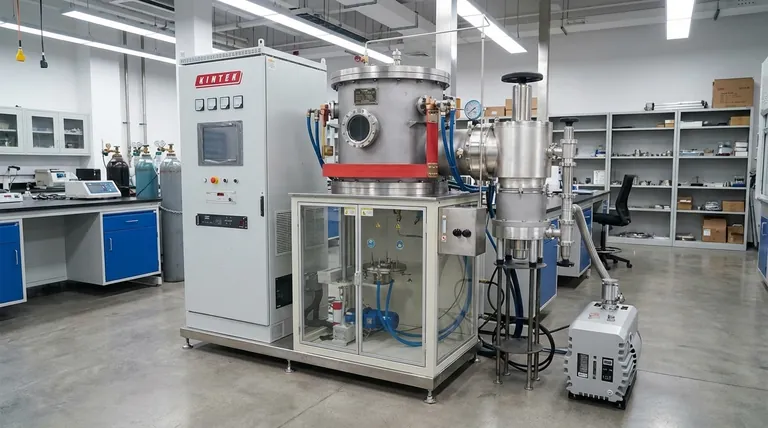
The primary function of a vacuum induction furnace in processing Fe-C-B-Cr-W alloys is to ensure compositional precision through a controlled melting environment. By operating under a vacuum or a partial pressure argon atmosphere (typically 500 mbar), the furnace prevents the oxidation of reactive elements while utilizing electromagnetic induction to vigorously stir the melt. This stirring action is critical for overcoming significant density differences between elements, ensuring a homogeneous alloy suitable for laboratory analysis.
The core value of this process lies in its dual ability to shield the melt from atmospheric contamination while mechanically forcing heavy elements like tungsten to mix uniformly with lighter components, establishing a flawless foundation for microstructure analysis.
Solving the Homogeneity Challenge
The Fe-C-B-Cr-W alloy system presents a specific physical challenge: the extreme variance in atomic density between its components.
Overcoming Density Disparities
Tungsten (W) is significantly denser than iron (Fe), carbon (C), or boron (B). Without active intervention, tungsten tends to settle at the bottom of the crucible, leading to segregation. Vacuum induction melting addresses this by generating strong convection currents within the molten pool.
The Mechanism of Electromagnetic Stirring
The induction heating process creates an electromagnetic field that does more than just heat the metal; it induces a physical stirring effect. This continuous movement forces the heavy tungsten and the lighter boron to circulate throughout the iron matrix. The result is a chemically uniform ingot where every section of the casting reflects the intended nominal composition.
Ensuring Chemical Purity and Control
In a laboratory setting, the goal is often to study the intrinsic properties of the material, which requires the elimination of external variables like impurities.
Preventing Oxidation
Active elements within the alloy, such as chromium (Cr) and carbon (C), are prone to oxidation if exposed to air at melting temperatures. The furnace removes oxygen from the chamber, preventing the loss of these elements to slag or gas. This ensures the final alloy retains the exact chemical ratio calculated by the researcher.
Managing the Atmosphere
While the "vacuum" aspect is critical for degassing, the process often utilizes a controlled argon atmosphere (e.g., 500 mbar) during the melt. This backfilled pressure helps suppress the evaporation of volatile elements that might otherwise vaporize in a hard vacuum. It creates a stable environment that balances purity with compositional stability.
Removal of Impurity Gases
The vacuum environment actively pulls dissolved gases, such as nitrogen and oxygen, out of the molten metal. Reducing these gaseous impurities minimizes the formation of non-metallic inclusions. This results in a "clean" microstructure, essential for accurately assessing the alloy's mechanical and thermal performance.
Understanding the Trade-offs
While vacuum induction melting is the gold standard for laboratory precision, it is not without operational constraints.
Batch Size vs. Homogeneity
The electromagnetic stirring effect is highly efficient in the compact crucible sizes used in laboratories. However, as scale increases, ensuring the same level of homogeneity requires significantly more power and complex thermal management. For laboratory castings, the trade-off is accepting smaller batch sizes to guarantee the absolute highest fidelity in chemical composition.
Complexity of Process Control
Achieving the correct balance between vacuum pressure and argon backfill requires precise calibration. If the pressure is too low, volatile components may evaporate; if too high, the degassing efficiency drops. Operators must strictly adhere to protocols (like the 500 mbar standard) to maintain consistency across different experimental heats.
Making the Right Choice for Your Research
To maximize the utility of your Fe-C-B-Cr-W alloy samples, align your melting parameters with your analytical goals.
- If your primary focus is Microstructural Analysis: Prioritize the electromagnetic stirring phase to ensure tungsten and boron are perfectly distributed, preventing localized segregation that could skew microscopy results.
- If your primary focus is Mechanical Property Testing: Ensure the vacuum degassing cycle is sufficient to remove oxides and nitrogen, as these inclusions serve as crack initiation points that will artificially lower strength data.
- If your primary focus is Alloy Formulation: Strictly control the argon backfill pressure (e.g., 500 mbar) to prevent the volatilization of specific elements, ensuring the final ingot matches your theoretical stoichiometry.
Ultimately, the vacuum induction furnace transforms a mixture of disparate raw materials into a single, scientifically valid material system by substituting gravity with magnetic force and atmosphere with inert gas.
Summary Table:
| Feature | Function in Fe-C-B-Cr-W Melting | Benefit to Researcher |
|---|---|---|
| Electromagnetic Stirring | Overcomes density differences (e.g., Tungsten) | Ensures chemical homogeneity |
| Vacuum Environment | Removes dissolved gases (O2, N2) | Minimizes non-metallic inclusions |
| Argon Atmosphere (500 mbar) | Suppresses evaporation of volatile elements | Maintains exact stoichiometry |
| Controlled Environment | Prevents oxidation of Cr and C | Protects alloy purity and integrity |
Elevate Your Materials Research with KINTEK
Precision in alloy formulation begins with the right thermal environment. Backed by expert R&D and manufacturing, KINTEK offers high-performance Vacuum Induction, Muffle, Tube, Rotary, and CVD systems, all fully customizable to meet the rigorous demands of laboratory melting and heat treatment. Whether you are solving homogeneity challenges in dense alloys or requiring ultra-clean vacuum environments, our systems deliver the control you need to ensure scientific validity.
Ready to optimize your lab's melting process? Contact KINTEK today for a customized solution
References
- H. SCHAEFER, Sebastian Weber. Microstructure Formation in Hypoeutectic Alloys in the Fe–C–B–Cr–W System. DOI: 10.1007/s11661-024-07675-3
This article is also based on technical information from Kintek Furnace Knowledge Base .
Related Products
- 600T Vacuum Induction Hot Press Vacuum Heat Treat and Sintering Furnace
- Vacuum Induction Melting Furnace
- Small Vacuum Heat Treat and Tungsten Wire Sintering Furnace
- Vacuum Hot Press Furnace Machine Heated Vacuum Press Tube Furnace
- High Pressure Laboratory Vacuum Tube Furnace
People Also Ask
- Why use Vacuum Hot Press (VHP) for ZnS Ceramics? Achieve Superior IR Transparency and Mechanical Strength
- How does a vacuum hot press sintering furnace mitigate copper sintering swelling? Solve Fe-Cu Expansion Issues
- What is the core function of a vacuum hot press sintering furnace in the preparation of high-density RuTi alloys? Achieve Maximum Density and Purity
- What are the benefits of using a vacuum hot press sintering furnace for the preparation of SiCw/2024 aluminum matrix composites? Achieve High-Performance Aerospace Materials
- What are the key advantages of vacuum hot press sintering furnaces? Achieve Superior Density and Purity in Materials



















