
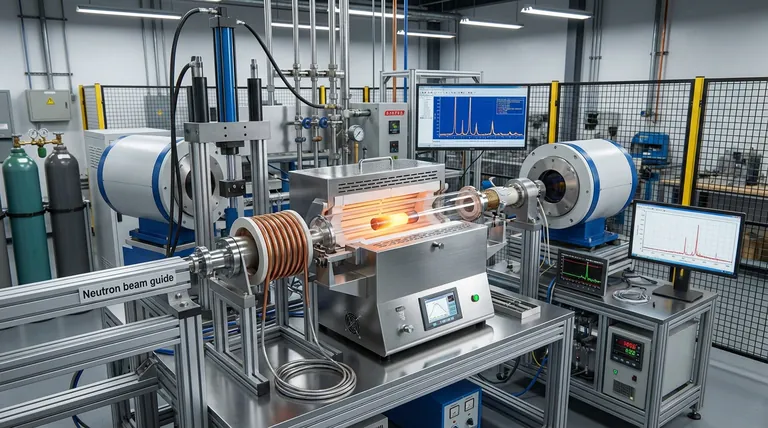
The integration of in-situ neutron diffraction with high-frequency induction heating and deformation devices provides a critical solution to the "black box" problem of high-temperature metallurgy. It enables the observation of microstructural evolution—specifically austenite dislocations—in real-time, eliminating the need to quench samples before analysis.
By bypassing the structural alterations caused by cooling, this system allows researchers to distinguish between defects formed during high-temperature deformation and those created during the final phase transformation.
Overcoming the "Quench" Limitation
The Blind Spot of Traditional Analysis
Historically, studying high-temperature material states required quenching (rapid cooling) to "freeze" the microstructure for analysis.
However, this process inherently alters the material, often triggering phase transformations (such as austenite to martensite) that obscure the original high-temperature state.
Real-Time Observation
The integrated system solves this by placing the sample within a neutron beam while it is simultaneously heated and deformed.
This allows for the acquisition of diffraction patterns during the process, providing a direct view of the material's behavior as it happens.
Unlocking Mechanisms in Fe-Mn-C Alloys
Differentiating Dislocation Sources
A primary application of this technology is the precise differentiation of dislocation quantities in alloys like Fe-5%Mn-C.
Researchers can separate the dislocations introduced during the austenite phase from the total dislocation density found in the final martensite structure.
Revealing Inheritance Mechanisms
This separation is vital for understanding "dislocation inheritance," or how defects in the hot phase transfer to the cold phase.
Specifically, this system has revealed the locking mechanism of carbon elements during this inheritance process, a phenomenon impossible to isolate using post-mortem analysis.
Understanding the Trade-offs
System Complexity and Access
While powerful, this approach requires access to a neutron source, which is a scarce and expensive resource compared to standard laboratory X-ray equipment.
Specificity of Application
This setup is highly specialized for understanding dynamic mechanisms and phase evolution.
It is less suited for high-throughput screening of materials where simple mechanical property data (like yield strength) is the only metric required.
Making the Right Choice for Your Research
This integrated system is a sophisticated tool designed for fundamental mechanistic discovery rather than routine testing.
- If your primary focus is uncovering fundamental mechanisms: Use this system to isolate high-temperature behaviors, such as carbon locking and dislocation inheritance, without the interference of phase transformations.
- If your primary focus is final material properties: Traditional mechanical testing combined with post-mortem microscopy may be sufficient and more cost-effective.
The true power of this system lies in its ability to turn the invisible, high-temperature history of a metal into quantifiable, real-time data.
Summary Table:
| Feature | Traditional Post-Mortem Analysis | In-Situ Integrated System |
|---|---|---|
| Observation Timing | After quenching (delayed) | Real-time (during deformation) |
| Microstructure State | Often altered by phase transformation | Original high-temp state preserved |
| Key Insight | Total final dislocation density | Distinct high-temp vs. phase-change defects |
| Primary Benefit | Cost-effective routine testing | Fundamental mechanism discovery |
| Technical Challenge | Cooling obscures original data | High complexity; requires neutron source |
Unlock the Secrets of High-Temperature Metallurgy
Struggling to visualize what happens inside your materials during extreme thermal and mechanical stress? KINTEK provides the advanced heating solutions necessary for cutting-edge research. Backed by expert R&D and manufacturing, we offer high-performance Muffle, Tube, Rotary, Vacuum, and CVD systems, all customizable to integrate with your specialized lab equipment.
Whether you are investigating dislocation inheritance or optimizing phase transformations, our technical experts are ready to help you build the perfect thermal environment for your unique needs. Contact KINTEK today to enhance your lab’s capabilities and turn invisible metallurgical histories into quantifiable data.
References
- Change in Dislocation Density via Ausforming in Fe-5%Mn-C Alloy with Lath Martensitic Structure. DOI: 10.2355/isijinternational.isijint-2025-090
This article is also based on technical information from Kintek Furnace Knowledge Base .
Related Products
- Vacuum Induction Melting Furnace
- 600T Vacuum Induction Hot Press Vacuum Heat Treat and Sintering Furnace
- Multi Heating Zones CVD Tube Furnace Machine for Chemical Vapor Deposition Equipment
People Also Ask
- What are the core functions of the High Vacuum Induction Melting (VIM) furnace? Optimize DD5 Superalloy Purification
- What are the technical advantages of using a Vacuum Induction Melting furnace in the development of advanced packaging steel?
- What are the advantages of using a VIM furnace to control residual oxygen pressure? Achieve Superior Metal Uniformity
- What is the role of VIM and directional solidification in aero-engine blade substrates? Engineering Extreme Durability
- What role does a Vacuum Induction Melting furnace play in the production of high-aluminum nickel-based superalloys?


