The key to unlocking rapid densification and durable bonding in liquid-phase sintering lies in a single property: how well the liquid wets the solid particles.
Wettability, measured by the contact angle using the sessile drop method, directly governs the capillary forces that pull grains together and fill pores. A lower contact angle means the liquid spreads readily across solid surfaces, generating strong compressive capillary pressure that accelerates particle rearrangement and pore elimination. This same wetting behavior ensures a continuous liquid film at grain boundaries, which promotes mass transport by solution-precipitation and, upon cooling, yields strong solid‑solid bonds throughout the compact.
Core Takeaway: Wettability is not a simple on/off switch. Its true influence on densification and bonding emerges from its interaction with dihedral angle, liquid volume fraction, and viscosity. A low contact angle delivers the capillary suction needed for rapid densification, but only a careful balance of all these factors in a laboratory furnace prevents slumping or swelling. Mastering this balance is what turns a porous green body into a dense, well‑bonded component.
The Mechanics: How Wettability Drives Densification
The Capillary Engine: Why a Lower Contact Angle Accelerates Sintering
During liquid‑phase sintering, the wetting angle between the liquid and the solid grains determines the sign and magnitude of capillary forces.
When the contact angle is low (e.g., ~10°), the liquid forms concave menisci with a small radius of curvature. This generates strong compressive capillary pressure that literally pulls particles together, driving the initial rearrangement stage of densification.
The result is rapid shrinkage and high final density. In contrast, high contact angles (>60°–90°) create flat or convex menisci, generating repulsive capillary forces that cause the compact to swell instead of densify.
Bonding Through Liquid Films: From Rearrangement to Solid-State Necks
Wettability also shapes the quality of interparticle bonding. A low contact angle ensures the liquid phase penetrates between grains, coating every solid-solid interface.
This continuous liquid film serves as a fast diffusion path for solution‑precipitation—atoms dissolve from smaller or high‑curvature grains and reprecipitate at neck regions.
The result is a dense, strong solid‑solid bond after cooling. High wettability thus transforms the liquid from a mere pore filler into a dynamic mass‑transport medium that bridges grains.
The Unsung Parameter: Dihedral Angle’s Role in Meniscus Shape
At the junction where two solid grains meet a liquid pocket, the dihedral angle (ψ) dictates how the liquid penetrates grain boundaries.
A dihedral angle near 0° means the liquid can completely penetrate solid‑solid grain boundaries, destroying the solid skeleton and causing slumping or shape distortion.
However, for a fixed wetting angle, a moderately increased dihedral angle enlarges the radius of the liquid meniscus. This larger meniscus effectively widens the liquid channels, allowing faster liquid flow into pores and enhancing densification—provided the dihedral angle stays well below the critical threshold for swelling.
The Critical Interplay of Processing Variables
Liquid Volume Fraction: The Arithmetic of Densification
Wettability’s effect is not uniform; it scales with how much liquid is present. A larger liquid volume fraction increases the meniscus radius for a given grain size, dramatically accelerating densification kinetics (often proportional to the cube of the liquid fraction).
When the liquid fraction exceeds 36% by volume, particle rearrangement alone can theoretically achieve full density—no solution‑precipitation needed. Below this threshold, rearrangement is insufficient, and secondary mechanisms must finish the job.
At very low liquid contents (<2–3 vol%), the liquid cannot effectively lubricate particle surfaces, making rearrangement difficult. In such cases, even excellent wettability fails to deliver full density if a rigid solid‑state skeleton forms first.
Viscosity: The Hidden Governor of Particle Rearrangement
The viscosity of the liquid phase determines how particles move under capillary forces. A very low viscosity (e.g., 1 mPa·s) allows particles to bounce and rearrange so freely that they form a rigid skeleton and rounded pores that are difficult to eliminate.
Surprisingly, a higher liquid viscosity (e.g., 100 mPa·s) restricts local particle motion, leading to uniform contraction and crack‑shaped pores. These sharp‑tipped pores are far easier for capillary action to fill and close.
Thus, the ideal liquid for high densification is not necessarily the most fluid; instead, a moderate viscosity that promotes uniform contraction often yields a higher final density.
Furnace Atmosphere and Temperature: The Enablers of Controlled Wetting
In a high‑temperature laboratory furnace, atmosphere composition, temperature uniformity, and heating profile directly control wettability. A precisely controlled reducing or inert atmosphere can lower the contact angle by cleaning particle surfaces and altering surface tension.
Uniform chamber heating prevents local temperature differences that would create uneven liquid formation, leading to microstructural defects.
Programmed thermal cycles, with an initial ramp to a temperature just above the liquidus, create the liquid at the right moment—ensuring liquid formation after some solid‑state necking has provided a stable skeleton, thereby avoiding immediate slumping while still benefiting from eventual capillary densification.
Understanding the Trade‑offs
The pursuit of perfect wetting is not without risk. A contact angle that is too low, combined with a very low dihedral angle, can cause the liquid to penetrate grain boundaries completely, eliminating all solid‑solid contacts and causing the component to slump.
At the opposite extreme, a high wetting angle stalls densification and produces weak, porous structures. Even well‑balanced systems can suffer if the liquid volume fraction is mismatched—too much liquid reduces shape stability, while too little liquid prevents rearrangement.
Furthermore, optimizing for a low contact angle through atmosphere control may introduce impurities that degrade grain boundary strength or alter the liquid’s viscosity. Every decision is a compromise.
Making the Right Choice for Your Laboratory Sintering Process
The wealth of interdependent variables can feel overwhelming, but a goal‑oriented approach simplifies the challenge. Tailor your furnace recipe and powder composition to the outcome that matters most.
- If your primary focus is rapid, high‑density sintering with minimal cycle time: Formulate the liquid volume fraction to exceed 15–20 vol% and target a contact angle below 30° through atmosphere control. Accept a slightly higher risk of minor shape distortion if the setter can support the part.
- If your primary focus is achieving the highest possible final density with a narrow dihedral angle window: Use a liquid with moderate viscosity (around 100 mPa·s) and maintain a dihedral angle that is low enough for strong capillary pressure but above the 0° slumping threshold. Preheat to form a stabilizing solid skeleton before liquid formation.
- If your primary focus is strict dimensional precision and avoiding slumping: Keep the liquid volume fraction well below 36% and ensure the dihedral angle is sufficiently high (e.g., >10°‑20°) to preserve a solid‑solid skeleton. Use a heating profile that delays full wetting until initial necks are established.
- If your primary focus is maximizing bonding strength for load‑bearing applications: Prioritize a low contact angle to maintain a continuous intergranular liquid film during sintering, and follow with a controlled cooling stage that allows solute to precipitate and form strong solid‑state bridges. Verify atmosphere purity to prevent interfacial contamination.
Every variable in liquid‑phase sintering is a lever—pull the right combination, and you turn a heap of powder into a dense, resilient part.
Summary Table:
| Parameter / Variable | Optimal Target / Condition | Primary Impact on Sintering | Risk of Imbalance |
|---|---|---|---|
| Contact Angle (θ) | Low (< 30°) | Generates strong compressive capillary pressure to pull grains together and form liquid films. | High angle (> 60°) creates repulsive capillary forces, causing compact swelling. |
| Dihedral Angle (ψ) | Moderate (> 0°, carefully controlled) | Widens liquid channels for faster flow into pores while maintaining a solid skeleton. | Dihedral angle ~0° fully penetrates grain boundaries, destroying skeleton and causing slumping. |
| Liquid Volume Fraction | 15–36 vol% | Accelerates rearrangement kinetics (rearrangement alone can fully densify at > 36%). | Extremely low (< 3%) stalls rearrangement; excessive volume leads to loss of dimensional stability. |
| Liquid Viscosity | Moderate (~100 mPa·s) | Restricts irregular particle motion, yielding sharp, easily closed pores and uniform contraction. | Very low viscosity (1 mPa·s) leads to early rigid skeleton formation and persistent round pores. |
| Atmosphere & Temp | Reducing/Inert, precise thermal ramp | Cleans particle surfaces to lower contact angle; establishes solid necks before liquid formation. | Uneven heating causes localized liquid pooling, thermal gradients, and microstructural defects. |
Optimize Your Liquid-Phase Sintering Process with KINTEK
Achieving precise densification and strong interparticle bonding requires absolute control over chamber atmosphere, thermal uniformity, and heating profiles. KINTEK specializes in high-performance laboratory equipment and consumables, delivering customizable high-temperature furnaces engineered to meet your exact material research needs.
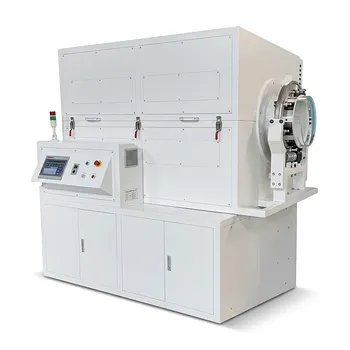
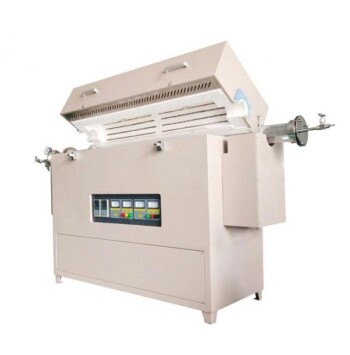
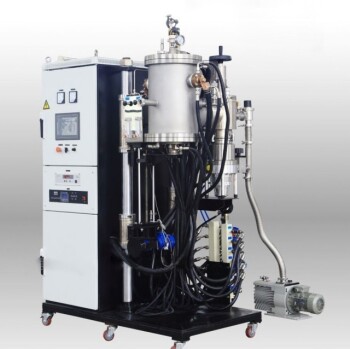
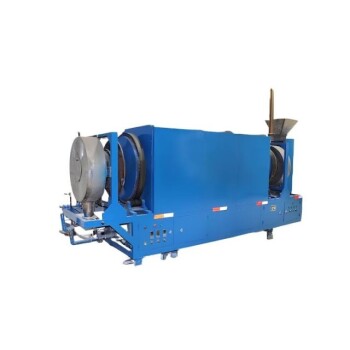
Our extensive line includes atmosphere, vacuum, tube, muffle, CVD, rotary, dental, and induction melting furnaces—all designed to give you precise control over surface tension, wettability, and phase transformations during sintering.
Take control of your sintering results today. Contact KINTEK experts now to discover how our tailored furnace solutions can enhance your lab's efficiency and product quality!
Related Products
- Laboratory Quartz Tube Furnace RTP Heating Tubular Furnace
- Laboratory Muffle Oven Furnace with Bottom Lifting
- Laboratory Vacuum Tilt Rotary Tube Furnace Rotating Tube Furnace
- 1200℃ Muffle Oven Furnace for Laboratory
- 1400℃ High Temperature Laboratory Tube Furnace with Alumina Tube
People Also Ask
- What physical conditions does a laboratory Tube Furnace provide for SOEC? Precision Heat for Solid Oxide Characterization
- What are the main features and functions of a laboratory tube furnace? Unlock Precise High-Temp Control for Your Lab
- What conditions does a tube furnace provide for post-ion-implantation? Achieve Precise Microstructural Repair
- What role does a laboratory tube furnace play in geological and mineralogical research? Unlock Earth's Secrets with Precision
- What parameters must be controlled when calcining freeze-dried oxide precursors in a laboratory tube furnace? A Guide