Controlling the calcination of freeze-dried oxide precursors comes down to precise temperature management, atmosphere regulation, and furnace geometry. The starting salts (like zinc nitrate) must decompose completely into the target oxide without triggering hard agglomerates or excessive crystallite growth. For example, a 2-hour hold at 275 °C in air can yield single-phase hexagonal ZnO crystals around 25 nm while preserving high reactivity—provided the tube furnace delivers uniform heating and steady airflow.
Calcination turns a delicate, porous precursor into a reactive ceramic powder. The goal is to drive off volatiles and crystallize the oxide while locking in small particle sizes. This demands control over temperature profile, hold time, gas composition, and flow uniformity—all within a furnace design that minimizes temperature gradients and contamination.
The Essential Process Parameters
Temperature Profile and Soak Time
The freeze-dried precursor is a highly porous, amorphous or weakly crystalline solid. Decomposition and crystallization are thermally activated, so the heating profile directly dictates phase purity and crystallite size.
Low-temperature precision is critical. At just 275 °C, nitrate-based precursors can fully transform into the oxide phase. This low thermal budget allows crystallization without rapid grain coarsening. Deviating even 25 °C can shift the balance between incomplete conversion and unwanted sintering.
A defined soak time completes the reaction. The primary reference uses 2 hours. This dwell period ensures that outgassing is finished and no residual organic or nitrate groups remain. Cutting the soak short risks incomplete decomposition, while extending it can promote inter-particle neck formation.
Heating rate influences agglomeration. A rapid ramp can cause violent decomposition, fragmenting the porous precursor into irregular clumps. A controlled, moderate rate (often 2–5 °C/min) allows gases to escape gently and preserves the fine pore structure.
Atmosphere Management
The gas environment inside the tube determines the decomposition pathway and end-product stoichiometry.
Air is the default for forming stoichiometric oxides. In the zinc nitrate example, air supplies oxygen to fully oxidize the metal and burn off organics. A continuous flow sweeps away reaction byproducts, preventing re‑adsorption.
Inert or reducing atmospheres may be needed for special cases. While not the primary scenario, if the precursor contains dopants or if a sub‑oxide is desired, switching to argon or a forming gas becomes essential. The key is to maintain a strict protective environment—impurities like oxygen leaks can alter the oxidation state.
Steady gas flow prevents localized pressure buildup. The decomposition releases gases. A laminar, low-turbulence flow ensures those volatiles are carried out rather than getting trapped, which would cause uneven reaction or even mechanical disruption of the powder bed.
Furnace Geometry and Thermal Uniformity
Not all tube furnaces are equal. The physical design directly impacts how evenly the precursor sees temperature and atmosphere.
A horizontal tube furnace is preferred for powder batches. It provides a long, stable thermal flat zone where the sample boat can sit. This minimizes temperature gradients that would otherwise lead to a mixture of under‑ and over‑calcined material.
Airflow must be symmetric and consistent. With a horizontal setup, the inlet and outlet align naturally with the tube axis, giving a smooth gas sweep over the powder bed. That prevents “hot spots” caused by stagnant gas pockets and helps avoid premature hard agglomeration.
Placement inside the furnace matters. The sample should rest in the calibrated uniform zone. Even small offsets can expose the powder to temperature drops of tens of degrees, changing the final crystallite size and reactivity.
Understanding the Trade-offs
Small Crystallites vs. Full Decomposition
Lower temperatures (e.g., 275 °C) and shorter soaks keep crystallites small (~25 nm) but may leave behind trace carbon or nitrate if the precursor is not fully decomposed. Pushing the temperature higher guarantees complete reaction at the cost of grain coarsening, which reduces powder sinterability later.
Atmosphere Purity vs. Process Simplicity
Using static air in a simple muffle furnace is tempting but fails to remove evolved gases. A flowing atmosphere—even just compressed air—greatly improves reproducibility, yet it requires careful flow‑rate control. Too high a flow can entrain light powder, while too low defeats the purpose.
Uniformity vs. Throughput
A long, narrow tube with a generous uniform zone ensures every particle sees the same history, but it limits how much powder can be calcined in one run. Scaling up to a rotary tube furnace can increase capacity, but rotation speed, tilt angle, and gas sealing become additional parameters that must be optimized.
How to Apply This to Your Project
The exact parameter set depends on whether your priority is phase purity, nanoscale size, or process throughput.
- If your primary focus is achieving the smallest possible crystallites: Use a low calcination temperature (250–300 °C), a moderate heating ramp (2–3 °C/min), and a soak just long enough for complete decomposition (1–2 hours) in flowing air. Check for any residual precursor by TGA or FTIR, not just by eye.
- If your primary focus is guaranteed full decomposition and single‑phase oxide: Increase the soak time slightly or step the temperature in stages—first a low-temperature hold to remove the bulk of volatiles, then a brief higher hold (e.g., 400 °C) to finish the reaction. Always maintain airflow to flush out gases.
- If your primary focus is minimizing hard agglomeration: Use a horizontal tube with a deep sample boat, a gentle gas flow rate, and avoid high heating rates that cause rapid internal pressure spikes. Consider adding a pre‑drying step below 150 °C if the freeze‑dried powder absorbed moisture.
- If your primary focus is scaling up while keeping reproducibility: Invest in a furnace with a well‑characterized uniform zone, real‑time pressure and flow monitoring, and record the temperature profile with a witness thermocouple. Regularly check the exhaust for bubbles to confirm the gas path is unobstructed.
Precise control of these parameters transforms a fragile, salt‑laden precursor into a consistent, high‑purity oxide powder ready for downstream processing.
Summary Table:
| Calcination Parameter | Recommended Setting / Control | Impact on Final Powder |
|---|---|---|
| Temperature & Ramp | Low temp (e.g., 275 °C), 2–5 °C/min ramp | Prevents grain coarsening and violent outgassing |
| Soak Time | 1–2 hours dwell time | Ensures complete volatile removal without particle necking |
| Atmosphere & Flow | Continuous laminar flow (Air, Inert, or Reducing) | Sweeps away byproducts and controls oxidation state |
| Furnace Geometry | Horizontal tube furnace with uniform flat zone | Prevents thermal gradients and ensures homogeneous calcination |
Ready to optimize your powder synthesis with precise thermal control? At KINTEK, we specialize in high-performance laboratory equipment tailored for advanced material processing. Our extensive line of customizable tube furnaces, high-temperature atmosphere furnaces, vacuum systems, and rotary furnaces are engineered to provide exceptional temperature uniformity and reliable atmosphere regulation.
Whether you require customized heating zones for research or scalable equipment for production, KINTEK offers the precise thermal solutions and expert technical support you need. Contact KINTEK today to build your ideal custom furnace solution!
Related Products
- 1400℃ High Temperature Laboratory Tube Furnace with Alumina Tube
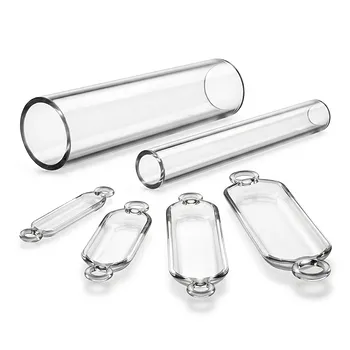
- High Purity Quartz Tube and Quartz Boat for Laboratory Furnaces
- Laboratory Quartz Tube Furnace RTP Heating Tubular Furnace
- Laboratory Vacuum Tilt Rotary Tube Furnace Rotating Tube Furnace
- 1700℃ High Temperature Laboratory Tube Furnace with Alumina Tube
People Also Ask
- How do high-temperature laboratory tube furnaces ensure environmental stability? Precision Thermal Reduction Tips
- How are high-temperature laboratory tube furnaces applied in long-term vacuum homogenization heat treatments for intermetallic samples?
- How are high-temp tube furnaces used to measure diffusion coefficients per Fick's law? Master Precision Annealing
- How are high-temperature tube furnaces applied in testing ceramic-supported alloy membranes? Insights
- How does a laboratory high-temperature tube furnace contribute to the conversion of electrospun fibers? Expert Insights