
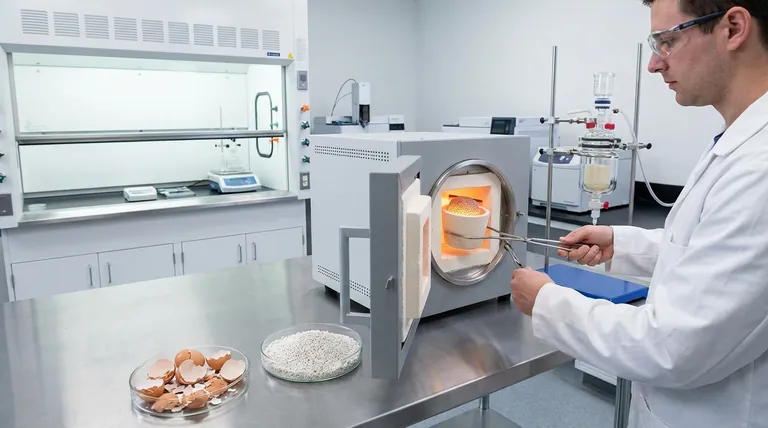
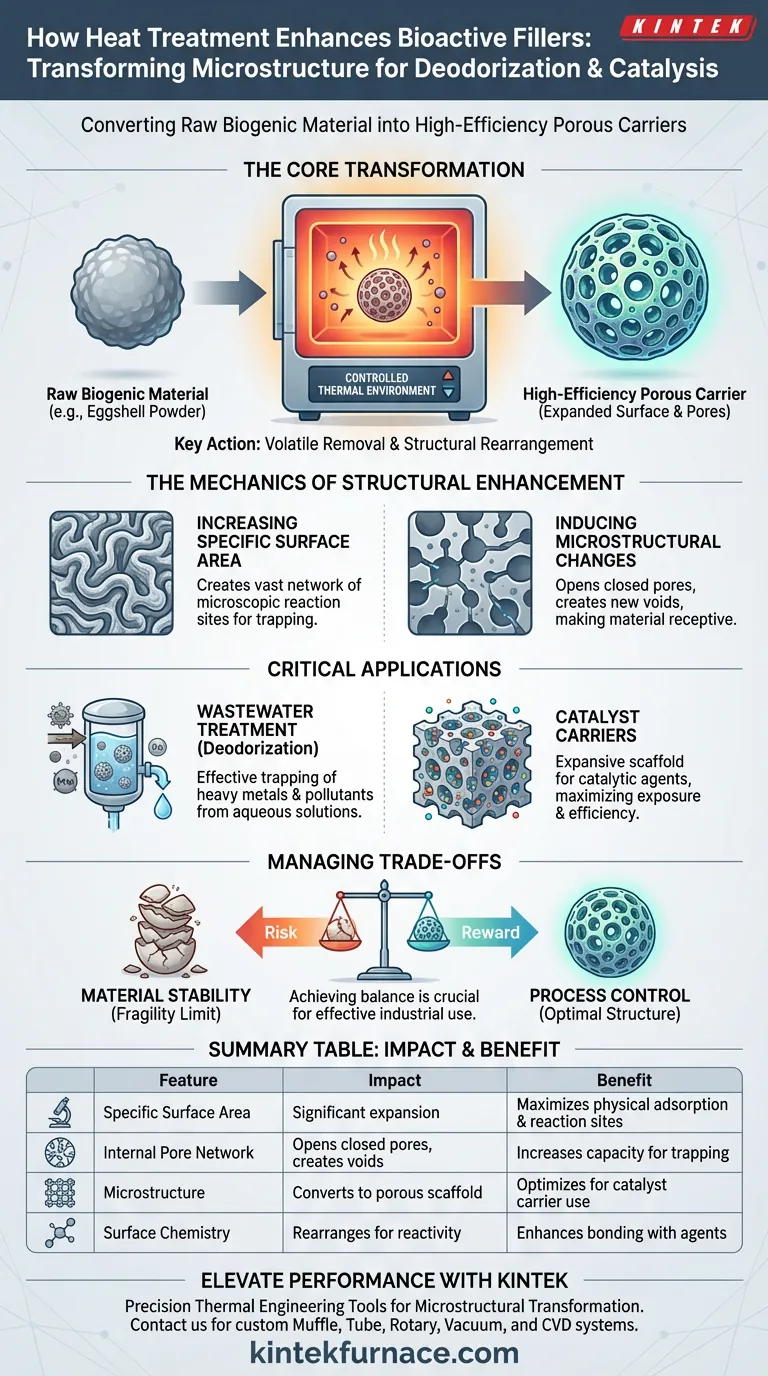
Heat treatment equipment fundamentally transforms the microstructure of bioactive fillers by subjecting them to strictly controlled thermal environments. This process drives physical changes that significantly increase both the specific surface area and total porosity of biogenic particles, such as eggshell powder. By expanding the internal pore network, the equipment directly enhances the material's physical adsorption capacity, making it viable for industrial filtration and catalysis.
Thermal processing is not merely about drying; it is a microstructural engineering tool that converts raw biogenic material into high-efficiency porous carriers suitable for complex filtration and catalytic tasks.
The Mechanics of Structural Enhancement
To understand how bioactive fillers become effective deodorizers or catalyst carriers, you must look at how heat alters the physical architecture of the particle.
Increasing Specific Surface Area
The primary metric for the efficiency of any absorbent material is its specific surface area.
Heat treatment equipment operates to maximize this area by removing volatile components and rearranging the internal structure of the material.
This creates a vast network of microscopic surfaces where chemical reactions or physical trapping can occur.
Inducing Microstructural Changes
The equipment utilizes controlled atmospheres to induce stress and structural shifts within the biogenic particles.
These shifts open up closed pores and create new voids within the material matrix.
The result is a material that is no longer dense and impermeable, but rather highly porous and receptive to external fluids and gases.
Critical Applications for Porous Fillers
Once the porosity is enhanced, the material transitions from simple waste (like eggshell powder) to a functional industrial tool.
Wastewater and Heavy Metal Treatment
Enhanced porosity is the key driver for effective wastewater remediation.
The expanded pore structure allows the filler to physically adsorb heavy metals and other contaminants from aqueous solutions.
Without the microstructural changes induced by heat treatment, the material would lack the capacity to trap these pollutants effectively.
Serving as Catalyst Carriers
In catalytic applications, the bioactive filler acts as a support structure rather than the active agent.
The increased specific surface area provides an expansive scaffold where catalytic agents can be deposited.
This maximizes the exposure of the catalyst to the reaction medium, significantly improving overall process efficiency.
Understanding the Trade-offs
While heat treatment is essential for activating these materials, it introduces specific constraints that must be managed.
Process Control Sensitivity
Achieving the optimal pore structure requires precise control over the thermal atmosphere.
Inconsistent temperature or atmospheric conditions can lead to uneven porosity, rendering parts of the batch ineffective.
Material Stability
There is a physical limit to how much porosity can be induced before the material compromises its structural integrity.
Pushing the specific surface area too high through aggressive heating may result in particles that are too fragile for rigorous industrial flows.
Making the Right Choice for Your Goal
The level of heat treatment required depends heavily on your specific end-use application.
- If your primary focus is Wastewater Treatment: Prioritize treatment protocols that maximize total pore volume to ensure the highest possible capacity for trapping heavy metals.
- If your primary focus is Catalytic Support: Focus on achieving a balance between high surface area and mechanical stability to ensure the carrier remains intact during chemical reactions.
By precisely controlling thermal processing, you turn biogenic limitations into high-performance porous advantages.
Summary Table:
| Feature | Impact of Heat Treatment | Benefit for Application |
|---|---|---|
| Specific Surface Area | Significant expansion through volatile removal | Maximizes physical adsorption & reaction sites |
| Internal Pore Network | Opens closed pores and creates new voids | Increases capacity for heavy metal & pollutant trapping |
| Microstructure | Converts dense particles into porous scaffolds | Optimizes material for use as high-efficiency catalyst carriers |
| Surface Chemistry | Rearranges biogenic matrix for better reactivity | Enhances bonding with active catalytic agents |
Elevate Your Material Performance with KINTEK
Are you looking to transform biogenic materials into high-efficiency industrial fillers? KINTEK provides the precision thermal engineering tools necessary to master microstructural transformation. Backed by expert R&D and manufacturing, we offer a comprehensive range of Muffle, Tube, Rotary, Vacuum, and CVD systems, all of which are fully customizable to meet your specific porosity and surface area requirements.
Whether you are developing advanced wastewater filtration media or stable catalyst supports, our high-temperature lab furnaces ensure the consistent atmospheric control your research demands. Contact KINTEK today to discuss your unique needs and discover how our equipment can drive your next breakthrough in material science.
Visual Guide
References
- Sara Piras, Carlo Santulli. Biomimetic Use of Food-Waste Sources of Calcium Carbonate and Phosphate for Sustainable Materials—A Review. DOI: 10.3390/ma17040843
This article is also based on technical information from Kintek Furnace Knowledge Base .
Related Products
- Vacuum Heat Treat Furnace with Ceramic Fiber Liner
- 2200 ℃ Graphite Vacuum Heat Treat Furnace
- Vacuum Heat Treat Sintering and Brazing Furnace
- 9MPa Air Pressure Vacuum Heat Treat and Sintering Furnace
- Vacuum Heat Treat Sintering Furnace with Pressure for Vacuum Sintering
People Also Ask
- How does vacuum heat treating affect the grain structure of metal alloys? Achieve Precise Microstructure Control
- What are the benefits of using vacuum heat treating furnaces for metal alloys? Achieve Superior Metal Properties and Performance
- What is one of the most important uses of vacuum heat treating furnaces in aerospace? Achieve Superior Strength in Aircraft Alloys
- How does a vacuum heat treat furnace work? Achieve Pristine, High-Performance Results
- What is the difference between heat treat and vacuum heat treat? Achieve Superior Metal Properties with Pristine Finishes



















