
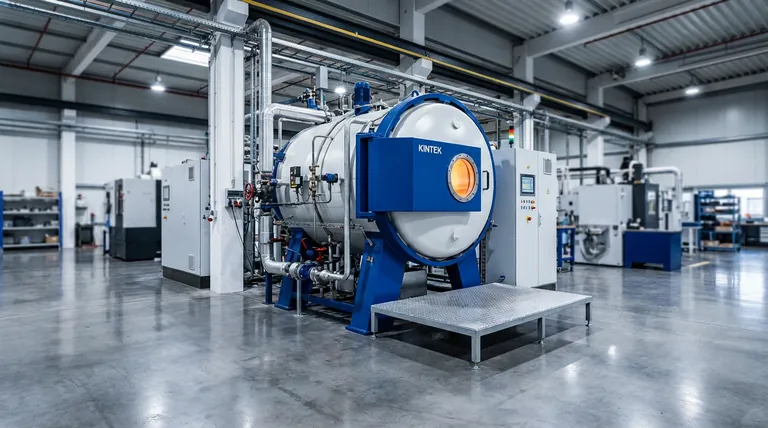
An industrial vacuum sintering furnace acts as the transformative environment where pressed powder compacts become solid, high-performance magnets. It contributes to densification by establishing a high-temperature vacuum or inert gas atmosphere that enables liquid-phase sintering, effectively shrinking the "green body" into a dense, solid form without oxidation.
The core value of the vacuum sintering furnace lies in its ability to precisely control the distribution of the neodymium-rich phase. By ensuring this phase is uniformly spread across grain boundaries, the furnace directly establishes the high remanence and coercivity that define the magnet's industrial performance.
The Mechanics of Densification
Facilitating Liquid-Phase Sintering
The furnace heats the pressed magnet powder—known as the green body—to critical temperatures.
At these temperatures, specific components within the alloy melt to form a liquid phase. This liquid acts as a transport medium, filling the voids between solid particles and rapidly increasing the density of the material.
The Importance of Atmosphere Control
This process occurs within a vacuum or an inert gas environment.
This controlled atmosphere prevents oxygen from reacting with the highly reactive neodymium, ensuring the material remains pure and the sintering process is not compromised by oxidation.
Optimizing Magnetic Performance
Distributing the Neodymium-Rich Phase
The defining characteristic of a high-performance NdFeB magnet is its microstructure.
The furnace's precise temperature regulation ensures that the neodymium-rich phase becomes liquid and wets the surface of the main magnetic grains. This creates a uniform boundary layer separating the grains.
Achieving Critical Magnetic Metrics
This grain isolation is what dictates the magnet's final properties.
By smoothing the grain boundaries and decoupling the magnetic grains, the furnace process allows the magnet to achieve high coercivity (resistance to demagnetization) and high remanence (magnetic strength). Without this specific microstructural arrangement, the magnet would lack the power required for industrial motors and generators.
Understanding the Trade-offs
The Risks of Temperature Instability
While the furnace enables high performance, the process relies heavily on the precision of the thermal control systems.
If the temperature is too low, the liquid phase will not distribute adequateley, resulting in a porous, weak magnet. Conversely, if the temperature is too high or fluctuates, it can lead to abnormal grain growth, which drastically reduces the magnetic properties despite achieving high density.
Making the Right Choice for Your Goal
To maximize the potential of neodymium-iron-boron magnets, you must align the furnace capabilities with your specific output requirements.
- If your primary focus is Maximum Coercivity: Ensure the furnace is capable of maintaining an exceptionally uniform temperature to guarantee distinct grain boundary isolation.
- If your primary focus is Material Purity: Prioritize a furnace with high-vacuum capabilities or high-purity inert gas flow to prevent oxidation of the neodymium during the liquid phase.
Precision in the sintering environment is the single greatest predictor of final magnet performance.
Summary Table:
| Feature | Impact on NdFeB Magnets | Benefit for Performance |
|---|---|---|
| Liquid-Phase Sintering | Shrinks green body and fills voids | Maximizes material density and strength |
| Vacuum/Inert Atmosphere | Prevents neodymium oxidation | Ensures high material purity and magnetic integrity |
| Precise Thermal Control | Distributes neodymium-rich phase | Optimizes coercivity and resistance to demagnetization |
| Microstructure Isolation | Decouples magnetic grains | Enhances remanence and magnetic energy product |
Elevate Your Magnetic Material Production with KINTEK
Precision in the sintering environment is the single greatest predictor of final magnet performance. Backed by expert R&D and world-class manufacturing, KINTEK offers high-performance Vacuum Sintering Systems, Muffle, Tube, and CVD furnaces tailored for the rigorous demands of NdFeB magnet production. Whether you need to maximize coercivity or ensure absolute material purity, our customizable laboratory and industrial high-temperature furnaces provide the uniform thermal control your unique applications require.
Ready to optimize your material densification? Contact our experts today to find your custom furnace solution.
References
- Finks, Christopher. Technical Analysis: Magnet-to-Magnet Rare Earth Recycling Without Solvent Extraction (M2M-Δ Architecture) - Defense Supply Chain Resilience. DOI: 10.5281/zenodo.17625286
This article is also based on technical information from Kintek Furnace Knowledge Base .
Related Products
- 600T Vacuum Induction Hot Press Vacuum Heat Treat and Sintering Furnace
- Vacuum Heat Treat Sintering Furnace Molybdenum Wire Vacuum Sintering Furnace
- Small Vacuum Heat Treat and Tungsten Wire Sintering Furnace
- 9MPa Air Pressure Vacuum Heat Treat and Sintering Furnace
- Vacuum Heat Treat Sintering Furnace with Pressure for Vacuum Sintering
People Also Ask
- Why use Vacuum Hot Press (VHP) for ZnS Ceramics? Achieve Superior IR Transparency and Mechanical Strength
- How does a vacuum hot press sintering furnace mitigate copper sintering swelling? Solve Fe-Cu Expansion Issues
- What is the core function of a vacuum hot press sintering furnace in the preparation of high-density RuTi alloys? Achieve Maximum Density and Purity
- What are the key advantages of vacuum hot press sintering furnaces? Achieve Superior Density and Purity in Materials
- How does the vacuum environment in a vacuum hot press sintering furnace protect chromium-containing ceramics? Find out.



















