Knowledge Why is the SOM titanium alloy furnace set to 1100°C–1300°C? Optimizing Oxygen-Ion Conductivity
Author avatar

Tech Team · Kintek Furnace

Updated 3 hours ago

Why is the SOM titanium alloy furnace set to 1100°C–1300°C? Optimizing Oxygen-Ion Conductivity


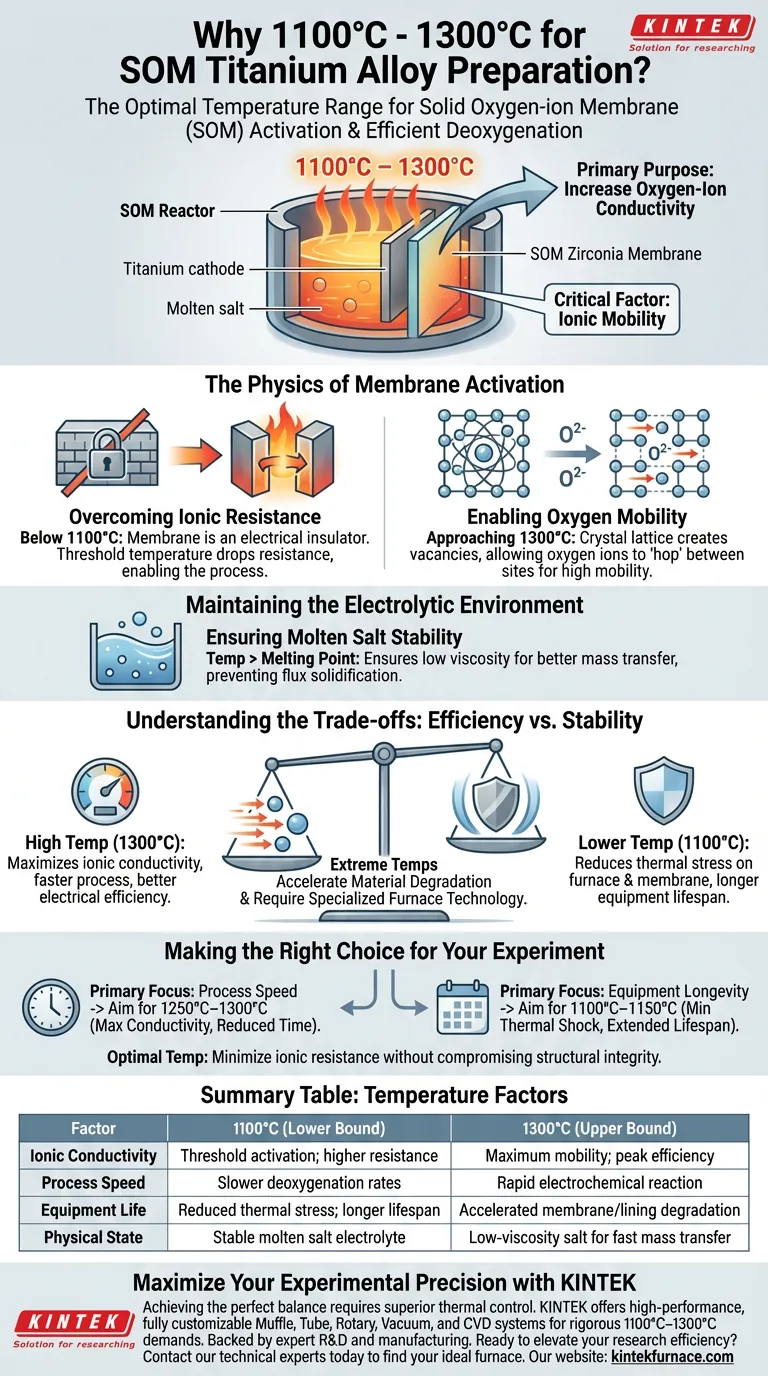
The temperature range of 1100°C to 1300°C is selected specifically to overcome the activation energy barrier of the Solid Oxygen-ion Membrane (SOM). While this heat ensures the molten salt electrolyte remains liquid, its primary technical purpose is to drastically increase the oxygen-ion conductivity of the membrane material, ensuring efficient deoxygenation of the titanium.

The critical factor driving this temperature selection is ionic mobility. At temperatures below 1100°C, the ceramic membrane acts as an insulator; only within this high-temperature window does it become sufficiently conductive to facilitate the electrochemical separation of oxygen from the alloy.
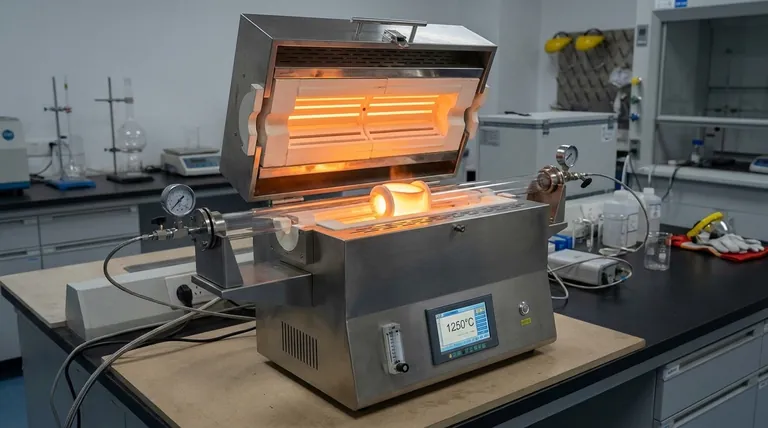
Why is the SOM titanium alloy furnace set to 1100°C–1300°C? Optimizing Oxygen-Ion Conductivity

The Physics of Membrane Activation

Overcoming Ionic Resistance

The core of the SOM process is the solid membrane, typically composed of zirconia-based ceramics. At standard temperatures, these materials are electrically resistive.

To function as an electrolyte, the material requires significant thermal energy. The 1100°C threshold is generally where the resistance drops low enough to allow the process to be energetically viable.

Enabling Oxygen Mobility

The process relies on "pumping" oxygen ions out of the titanium melt and through the solid membrane.

At temperatures approaching 1300°C, the crystal lattice of the membrane creates vacancies that allow oxygen ions to hop from one site to another. This high ionic mobility is the engine of the deoxygenation process.

Maintaining the Electrolytic Environment

Ensuring Molten Salt Stability

The secondary requirement for this temperature range is the physical state of the flux. The molten salt system acts as the transfer medium between the titanium cathode and the SOM anode.

The furnace must maintain a temperature well above the melting point of these salts. This ensures low viscosity, which promotes better mass transfer and prevents the solidification of the flux near cooler zones of the reactor.

Understanding the Trade-offs

The Balance of Efficiency vs. Stability

Operating at the higher end of the spectrum (1300°C) maximizes ionic conductivity, making the process faster and more electrically efficient.

However, extreme temperatures place immense stress on furnace components.

Material Limitations

While higher temperatures improve reaction kinetics, they also accelerate the degradation of the furnace lining and the membrane itself.

Furthermore, as noted in general high-temperature processing, specialized furnace technologies (such as those used in sintering at similar ranges) are required to maintain atmospheric control and temperature uniformity at these extremes.

Making the Right Choice for Your Experiment

To determine where in the 1100°C–1300°C range you should operate, consider your specific constraints:

  • If your primary focus is process speed: Aim for the upper end (1250°C–1300°C) to maximize the ionic conductivity of the zirconia membrane and reduce reaction time.
  • If your primary focus is equipment longevity: Operate closer to the lower bound (1100°C–1150°C) to minimize thermal shock and extend the lifespan of the membrane and heating elements.

Ultimately, the optimal temperature is the point where ionic resistance is minimized without compromising the structural integrity of the SOM apparatus.

Summary Table:

Factor 1100°C (Lower Bound) 1300°C (Upper Bound)
Ionic Conductivity Threshold activation; higher resistance Maximum mobility; peak efficiency
Process Speed Slower deoxygenation rates Rapid electrochemical reaction
Equipment Life Reduced thermal stress; longer lifespan Accelerated membrane/lining degradation
Physical State Stable molten salt electrolyte Low-viscosity salt for fast mass transfer

Maximize Your Experimental Precision with KINTEK

Achieving the perfect balance between ionic mobility and equipment longevity requires superior thermal control. KINTEK provides high-performance laboratory solutions tailored for advanced metallurgy and materials science. Backed by expert R&D and manufacturing, we offer Muffle, Tube, Rotary, Vacuum, and CVD systems, all fully customizable to meet the rigorous 1100°C–1300°C demands of SOM titanium processing.

Ready to elevate your research efficiency? Contact our technical experts today to find the ideal high-temperature furnace for your unique needs.

Visual Guide
Why is the SOM titanium alloy furnace set to 1100°C–1300°C? Optimizing Oxygen-Ion Conductivity Visual Guide

References

  1. Yuhang Miao, Jinming Hu. Research Progress of Preparing Titanium Alloy By Molten Salt Method. DOI: 10.62051/ijnres.v2n1.30

This article is also based on technical information from Kintek Furnace Knowledge Base .

Related Products

People Also Ask

Related Products

1700℃ High Temperature Laboratory Tube Furnace with Quartz or Alumina Tube

1700℃ High Temperature Laboratory Tube Furnace with Quartz or Alumina Tube

KINTEK's Tube Furnace with Alumina Tube: Precision heating up to 1700°C for material synthesis, CVD, and sintering. Compact, customizable, and vacuum-ready. Explore now!

1400℃ High Temperature Laboratory Tube Furnace with Quartz and Alumina Tube

1400℃ High Temperature Laboratory Tube Furnace with Quartz and Alumina Tube

KINTEK's Tube Furnace with Alumina Tube: Precision high-temperature processing up to 2000°C for labs. Ideal for material synthesis, CVD, and sintering. Customizable options available.

Molybdenum Vacuum Heat Treat Furnace

Molybdenum Vacuum Heat Treat Furnace

High-performance molybdenum vacuum furnace for precise 1400°C heat treatment. Ideal for sintering, brazing, and crystal growth. Durable, efficient, and customizable.

2200 ℃ Tungsten Vacuum Heat Treat and Sintering Furnace

2200 ℃ Tungsten Vacuum Heat Treat and Sintering Furnace

2200°C Tungsten Vacuum Furnace for high-temperature materials processing. Precise control, superior vacuum, customizable solutions. Ideal for research & industrial applications.

600T Vacuum Induction Hot Press Vacuum Heat Treat and Sintering Furnace

600T Vacuum Induction Hot Press Vacuum Heat Treat and Sintering Furnace

600T Vacuum Induction Hot Press Furnace for precise sintering. Advanced 600T pressure, 2200°C heating, vacuum/atmosphere control. Ideal for research & production.

1200℃ Split Tube Furnace Laboratory Quartz Tube Furnace with Quartz Tube

1200℃ Split Tube Furnace Laboratory Quartz Tube Furnace with Quartz Tube

Discover KINTEK's 1200℃ Split Tube Furnace with quartz tube for precise high-temperature lab applications. Customizable, durable, and efficient. Get yours now!

1700℃ High Temperature Muffle Oven Furnace for Laboratory

1700℃ High Temperature Muffle Oven Furnace for Laboratory

KT-17M Muffle Furnace: High-precision 1700°C lab furnace with PID control, energy efficiency, and customizable sizes for industrial & research applications.

1400℃ Muffle Oven Furnace for Laboratory

1400℃ Muffle Oven Furnace for Laboratory

KT-14M Muffle Furnace: Precision 1400°C heating with SiC elements, PID control, and energy-efficient design. Ideal for labs.

Vacuum Heat Treat Sintering and Brazing Furnace

Vacuum Heat Treat Sintering and Brazing Furnace

KINTEK Vacuum Brazing Furnaces deliver precision, clean joints with superior temperature control. Customizable for diverse metals, ideal for aerospace, medical, and thermal applications. Get a quote!

High Pressure Laboratory Vacuum Tube Furnace Quartz Tubular Furnace

High Pressure Laboratory Vacuum Tube Furnace Quartz Tubular Furnace

KINTEK High Pressure Tube Furnace: Precision heating up to 1100°C with 15Mpa pressure control. Ideal for sintering, crystal growth, and lab research. Customizable solutions available.

High Temperature Muffle Oven Furnace for Laboratory Debinding and Pre Sintering

High Temperature Muffle Oven Furnace for Laboratory Debinding and Pre Sintering

KT-MD Debinding & Pre-Sintering Furnace for ceramics - precise temperature control, energy-efficient design, customizable sizes. Boost your lab efficiency today!

Laboratory Muffle Oven Furnace with Bottom Lifting

Laboratory Muffle Oven Furnace with Bottom Lifting

Boost lab efficiency with KT-BL Bottom Lifting Furnace: precise 1600℃ control, superior uniformity, and enhanced productivity for material science and R&D.

Vacuum Heat Treat Furnace with Ceramic Fiber Liner

Vacuum Heat Treat Furnace with Ceramic Fiber Liner

KINTEK's Vacuum Furnace with Ceramic Fiber Lining offers precise high-temperature processing up to 1700°C, ensuring uniform heat distribution and energy efficiency. Ideal for labs and production.

Mesh Belt Controlled Atmosphere Furnace Inert Nitrogen Atmosphere Furnace

Mesh Belt Controlled Atmosphere Furnace Inert Nitrogen Atmosphere Furnace

KINTEK Mesh Belt Furnace: High-performance controlled atmosphere furnace for sintering, hardening & heat treatment. Customizable, energy-efficient, precise temperature control. Get a quote now!

1700℃ Controlled Inert Nitrogen Atmosphere Furnace

1700℃ Controlled Inert Nitrogen Atmosphere Furnace

KT-17A Controlled Atmosphere Furnace: Precise 1700°C heating with vacuum & gas control. Ideal for sintering, research & material processing. Explore now!

1800℃ High Temperature Muffle Oven Furnace for Laboratory

1800℃ High Temperature Muffle Oven Furnace for Laboratory

KINTEK Muffle Furnaces: Precision 1800°C heating for labs. Energy-efficient, customizable, with PID control. Ideal for sintering, annealing, and research.

2200 ℃ Graphite Vacuum Heat Treat Furnace

2200 ℃ Graphite Vacuum Heat Treat Furnace

2200℃ Graphite Vacuum Furnace for high-temperature sintering. Precise PID control, 6*10⁻³Pa vacuum, durable graphite heating. Ideal for research & production.

Laboratory Vacuum Tilt Rotary Tube Furnace Rotating Tube Furnace

Laboratory Vacuum Tilt Rotary Tube Furnace Rotating Tube Furnace

KINTEK Laboratory Rotary Furnace: Precision heating for calcination, drying, sintering. Customizable solutions with vacuum & controlled atmosphere. Enhance research now!

Vertical Laboratory Quartz Tube Furnace Tubular Furnace

Vertical Laboratory Quartz Tube Furnace Tubular Furnace

Precision KINTEK Vertical Tube Furnace: 1800℃ heating, PID control, customizable for labs. Ideal for CVD, crystal growth & materials testing.

Laboratory Quartz Tube Furnace RTP Heating Tubular Furnace

Laboratory Quartz Tube Furnace RTP Heating Tubular Furnace

KINTEK's RTP Rapid Heating Tube Furnace delivers precise temperature control, rapid heating up to 100°C/sec, and versatile atmosphere options for advanced lab applications.


Leave Your Message


















