
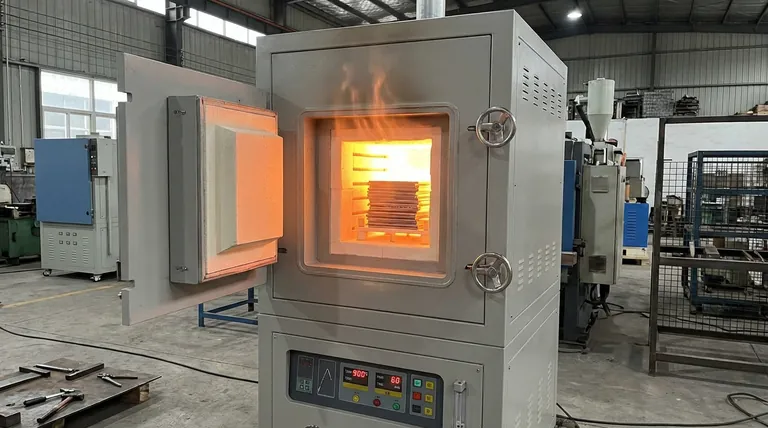
An industrial high-temperature box furnace executes solution treatment by maintaining a stable thermal environment at exactly 900°C (1173 K) for a duration of one hour. This precise exposure triggers essential microstructural changes within the SS317L layer of clad plates, reversing the physical stresses caused by manufacturing.
The furnace acts as a catalyst for elemental diffusion, allowing alloying elements to reintegrate into the steel matrix. By sustaining 900°C, the process dissolves harmful precipitates and eliminates work hardening, ultimately restoring the material's critical corrosion resistance and plasticity.
The Mechanics of Solution Treatment
The effectiveness of the solution treatment relies heavily on the furnace's ability to maintain specific environmental parameters.
Achieving Thermal Stability
The furnace must provide a stable, constant temperature of 900°C (1173 K).
Fluctuations in temperature can disrupt the internal chemical processes required for the steel's rehabilitation.
The Necessity of Duration
The material requires a specific residence time of one hour within this thermal environment.
This duration is calculated to ensure that heat penetrates the clad plate uniformly and that slow-moving atomic processes reach completion.
Restoring Material Properties
The primary goal of this treatment is to repair the microstructure of the SS317L layer, which is often degraded during the rolling process.
Promoting Elemental Diffusion
At high temperatures, alloying elements within the steel gain the energy needed to move freely.
The furnace ensures these elements fully diffuse back into the matrix, creating a homogeneous internal structure.
Dissolving Harmful Phases
During previous manufacturing steps, harmful precipitated phases, such as chromium carbides, may form.
The 900°C heat treatment dissolves these precipitates, which is essential for preventing intergranular corrosion.
Reversing Work Hardening
The rolling process typically introduces "work hardening," making the material brittle and difficult to shape.
Solution treatment relieves these internal stresses, effectively restoring the plasticity of the clad plate.
Critical Process Constraints
While the solution treatment is effective, it relies on strict adherence to the process parameters.
Temperature Precision
The specific target of 900°C is not arbitrary; it is the activation energy required for phase dissolution.
Failure to reach this temperature results in retained carbides, leaving the steel vulnerable to corrosion.
Time Management Risks
The one-hour duration acts as a minimum threshold for full diffusion.
Shortening this cycle risks leaving the center of the material untreated, resulting in inconsistent mechanical properties.
Optimizing the Treatment Strategy
To ensure the SS317L layer performs as intended in industrial applications, you must prioritize the specific outcome required for your project.
- If your primary focus is Corrosion Resistance: Ensure the temperature holds strictly at 900°C to guarantee the complete dissolution of chromium carbides.
- If your primary focus is Formability: Prioritize the full one-hour duration to ensure work hardening is entirely eliminated, restoring maximum plasticity.
Precise thermal control is the definitive requirement for fully rehabilitating the microstructure of SS317L clad plates.
Summary Table:
| Process Parameter | Requirement | Objective |
|---|---|---|
| Target Temperature | 900°C (1173 K) | Dissolve chromium carbides & promote diffusion |
| Soaking Time | 60 Minutes | Ensure uniform heat penetration & stress relief |
| Key Outcome 1 | Phase Dissolution | Restore maximum corrosion resistance |
| Key Outcome 2 | Stress Relief | Eliminate work hardening & restore plasticity |
Elevate Your Material Performance with KINTEK
Precision is the difference between a resilient material and a failed component. Backed by expert R&D and manufacturing, KINTEK offers high-performance Box, Muffle, Tube, Rotary, Vacuum, and CVD systems designed to meet the rigorous thermal demands of solution treatment.
Whether you are processing SS317L clad plates or developing advanced alloys, our customizable lab and industrial high-temperature furnaces provide the temperature stability and control you need.
Ready to optimize your heat treatment process?
Contact our specialists today to find your custom solution!
References
- Laxya Gupta, Madangopal Krishnan. Effect of Heat Treatments on the Microstructure and Mechanical Properties of SS317L/ASTM SA516 GR60 Steel Clad Plate Fabricated Through Hot Roll Bonding. DOI: 10.1007/s11661-024-07547-w
This article is also based on technical information from Kintek Furnace Knowledge Base .
Related Products
- 1400℃ High Temperature Laboratory Tube Furnace with Alumina Tube
- 1700℃ High Temperature Laboratory Tube Furnace with Alumina Tube
- 1800℃ High Temperature Muffle Oven Furnace for Laboratory
- 1700℃ High Temperature Muffle Oven Furnace for Laboratory
- 1700℃ Controlled Inert Nitrogen Atmosphere Furnace
People Also Ask
- How does zone-melting in tube furnaces synthesize bismuth micro-wires? Master Single-Crystal Thermoelectric Growth
- How are high-temp tube furnaces used to measure diffusion coefficients per Fick's law? Master Precision Annealing
- How are high-temperature laboratory tube furnaces applied in long-term vacuum homogenization heat treatments for intermetallic samples?
- How do high-temperature laboratory tube furnaces ensure environmental stability? Precision Thermal Reduction Tips
- How are high-temperature tube furnaces applied in testing ceramic-supported alloy membranes? Insights



















