
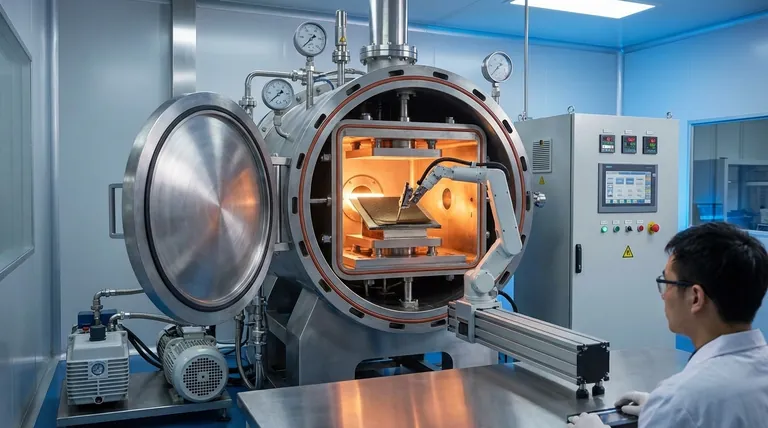
A vacuum hot pressing furnace acts as the critical densification engine for high-performance composites. It works by applying substantial mechanical pressure simultaneously with high thermal energy within an oxygen-free environment. This unique combination forces powder particles to bond tightly, eliminating voids that would otherwise weaken the final material.
Core Takeaway The vacuum hot pressing furnace is essential for producing high-hardness materials because it achieves near-theoretical density through the simultaneous application of heat and uniaxial pressure. By removing oxide films and preventing oxidation, it ensures a clean, strong bond between the metal matrix and lubricating particles, directly resulting in superior wear resistance and mechanical strength.
The Mechanics of Densification
Simultaneous Heat and Pressure
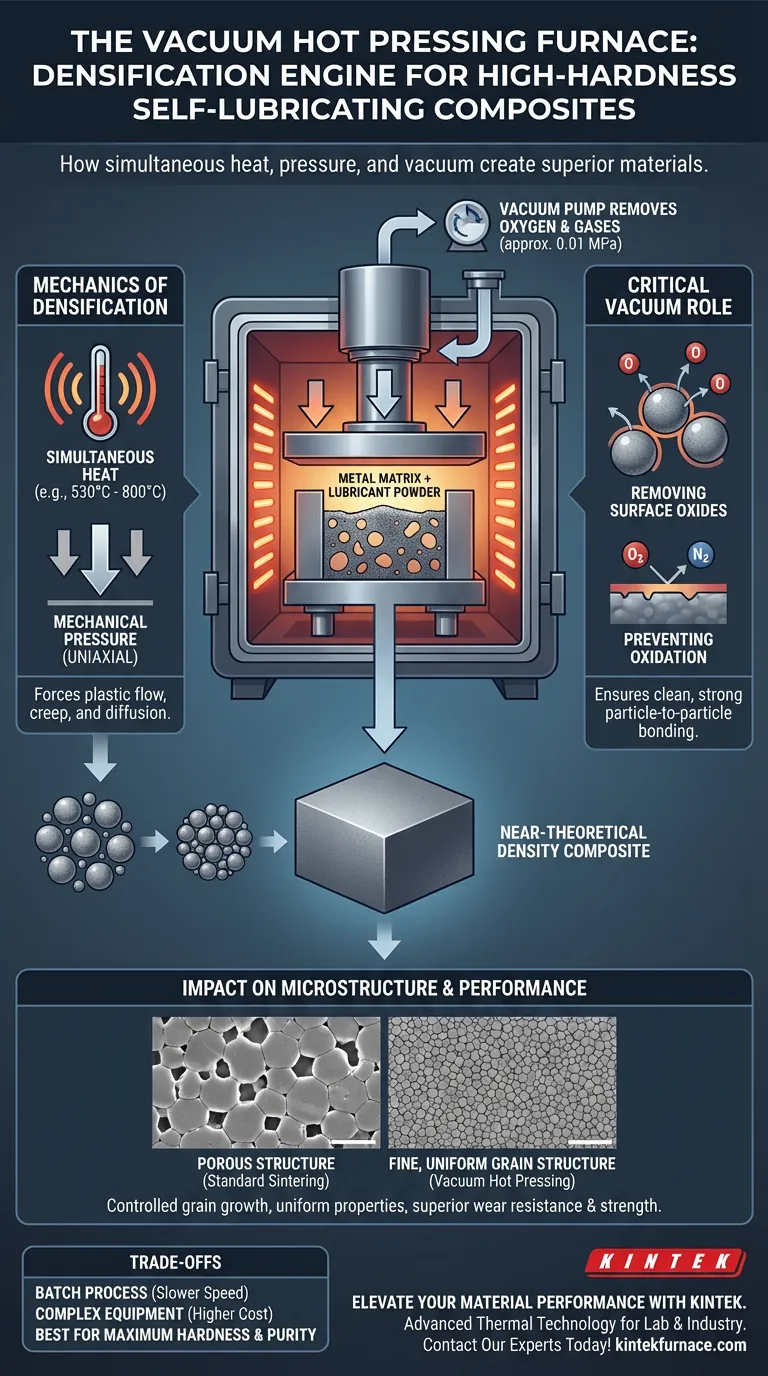
The defining feature of this furnace is the application of mechanical pressure (e.g., uniaxial pressure) at the same time as high-temperature heating (often between 530°C and 800°C).
While heat promotes the diffusion between powder particles, the mechanical pressure actively forces the material together.
Eliminating Porosity
In standard sintering, pores may remain between particles. In vacuum hot pressing, the applied pressure drives plastic flow and creep mechanisms.
This physically forces the material to fill voids, significantly reducing porosity and achieving densities that approach the theoretical limit of the material.
The Critical Role of the Vacuum Environment
Removing Surface Oxides
The primary reference highlights that the vacuum environment is not just passive; it actively removes oxide films from the surface of the powder particles.
Oxide films act as barriers to bonding. By stripping them away, the furnace enables direct particle-to-particle contact, which is essential for high hardness.
Preventing Oxidative Degradation
High temperatures usually accelerate oxidation, which degrades metal matrices. The vacuum (often around 0.01 MPa) removes harmful gases like oxygen, nitrogen, and water vapor.
This prevents the oxidation and carburization of the metal matrix, ensuring the composite maintains its intended chemical purity and strength.
Ensuring Clean Interface Bonding
For self-lubricating composites, which often mix metals with ceramics or lubricants, the interface between these distinct materials is a potential weak point.
The vacuum promotes degassing and impurity removal, creating a clean, microscopic interface bond. This strong bond prevents the material from crumbling under stress or friction.
Impact on Microstructure and Performance
Controlling Grain Growth
High-hardness materials rely on fine grain structures. Because the furnace applies high pressure, it can often achieve densification at relatively lower temperatures compared to pressureless sintering.
This helps suppress grain growth during the process. Smaller grains typically result in harder, tougher materials.
Uniformity and Stability
Advanced vacuum furnaces utilize high-precision control systems to regulate temperature, pressure, and suppression rates.
This precision results in a uniform material structure across the entire sample, ensuring that the hardness and self-lubricating properties are consistent and reliable in every part of the component.
Understanding the Trade-offs
Process Speed and Volume
Vacuum hot pressing is typically a batch process, unlike continuous sintering methods.
It requires time to pump down the vacuum, heat the chamber, apply pressure, and cool down under controlled conditions. This generally makes it slower and less suitable for massive, high-speed production runs compared to conventional conveyor sintering.
Equipment Complexity
The requirement for maintaining a high vacuum while applying tons of mechanical force adds complexity.
These furnaces require robust insulation, sophisticated seals, and advanced control systems to manage the energy and forces involved. This contributes to higher capital and operational costs compared to atmospheric furnaces.
Making the Right Choice for Your Goal
When deciding if vacuum hot pressing is the right manufacturing route for your composite material, consider your specific performance requirements.
- If your primary focus is Maximum Hardness and Density: Choose vacuum hot pressing. The combination of pressure and vacuum is the only reliable way to achieve near-theoretical density and pore-free structures.
- If your primary focus is Material Purity: Choose this method to ensure the complete removal of oxide films and the prevention of high-temperature oxidation, which is critical for high-quality bonding.
- If your primary focus is High-Volume, Low-Cost Production: Evaluate if pressureless sintering can meet your minimum specs, as hot pressing is a more resource-intensive batch process.
Ultimately, for high-hardness self-lubricating composites, the vacuum hot pressing furnace is not just an option—it is a prerequisite for achieving the structural integrity required for demanding industrial applications.
Summary Table:
| Feature | Vacuum Hot Pressing Impact | Benefit for Composites |
|---|---|---|
| Pressure Application | Uniaxial pressure during heating | Eliminates voids & achieves near-theoretical density |
| Vacuum Environment | Removes oxide films & harmful gases | Prevents oxidation and ensures pure bonding interfaces |
| Temperature Control | Precise heating (530°C - 800°C) | Suppresses grain growth for a harder, tougher structure |
| Microstructure | Plastic flow & creep mechanisms | Consistent uniformity and superior mechanical strength |
Elevate Your Material Performance with KINTEK
Unlock the full potential of your high-performance composites with KINTEK’s advanced thermal technology. Backed by expert R&D and world-class manufacturing, KINTEK offers high-precision Vacuum, Muffle, Tube, Rotary, and CVD systems tailored to your specific lab and industrial requirements. Whether you are developing high-hardness self-lubricating materials or advanced ceramics, our customizable high-temperature furnaces provide the pressure and purity your research demands.
Ready to optimize your densification process?
→ Contact Our Experts Today for a Custom Solution
Visual Guide
References
- Huifeng Ning, Litian Hu. Modeling and prediction of tribological properties of copper/aluminum-graphite self-lubricating composites using machine learning algorithms. DOI: 10.1007/s40544-023-0847-2
This article is also based on technical information from Kintek Furnace Knowledge Base .
Related Products
- 600T Vacuum Induction Hot Press Vacuum Heat Treat and Sintering Furnace
- Vacuum Hot Press Furnace Machine for Lamination and Heating
- Vacuum Hot Press Furnace Machine Heated Vacuum Press
- Vacuum Hot Press Furnace Machine Heated Vacuum Press Tube Furnace
- High Pressure Laboratory Vacuum Tube Furnace
People Also Ask
- Why use Vacuum Hot Press (VHP) for ZnS Ceramics? Achieve Superior IR Transparency and Mechanical Strength
- How does a vacuum hot press sintering furnace mitigate copper sintering swelling? Solve Fe-Cu Expansion Issues
- What is the core function of a vacuum hot press sintering furnace in the preparation of high-density RuTi alloys? Achieve Maximum Density and Purity
- What are the key advantages of vacuum hot press sintering furnaces? Achieve Superior Density and Purity in Materials
- How does the vacuum environment in a vacuum hot press sintering furnace protect chromium-containing ceramics? Find out.



















