
Vacuum drying significantly outperforms ordinary drying by lowering environmental pressure to facilitate rapid evaporation of water and residual solvents at a moderate 80 °C. For TiO2/LDH (Layered Double Hydroxide) composites, this process is critical because it prevents the thermal degradation of surface active sites and inhibits the formation of "hard agglomerates," ensuring the material retains the high specific surface area necessary for its function.
By decoupling evaporation from high heat, vacuum drying preserves the delicate microstructure of TiO2/LDH composites. It eliminates the destructive forces typical of standard drying, ensuring active sites remain accessible and the carrier structure remains porous rather than collapsing into a dense, inactive mass.
The Mechanism of Preservation
Lowering the Thermal Threshold
Ordinary drying relies on high temperatures to force evaporation, which can be destructive to sensitive nanocomposites.
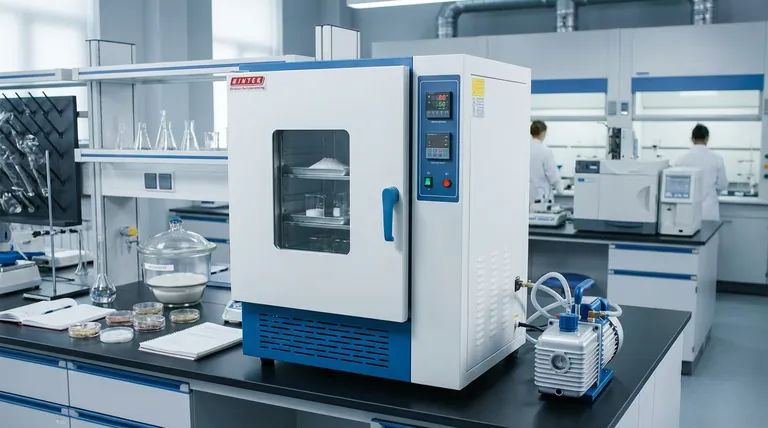
A vacuum drying oven alters the physics of the process by reducing the system pressure. This depression allows solvents to boil and evaporate at significantly lower temperatures—specifically around 80 °C for this application—minimizing thermal stress on the material.
Protecting Surface Active Sites
The functionality of TiO2/LDH composites depends heavily on their surface chemistry. High heat can denature or chemically alter these active sites, rendering them inert.
By drying at a controlled, lower temperature, the vacuum method ensures that the surface active sites remain intact and available for future chemical reactions or catalytic processes.
Preventing Structural Degradation
Inhibiting Hard Agglomeration
One of the primary failure modes in drying nanomaterials is "hard agglomeration." This occurs when surface tension forces during slow, high-heat evaporation pull nanoparticles together into tight, irreversible clumps.
Vacuum drying induces rapid evaporation that bypasses the conditions leading to these tight bonds. It effectively prevents hard agglomeration, allowing the particles to remain discrete or loosely associated.
Maintaining Specific Surface Area
The LDH (Layered Double Hydroxide) carrier serves as a high-surface-area scaffold for the TiO2. If the structure collapses during drying, that surface area is lost.
By preventing agglomeration, vacuum drying maintains a high specific surface area. This ensures that the internal pore structure remains open and accessible, maximizing the composite's efficiency in its final application.
Understanding the Trade-offs
Equipment Complexity and Cost
While performant, vacuum drying requires more sophisticated hardware than standard convection ovens. You must account for the maintenance of vacuum pumps and the higher initial capital cost of the airtight chambers.
Batch Processing Limitations
Vacuum drying is inherently a batch process. Unlike continuous conveyor dryers used in ordinary drying, vacuum ovens require sealing, depressurizing, and repressurizing for each load. This can create bottlenecks in high-throughput manufacturing environments.
Making the Right Choice for Your Goal
To maximize the potential of your TiO2/LDH composites, align your drying method with your performance metrics.
- If your primary focus is Maximum Reactivity: Choose vacuum drying to preserve surface active sites and ensure the highest possible specific surface area.
- If your primary focus is Structural Integrity: Rely on vacuum drying to prevent hard agglomeration and maintain the porous architecture of the LDH carrier.
- If your primary focus is Throughput Speed: Acknowledge that vacuum drying is a slower, batch-based process compared to continuous air drying, but necessary for quality.
Vacuum drying is not merely a method of water removal; it is a critical processing step that defines the final quality and efficiency of your composite material.
Summary Table:
| Feature | Ordinary Drying | Vacuum Drying (80 °C) |
|---|---|---|
| Temperature Stress | High (Potential degradation) | Low (Preserves active sites) |
| Particle Structure | Risk of hard agglomeration | Prevents hard agglomerates |
| Surface Area | Reduced due to collapse | Maintains high specific surface area |
| Process Type | Often continuous | Batch-based |
| Evaporation Mechanism | High heat required | Lowered pressure threshold |
Elevate Your Material Research with KINTEK Precision
Don’t compromise the structural integrity of your sensitive TiO2/LDH composites. KINTEK’s advanced vacuum drying systems are engineered to provide the precise pressure control and uniform heating required to eliminate hard agglomeration and protect surface active sites.
Backed by expert R&D and manufacturing, KINTEK offers Muffle, Tube, Rotary, Vacuum, and CVD systems, all customizable for your unique lab requirements. Ensure your materials achieve their maximum specific surface area and catalytic potential with our industry-leading high-temp furnace solutions.
Ready to optimize your drying process? Contact our technical experts today to find the perfect customizable solution for your laboratory.
References
- Synthesis and Characterization of Visible-Light-Responsive TiO2/LDHs Heterostructures for Enhanced Photocatalytic Degradation Performance. DOI: 10.3390/w17172582
This article is also based on technical information from Kintek Furnace Knowledge Base .
Related Products
- Vacuum Heat Treat Sintering and Brazing Furnace
- Vacuum Heat Treat Sintering Furnace Molybdenum Wire Vacuum Sintering Furnace
- Dental Porcelain Zirconia Sintering Ceramic Vacuum Press Furnace
- Molybdenum Vacuum Heat Treat Furnace
- Vacuum Hot Press Furnace Machine Heated Vacuum Press
People Also Ask
- How does vacuum heat treating affect the grain structure of metal alloys? Achieve Precise Microstructure Control
- What are the benefits of using vacuum heat treating furnaces for metal alloys? Achieve Superior Metal Properties and Performance
- What is one of the most important uses of vacuum heat treating furnaces in aerospace? Achieve Superior Strength in Aircraft Alloys
- What is the temperature of a vacuum furnace brazing? Optimize Your Joint Strength and Cleanliness
- What are the steps involved in a typical vacuum brazing treatment? Master the Process for Strong, Clean Joints












