
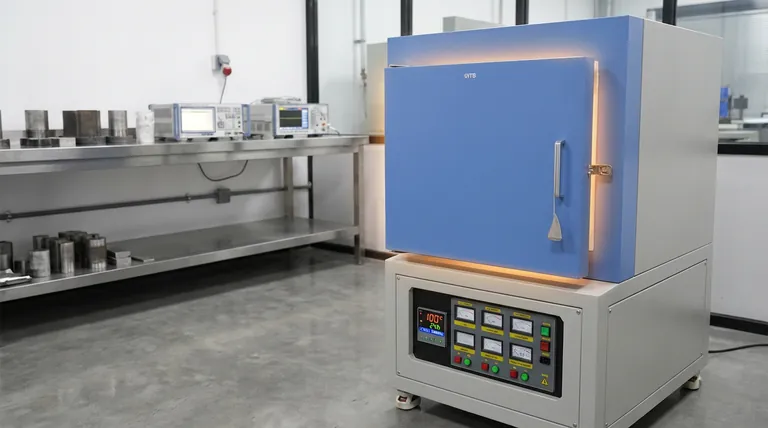
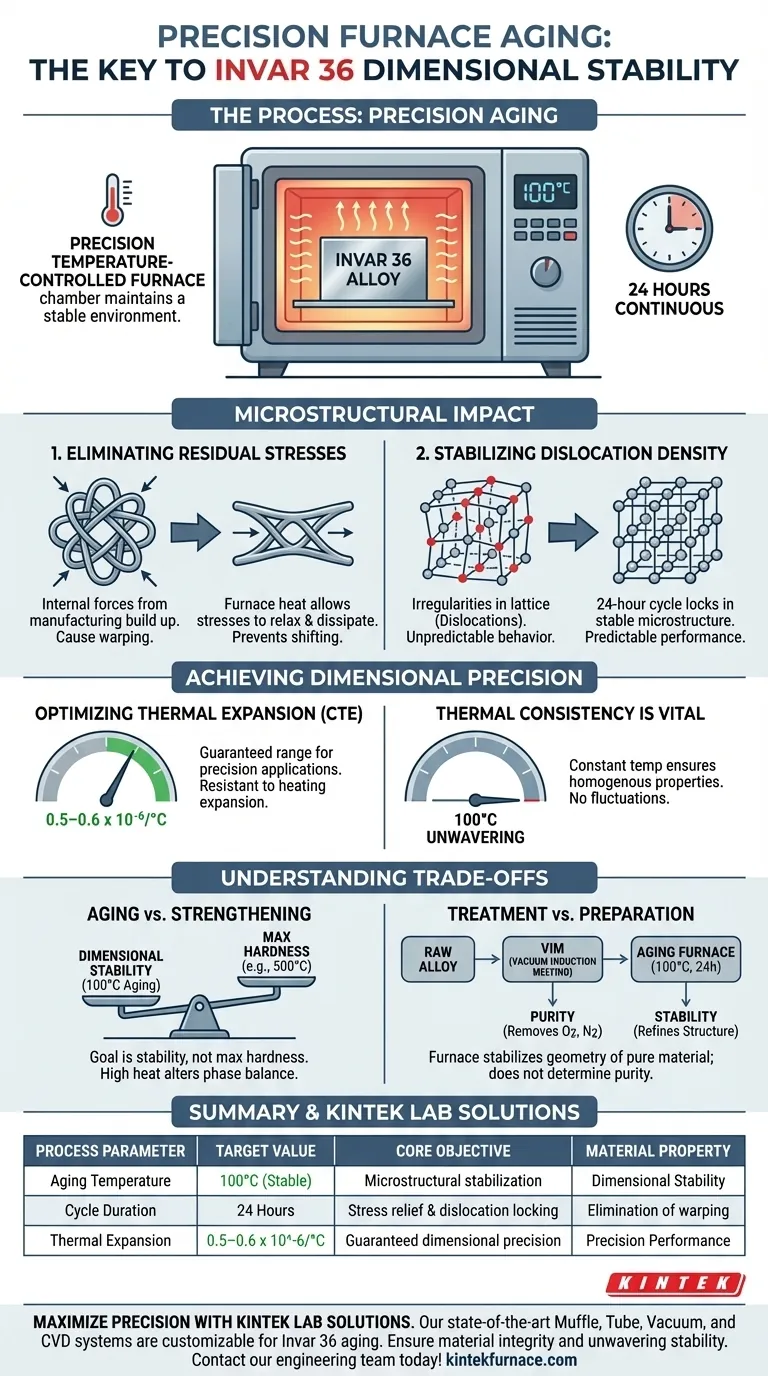
A precision temperature-controlled furnace facilitates the long-term aging of Invar 36 by maintaining a strictly stable environment at 100°C for a continuous 24-hour period. This specific thermal cycle is critical for eliminating residual internal stresses and stabilizing the alloy's microstructure without altering its fundamental composition.
The core objective of this process is to stabilize the dislocation density of the alloy, ensuring Invar 36 achieves its defining characteristic: an exceptionally low and consistent coefficient of thermal expansion (0.5–0.6 x 10^-6/°C).
The Microstructural Impact of Aging
Eliminating Residual Stresses
During the manufacturing and shaping of Invar 36, internal forces known as residual stresses build up within the material.
If left untreated, these stresses can cause the material to warp or shift over time. The furnace provides a controlled thermal environment that allows these internal forces to relax and dissipate.
Stabilizing Dislocation Density
Beyond simple stress relief, the 24-hour cycle at 100°C targets the alloy's crystalline structure.
The process stabilizes the dislocation density—irregularities in the crystal lattice. By "locking in" a stable microstructure, the furnace ensures the material behaves predictably under future thermal changes.
Achieving Dimensional Precision
Optimizing Thermal Expansion
The primary value of Invar 36 is its resistance to expanding when heated.
The precise aging treatment ensures the Coefficient of Thermal Expansion (CTE) remains within the target range of 0.5 to 0.6 x 10^-6/°C. Without this step, the CTE might fluctuate, compromising the alloy's precision applications.
The Role of Thermal Consistency
The "precision" aspect of the furnace is vital because fluctuations in temperature during the 24-hour cycle could introduce new inconsistencies.
A constant, unwavering 100°C ensures that the entire bulk of the material is treated uniformly, resulting in homogenous properties throughout the part.
Understanding the Trade-offs
Aging vs. Strengthening
It is important to distinguish the goal of this specific 100°C aging process from other heat treatments.
While precision furnaces can drive hardness and wear resistance through higher temperatures (e.g., 500°C for precipitation hardening in other alloys), the goal here is dimensional stability, not maximum hardness. Applying excessive heat could alter the phase balance detrimental to Invar's low expansion properties.
Treatment vs. Preparation
The aging furnace refines the structure of the solid metal, but it does not determine chemical purity.
Purity is established earlier in the process using Vacuum Induction Melting (VIM) to eliminate impurities like oxygen and nitrogen. The aging furnace acts as the finishing step to stabilize the physical geometry of that pure material.
Making the Right Choice for Your Goal
To achieve the best results with Invar 36, you must align your thermal processing with your specific engineering requirements.
- If your primary focus is Dimensional Stability: Utilize the precision furnace at 100°C for 24 hours to minimize CTE and residual stress.
- If your primary focus is Chemical Purity: Ensure the raw alloy was prepared using Vacuum Induction Melting (VIM) to prevent oxidation prior to any heat treatment.
Precision in thermal control is the bridge between a raw alloy and a high-performance engineering component.
Summary Table:
| Process Parameter | Target Value | Core Objective |
|---|---|---|
| Aging Temperature | 100°C (Stable) | Microstructural stabilization |
| Cycle Duration | 24 Hours | Stress relief & dislocation locking |
| Thermal Expansion (CTE) | 0.5–0.6 x 10^-6/°C | Guaranteed dimensional precision |
| Material Property | Dimensional Stability | Elimination of warping and shifting |
Maximize Dimensional Precision with KINTEK Lab Solutions
Don't let temperature fluctuations compromise your material integrity. KINTEK provides state-of-the-art Muffle, Tube, Vacuum, and CVD systems designed for the rigorous demands of Invar 36 aging and other precision heat treatments.
Backed by expert R&D and manufacturing, our high-temp furnaces are fully customizable to your unique thermal cycling needs, ensuring uniform heating and unwavering stability for your most critical components.
Ready to achieve superior material performance? Contact our engineering team today to discuss your custom furnace requirements!
Visual Guide
References
- Mehmet Kul, Markus Merkel. Minimum and Stable Coefficient of Thermal Expansion by Three-Step Heat Treatment of Invar 36. DOI: 10.3390/cryst14121097
This article is also based on technical information from Kintek Furnace Knowledge Base .
Related Products
- 1700℃ Controlled Inert Nitrogen Atmosphere Furnace
- 1400℃ Controlled Inert Nitrogen Atmosphere Furnace
- 1200℃ Controlled Inert Nitrogen Atmosphere Furnace
- Controlled Inert Nitrogen Hydrogen Atmosphere Furnace
- High Temperature Muffle Oven Furnace for Laboratory Debinding and Pre Sintering
People Also Ask
- Why is thorough binder burnout necessary before sintering advanced ceramics? Ensure Peak Density & Zero Defects
- How does real-time dilatometric analysis in a controlled-atmosphere furnace optimize PZT ceramic sintering?
- How does oxygen partial pressure control affect ceramic sintering? Master Defect Chemistry
- How do controlled-atmosphere furnaces support polymer pyrolysis? Master SiC & Si3N4 Ceramic Conversion
- Why is controlled-atmosphere heating required for functional ceramics and sensors? Master Defect Engineering



















