
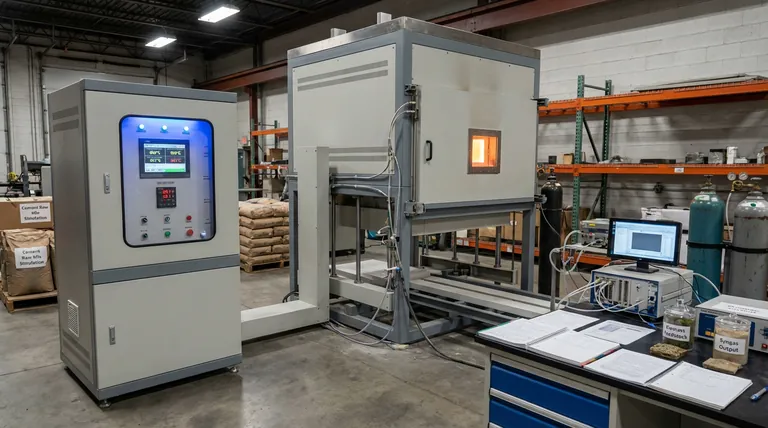
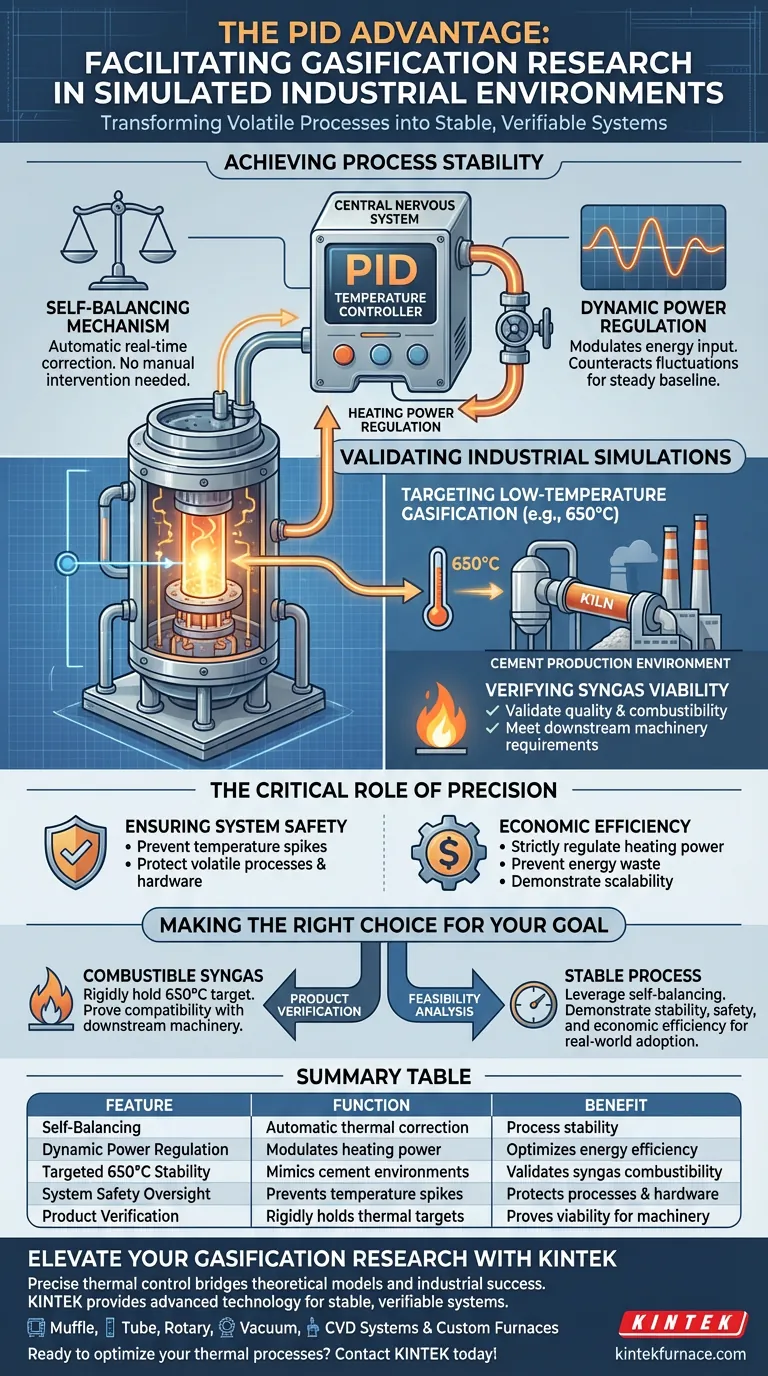
A PID temperature controller acts as the central nervous system for gasification reactors, facilitating research by maintaining a "self-balancing" state through the precise regulation of heating power. in the context of simulated industrial environments, such as cement production, this automation ensures the reactor holds specific low-temperature targets (e.g., 650°C) to validate the quality and combustibility of the resulting syngas.
By automating thermal regulation, the PID controller transforms a volatile chemical process into a stable, verifiable system. This precision allows researchers to prove that syngas generated at lower temperatures is both safe to produce and potent enough to power downstream industrial machinery.
Achieving Process Stability
The Mechanism of Self-Balancing
The fundamental role of the PID controller in this setting is to maintain the reactor in a self-balancing state. This means the system automatically corrects itself without the need for constant manual adjustment.
Dynamic Power Regulation
To achieve this equilibrium, the controller directly regulates the heating power supplied to the reactor. It modulates energy input in real-time to counteract thermal fluctuations, ensuring a steady operational baseline.
Validating Industrial Simulations
Targeting Low-Temperature Gasification
Research often requires simulating specific, non-standard environments to test feasibility. The PID controller enables the reactor to maintain precise low-temperature conditions, specifically around 650°C, which mimics processes like cement production.
Verifying Syngas Viability
Precision at these specific temperatures is critical for product validation. It allows researchers to determine if the syngas produced under these conditions meets the strict combustion requirements of downstream equipment.
The Critical Role of Precision
Ensuring System Safety
Gasification involves complex thermal reactions that can become hazardous if uncontrolled. The PID controller improves the safety of the system by preventing temperature spikes that could lead to equipment failure or unsafe operating conditions.
Economic Efficiency
Beyond safety, the controller plays a vital role in the economic viability of the research. By strictly regulating heating power and preventing energy waste, the system demonstrates the economic efficiency required for potential industrial scale-up.
Making the Right Choice for Your Goal
To maximize the value of your gasification research, consider how you apply the PID controller's capabilities:
- If your primary focus is Product Verification: Configure the controller to hold the 650°C target rigidly to prove the syngas is combustible and compatible with downstream machinery.
- If your primary focus is Feasibility Analysis: Leverage the self-balancing capability to demonstrate that the process is stable, safe, and economically efficient enough for real-world adoption.
Precise thermal control is the bridge that turns theoretical gasification models into practical, scalable industrial solutions.
Summary Table:
| Feature | Function in Gasification Research | Benefit for Industrial Simulation |
|---|---|---|
| Self-Balancing Control | Automatic real-time thermal correction | Ensures process stability without manual intervention |
| Dynamic Power Regulation | Modulates heating power to counter fluctuations | Optimizes energy efficiency and prevents thermal spikes |
| Targeted 650°C Stability | Mimics cement production environments | Validates syngas combustibility at lower temperatures |
| System Safety Oversight | Prevents equipment-damaging temperature spikes | Protects volatile chemical processes and hardware |
| Product Verification | Rigidly holds specific thermal targets | Proves viability for downstream industrial machinery |
Elevate Your Gasification Research with KINTEK
Precise thermal control is the bridge between theoretical models and scalable industrial success. KINTEK provides the advanced technology needed to turn complex gasification processes into stable, verifiable systems. Backed by expert R&D and world-class manufacturing, we offer a comprehensive range of Muffle, Tube, Rotary, Vacuum, and CVD systems, as well as other high-temperature laboratory furnaces—all fully customizable to meet your unique research specifications.
Whether you are verifying syngas viability or conducting feasibility analyses for cement production simulations, our equipment ensures the safety, economic efficiency, and precision your project demands.
Ready to optimize your thermal processes? Contact KINTEK today to discuss your custom furnace needs!
Visual Guide
References
- Chen Dai, Cai Yu. Characteristics of Low-Temperature Gasification Products from Wheat Straw in a Fluidized Bed Based on Cement Production Process. DOI: 10.3390/en17081943
This article is also based on technical information from Kintek Furnace Knowledge Base .
Related Products
- 1400℃ Muffle Oven Furnace for Laboratory
- 1700℃ Controlled Inert Nitrogen Atmosphere Furnace
- 1200℃ Controlled Inert Nitrogen Atmosphere Furnace
People Also Ask
- What is the primary function of a high-temperature laboratory muffle furnace in chemical synthesis? Achieve Precision.
- How does a high-temperature laboratory muffle furnace affect material properties? Transform Anodic Oxide Films Fast
- What role does a muffle furnace play in refractory bricks? Enhance Performance and Durability Testing
- How is a laboratory high-temperature muffle furnace used in agloporite preparation? Optimize Material Synthesis
- How does a laboratory high-temperature muffle furnace facilitate the homogenization of borosilicate glass samples? Expert Insights


