
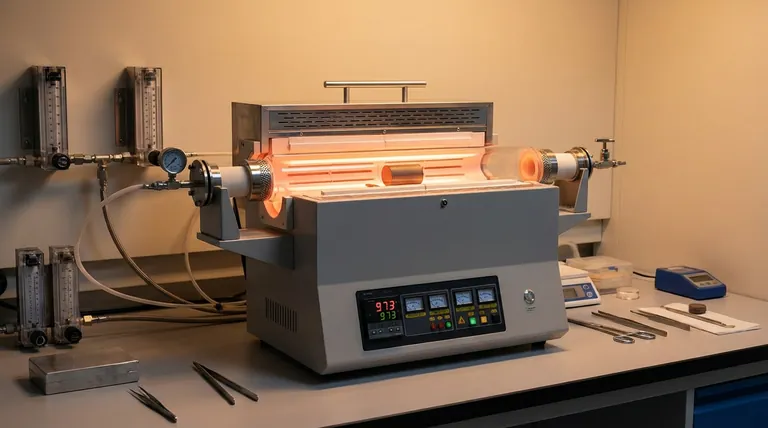
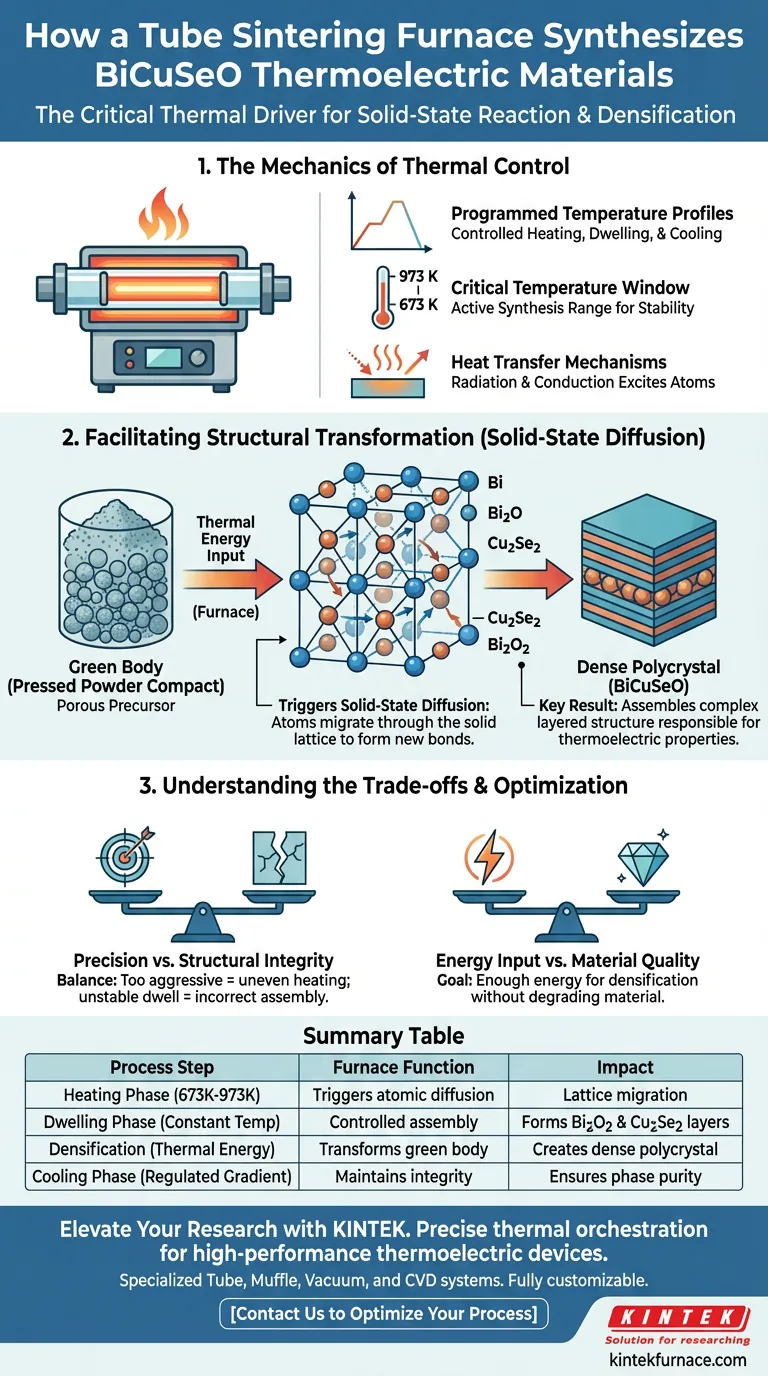
A laboratory tube sintering furnace serves as the critical thermal driver that enables the synthesis of BiCuSeO thermoelectric materials. By executing precise, programmed temperature curves typically ranging from 673 K to 973 K, the furnace applies thermal energy through radiation and conduction to trigger the solid-state diffusion necessary for material formation.
The furnace does not merely heat the sample; it orchestrates a precise transformation from a pressed "green body" to a dense polycrystal by driving the atomic assembly of Bi2O2 and Cu2Se2 layers.
The Mechanics of Thermal Control
Programmed Temperature Profiles
The success of the synthesis relies on the furnace's ability to execute a multi-stage thermal schedule.
This involves controlled heating rates, specific constant temperature phases (dwelling), and regulated cooling periods.
The Critical Temperature Window
The primary reference indicates that the active synthesis typically occurs within a window of 673 K to 973 K.
Maintaining stability within this range is essential, as deviations can alter the reaction kinetics or fail to fully activate the diffusion process.
Heat Transfer Mechanisms
Inside the furnace chamber, thermal energy is transferred to the BiCuSeO samples through radiation and conduction.
This energy transfer is the catalyst that excites the atoms within the precursor materials, allowing them to overcome energy barriers and move into their correct lattice positions.
Facilitating the Structural Transformation
Triggering Solid-State Diffusion
The core function of the thermal energy is to initiate solid-state diffusion reactions.
Unlike liquid-phase reactions, this process relies on atoms migrating through the solid lattice to form new chemical bonds.
Forming the Layered Architecture
BiCuSeO is defined by its specific crystal structure, consisting of alternating Bi2O2 insulating layers and Cu2Se2 conductive layers.
The sintering furnace drives the assembly of this complex layered structure, which is directly responsible for the material's thermoelectric properties.
Densification of the Green Body
Before entering the furnace, the material exists as a pressed powder compact, known as a green body.
The sintering process eliminates the voids between powder particles, transforming the porous compact into a mechanically robust, dense polycrystal.
Understanding the Trade-offs
Precision vs. Structural Integrity
While high temperatures facilitate faster diffusion, the process requires exacting control over the thermal field.
If the programmed curve is too aggressive, you risk uneven heating; if the constant temperature phase is unstable, the layered structure may not assemble correctly.
Energy Input vs. Material Quality
The goal is to provide enough energy to drive densification without degrading the material.
The furnace must balance the thermal input to maximize electrical transport properties while ensuring the correct structural phases are formed.
Making the Right Choice for Your Goal
To optimize your synthesis of BiCuSeO, consider how you program the furnace based on your specific objectives:
- If your primary focus is Structural Homogeneity: Ensure your specific programmed temperature curve includes a stable "constant temperature" phase between 673 K and 973 K to allow complete diffusion.
- If your primary focus is Material Density: Prioritize the precision of the thermal field control to effectively transform the porous green body into a solid polycrystal.
Precise thermal regulation is the key to converting raw powder into a high-performance thermoelectric device.
Summary Table:
| Process Step | Furnace Function | Impact on BiCuSeO |
|---|---|---|
| Heating Phase | Programmed 673 K - 973 K | Triggers atomic diffusion and lattice migration |
| Dwelling Phase | Constant Temperature Control | Assemblies alternating Bi2O2 and Cu2Se2 layers |
| Densification | Thermal Energy Transfer | Transforms porous 'green body' into dense polycrystal |
| Cooling Phase | Regulated Thermal Gradient | Maintains structural integrity and phase purity |
Elevate Your Thermoelectric Research with KINTEK
Precise thermal orchestration is the difference between a porous sample and a high-performance thermoelectric device. Backed by expert R&D and world-class manufacturing, KINTEK offers specialized Tube, Muffle, Vacuum, and CVD systems designed to meet the exacting temperature profiles required for complex material synthesis like BiCuSeO.
Whether you need custom dimensions or advanced multi-stage programming, our lab high-temp furnaces are fully customizable for your unique research needs. Contact us today to optimize your sintering process and achieve superior structural homogeneity.
Visual Guide
References
- N. P. Madhukar, Saikat Chattopadhyay. Role of sintering temperature in modulating the charge transport of BiCuSeO thermoelectric system: correlations to the microstructure. DOI: 10.1007/s00339-023-07218-4
This article is also based on technical information from Kintek Furnace Knowledge Base .
Related Products
- Laboratory Quartz Tube Furnace RTP Heating Tubular Furnace
- Vertical Laboratory Quartz Tube Furnace Tubular Furnace
- 1700℃ High Temperature Laboratory Tube Furnace with Alumina Tube
- 1400℃ High Temperature Laboratory Tube Furnace with Alumina Tube
- 1200℃ Split Tube Furnace Laboratory Quartz Tube Furnace with Quartz Tube
People Also Ask
- What physical conditions does a laboratory Tube Furnace provide for SOEC? Precision Heat for Solid Oxide Characterization
- What are the main features and functions of a laboratory tube furnace? Unlock Precise High-Temp Control for Your Lab
- What role does a laboratory tube furnace play in geological and mineralogical research? Unlock Earth's Secrets with Precision
- What conditions do tube furnaces provide for Au-Seeded TiO2 nanowires? Master Precision Thermal Synthesis
- What parameters must be controlled when calcining freeze-dried oxide precursors in a laboratory tube furnace? A Guide



















