
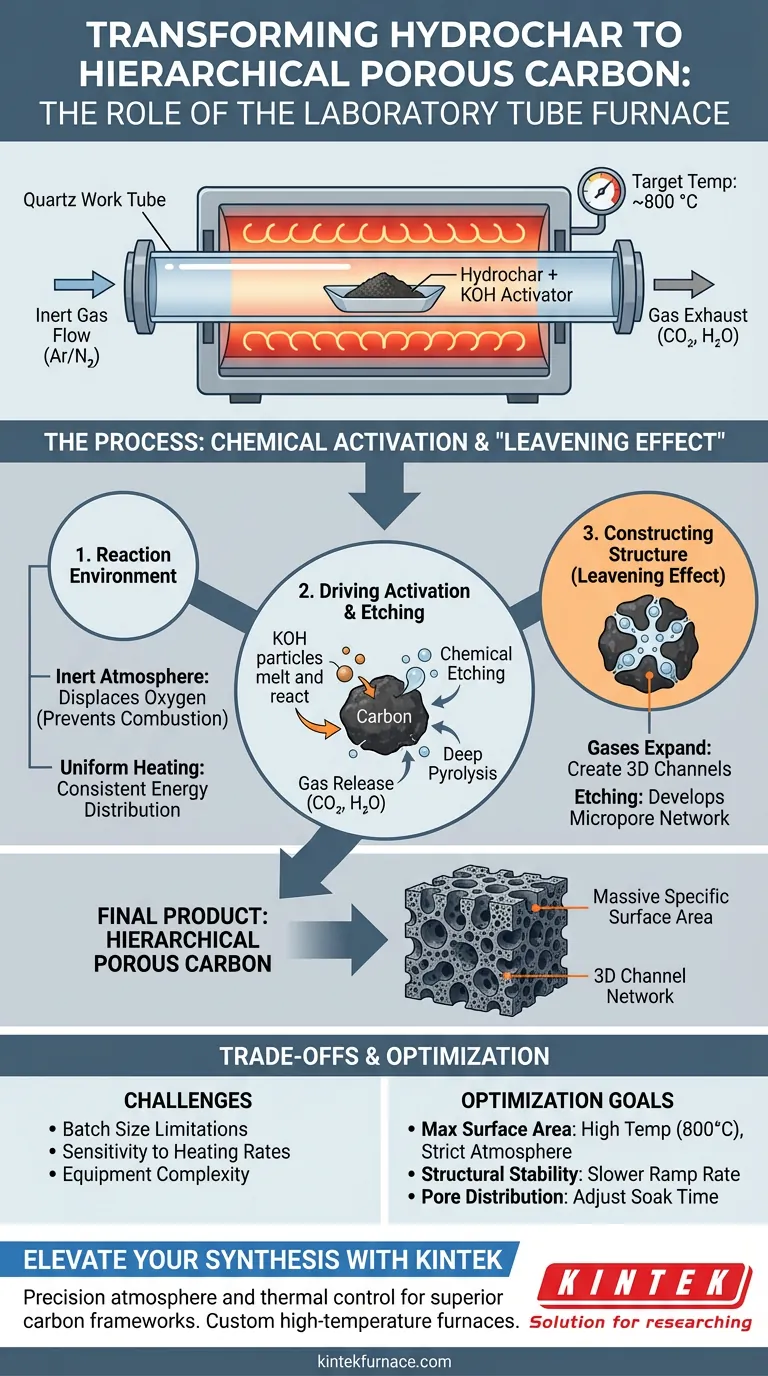
A laboratory tube furnace facilitates the transformation of hydrochar into hierarchical porous carbon by creating a strictly controlled thermal and atmospheric environment essential for chemical etching. It heats hydrochar mixed with an activator, such as potassium hydroxide (KOH), to high temperatures (typically 800 °C) under an inert gas flow, triggering reactions that sculpt the carbon's internal structure.
The tube furnace enables a "leavening effect" by maintaining an oxygen-free zone where chemical decomposition releases gases; these gases expand to construct a vast network of 3D channels and micropores without burning away the carbon framework.
Establishing the Reaction Environment
The Role of Inert Atmosphere
For hierarchical porous carbon to form, oxidation must be prevented. The tube furnace utilizes a continuous flow of inert gas, such as argon or nitrogen, to displace oxygen within the work tube.
Preventing Combustion
Without this inert environment, the high temperatures required for activation would simply cause the hydrochar to burn into ash. The furnace ensures the material undergoes thermochemical decomposition rather than combustion.
Uniform Heating Profile
Heating elements surround the cylindrical tube, providing consistent thermal energy along the sample's length. This uniformity is critical for ensuring that the chemical activator (KOH) reacts evenly across the entire hydrochar sample.
Driving the Chemical Activation
Triggering Chemical Etching
As the furnace ramps up to target temperatures (e.g., 800 °C), the KOH melts and begins to react chemically with the hydrochar. This process is known as chemical etching, where the activator "eats away" specific parts of the carbon skeleton.
Thermal Decomposition
Simultaneously, the precise heat facilitates deep pyrolysis. This removes volatile components from the hydrochar, leaving behind a stable, rigid carbon framework ready to be restructured.
Release of Activation Gases
The reaction between the carbon and the KOH at these temperatures generates gases, specifically carbon dioxide ($CO_2$) and water vapor ($H_2O$). The controlled release of these gases is the engine of pore formation.
Constructing the Hierarchical Structure
The Leavening Effect
The gases generated during activation cannot escape instantly; instead, they expand within the material. This creates a leavening effect, similar to how yeast makes bread rise.
Formation of 3D Channels
As these gases force their way out, they create three-dimensional hierarchical channels. These macro-channels allow fluids or electrolytes to easily access the deeper internal structure of the material.
Developing the Micropore Network
Within the walls of these larger channels, the etching process creates a vast network of micropores. This results in a material with a massive specific surface area and a highly amorphous structure.
Understanding the Trade-offs
Batch Size Limitations
Tube furnaces are ideal for research and small-scale synthesis but are limited in volume. The geometry of the tube restricts the amount of hydrochar that can be processed uniformly in a single run.
Sensitivity to Heating Rates
The quality of the final carbon is highly sensitive to the heating ramp rate. If the furnace heats too quickly, the "leavening" gases may release too violently, collapsing the pore structure rather than building it.
Equipment Complexity
Achieving the correct hierarchy requires precise synchronization of gas flow, temperature ramping, and hold times. Miscalibrating the furnace controller can lead to incomplete activation or excessive burn-off of the carbon yield.
Making the Right Choice for Your Goal
To maximize the utility of a tube furnace for carbon activation, align your parameters with your specific material requirements:
- If your primary focus is maximizing specific surface area: Prioritize higher activation temperatures (around 800 °C) and ensure the inert atmosphere is strictly maintained to allow aggressive micropore etching.
- If your primary focus is structural stability: Use a slower heating ramp rate to allow volatile gases to escape gradually, preserving the integrity of the carbon walls.
- If your primary focus is pore size distribution: Adjust the "soak time" (the duration the furnace holds the peak temperature) to control the depth of the chemical etching process.
Success in creating hierarchical porous carbon relies not just on high heat, but on the precise orchestration of atmosphere and time.
Summary Table:
| Feature | Role in Carbon Activation | Impact on Material |
|---|---|---|
| Inert Atmosphere | Displaces oxygen using Argon/Nitrogen | Prevents combustion; ensures thermochemical decomposition |
| Uniform Heating | Consistent thermal energy distribution | Ensures even KOH reaction across the hydrochar skeleton |
| Temperature Control | Precise ramping to ~800 °C | Triggers chemical etching and deep pyrolysis |
| Gas Management | Controlled release of CO2 and H2O | Creates a "leavening effect" to build 3D porous channels |
Elevate Your Materials Synthesis with KINTEK
Precision is the difference between carbon ash and a high-performance hierarchical framework. Backed by expert R&D and manufacturing, KINTEK offers specialized Tube, Vacuum, CVD, and Muffle systems designed to give you total control over atmosphere and thermal profiles.
Whether you are optimizing micropore networks or scaling up small-batch research, our customizable high-temperature furnaces provide the stability your lab requires.
Ready to refine your activation process? Contact KINTEK today for a tailored solution.
Visual Guide
References
- Marija Ercegović, Jugoslav Krstić. Efficient Adsorption of Pollutants from Aqueous Solutions by Hydrochar-Based Hierarchical Porous Carbons. DOI: 10.3390/w16152177
This article is also based on technical information from Kintek Furnace Knowledge Base .
Related Products
- 1400℃ High Temperature Laboratory Tube Furnace with Alumina Tube
- Laboratory Quartz Tube Furnace RTP Heating Tubular Furnace
- Laboratory Vacuum Tilt Rotary Tube Furnace Rotating Tube Furnace
- 1700℃ High Temperature Laboratory Tube Furnace with Alumina Tube
- Vertical Laboratory Quartz Tube Furnace Tubular Furnace
People Also Ask
- How are high-temp tube furnaces used to measure diffusion coefficients per Fick's law? Master Precision Annealing
- How are high-temperature laboratory tube furnaces applied in long-term vacuum homogenization heat treatments for intermetallic samples?
- How do high-temperature laboratory tube furnaces ensure environmental stability? Precision Thermal Reduction Tips
- How are high-temperature tube furnaces applied in testing ceramic-supported alloy membranes? Insights
- How does a laboratory high-temperature tube furnace contribute to the conversion of electrospun fibers? Expert Insights



















