
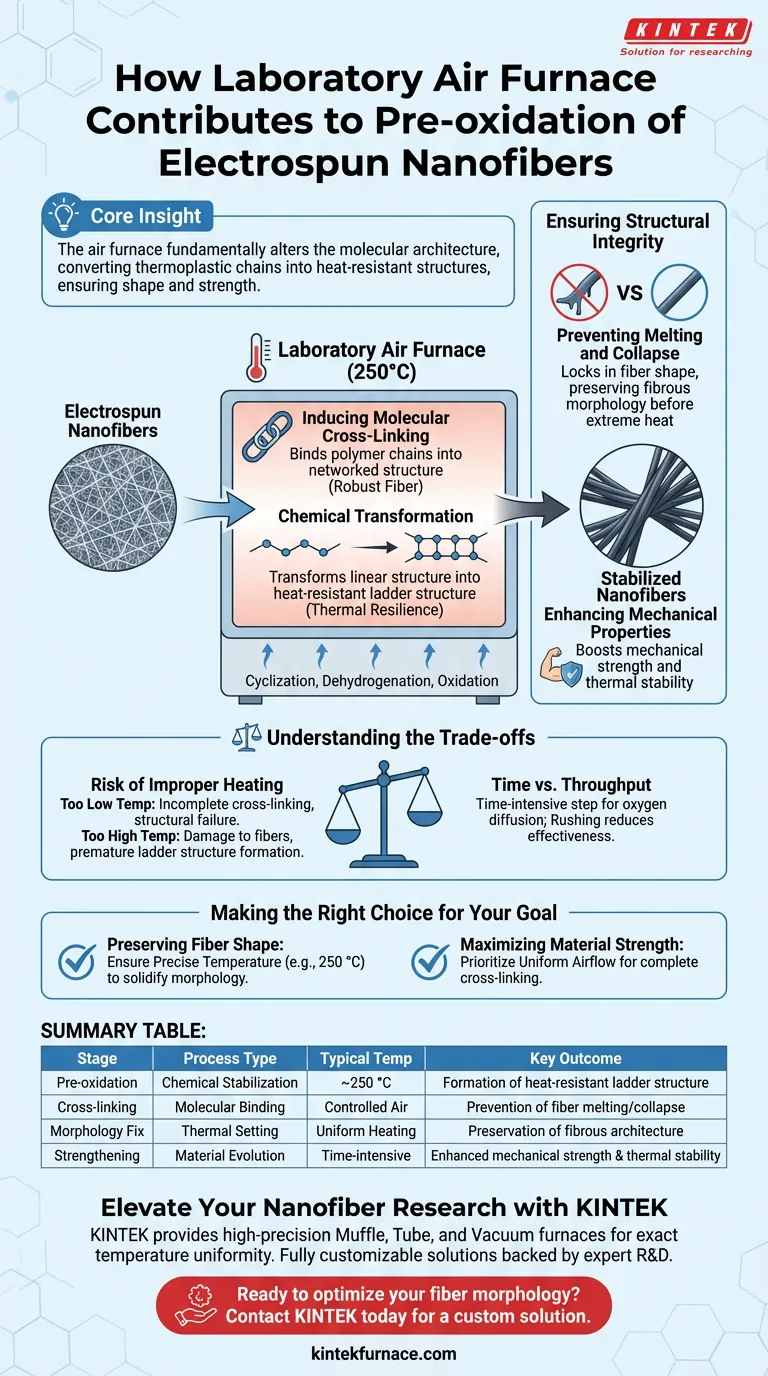
The primary role of a laboratory air furnace in the context of electrospun nanofibers is to execute the critical stabilization or pre-oxidation phase. By subjecting fibers to a controlled air environment at specific temperatures—typically around 250 °C—the furnace facilitates a chemical transformation that prevents the material from melting during subsequent processing.
Core Insight: The air furnace does not merely dry the fibers; it fundamentally alters their molecular architecture. It converts thermoplastic chains into heat-resistant structures, ensuring the fibers retain their shape and strength during high-temperature carbonization.
The Mechanics of Stabilization
Inducing Molecular Cross-Linking
The heat treatment provided by the furnace drives cross-linking within the polymer molecular chains.
This process binds the polymer chains together, creating a networked structure. This network is essential for shifting the material from a simple plastic to a robust, stable fiber.
Chemical Transformation
Inside the furnace, specific reactions such as cyclization, dehydrogenation, and oxidation occur, particularly in polymers like polyacrylonitrile (PAN).
These reactions transform the polymer's original linear structure into a heat-resistant ladder structure. This structural evolution is what ultimately grants the fiber its thermal resilience.
Ensuring Structural Integrity
Preventing Melting and Collapse
Without the pre-oxidation step performed in the air furnace, electrospun fibers remain thermoplastic.
If these untreated fibers were exposed to the extreme heat of carbonization, they would simply melt or collapse. The furnace "locks in" the fiber shape, preserving the fibrous morphology.
Enhancing Mechanical Properties
Beyond shape retention, the furnace treatment significantly boosts the physical attributes of the material.
The cross-linking process directly enhances the mechanical strength of the nanofibers. It also improves thermal stability, preparing the material to withstand temperatures far exceeding the 250 °C stabilization point.
Understanding the Trade-offs
The Risk of Improper Heating
The stabilization process is highly sensitive to temperature accuracy.
If the furnace temperature is too low, the cross-linking will be incomplete, leading to structural failure later. Conversely, excessive heat can damage the fibers before the ladder structure fully forms.
Time vs. Throughput
Achieving full stabilization requires a specific duration in the air environment to ensure oxygen diffuses through the fiber diameter.
Rushing this stage reduces the effectiveness of the oxidation reactions. You must accept that this is a time-intensive step necessary to guarantee the quality of the final carbonized product.
Making the Right Choice for Your Goal
To ensure your electrospun fibers perform as intended, consider how the furnace parameters align with your specific objectives.
- If your primary focus is preserving fiber shape: Ensure the furnace maintains a precise temperature (e.g., 250 °C) to solidify the fibrous morphology before carbonization.
- If your primary focus is maximizing material strength: Prioritize a furnace with uniform airflow to guarantee complete cross-linking and ladder structure formation throughout the fiber mat.
The laboratory air furnace is the gatekeeper that determines whether your nanofibers become high-performance materials or simply melted plastic.
Summary Table:
| Stage | Process Type | Typical Temp | Key Outcome |
|---|---|---|---|
| Pre-oxidation | Chemical Stabilization | ~250 °C | Formation of heat-resistant ladder structure |
| Cross-linking | Molecular Binding | Controlled Air | Prevention of fiber melting/collapse during carbonization |
| Morphology Fix | Thermal Setting | Uniform Heating | Preservation of fibrous architecture and shape |
| Strengthening | Material Evolution | Time-intensive | Enhanced mechanical strength and thermal stability |
Elevate Your Nanofiber Research with KINTEK
Don't let improper thermal stabilization compromise your material integrity. KINTEK provides high-precision Muffle, Tube, and Vacuum furnaces designed to deliver the exact temperature uniformity required for complex pre-oxidation and carbonization workflows.
Whether you are a researcher or a commercial manufacturer, our systems are fully customizable to meet your specific stabilization parameters. Backed by expert R&D, KINTEK lab high-temp furnaces ensure your electrospun fibers achieve peak mechanical strength and thermal resilience.
Ready to optimize your fiber morphology? Contact KINTEK today for a custom solution.
Visual Guide
References
- Qinghua Li, Shaoming Huang. Efficient Polytelluride Anchoring for Ultralong-Life Potassium Storage: Combined Physical Barrier and Chemisorption in Nanogrid-in-Nanofiber. DOI: 10.1007/s40820-023-01318-9
This article is also based on technical information from Kintek Furnace Knowledge Base .
Related Products
- Laboratory Vacuum Tilt Rotary Tube Furnace Rotating Tube Furnace
- Laboratory Muffle Oven Furnace with Bottom Lifting
- Laboratory Quartz Tube Furnace RTP Heating Tubular Furnace
- High Pressure Laboratory Vacuum Tube Furnace
- 1200℃ Muffle Oven Furnace for Laboratory
People Also Ask
- What are the key advantages of using a rotary tube furnace? Achieve Dynamic, Uniform Heating for Powders
- When are rotary tube furnaces not suitable for a process? Avoid Costly Mistakes in Thermal Processing
- What other fields utilize rotary tube furnaces? Discover Versatile Heating Solutions for Multiple Industries
- What optional features enhance the processing capabilities of rotary tube furnaces? Boost Efficiency with Advanced Customizations
- What are the technical advantages of using a rotary tube furnace for hydrochar activation? Achieve Superior Porosity



















