
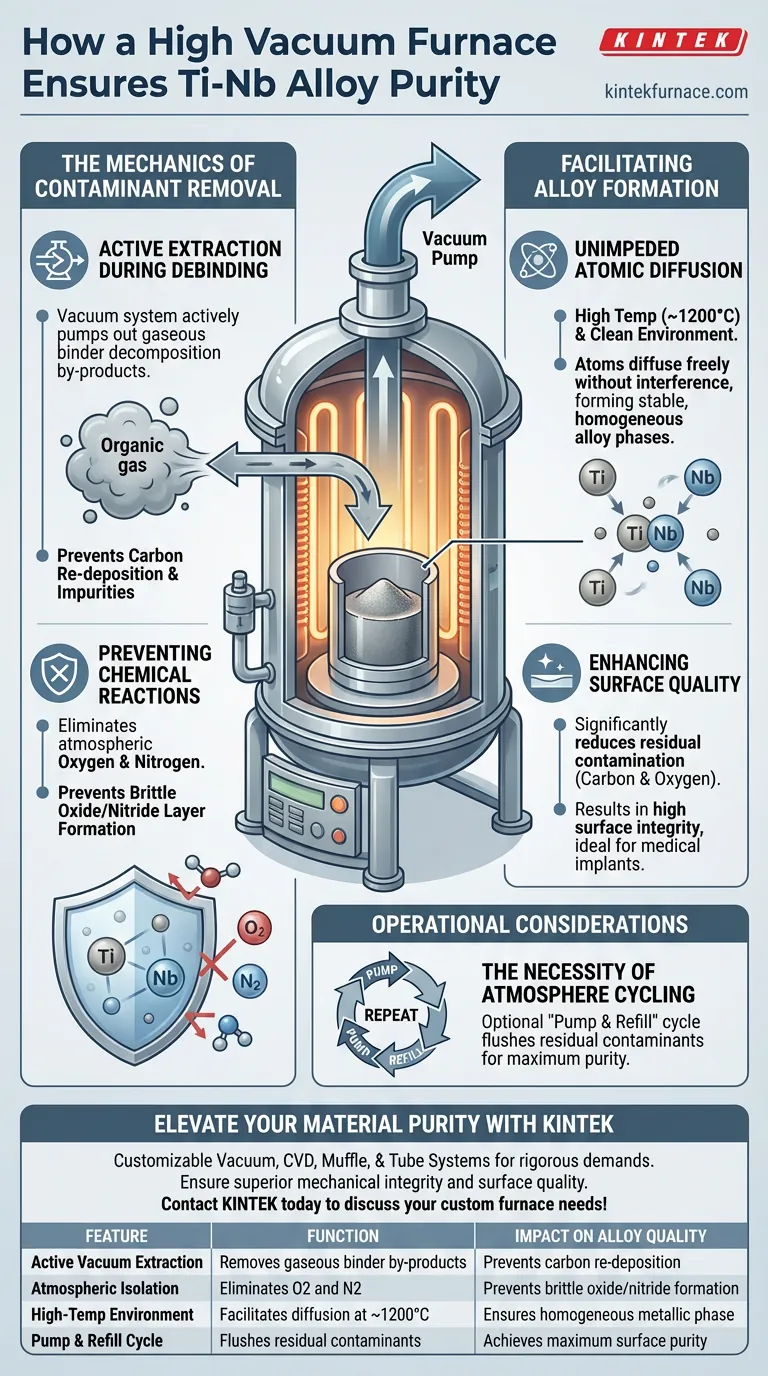
A high vacuum furnace ensures purity through a dual mechanism of active extraction and strict atmospheric isolation. By maintaining a controlled low-pressure environment, the furnace actively removes gaseous by-products released during binder decomposition while simultaneously shielding reactive titanium and niobium atoms from external contaminants like oxygen and nitrogen.
The vacuum environment acts as both a shield and a broom: it prevents environmental oxidation while actively sweeping away organic impurities, ensuring that the diffusion of metal atoms occurs in a pristine state.
The Mechanics of Contaminant Removal
Active Extraction During Debinding
During the initial heating stages, the organic binders used to shape the alloy begin to decompose.
The vacuum system is essential here. It does not just hold a static environment; it actively pumps out the gaseous by-products resulting from this decomposition.
Without this active extraction, these gases would linger around the metal, re-depositing carbon or other impurities onto the alloy surface.
Preventing Chemical Reactions
Titanium is highly reactive, particularly prone to oxidation and nitridation when heated.
A high vacuum environment eliminates the presence of atmospheric oxygen and nitrogen.
This isolation prevents the formation of brittle oxide or nitride layers that would compromise the mechanical integrity of the final alloy.
Facilitating Alloy Formation
Unimpeded Atomic Diffusion
To create a true Ti-Nb alloy, titanium and niobium atoms must diffuse into one another.
This process typically requires temperatures around 1200 degrees Celsius.
The vacuum ensures this occurs without interference. By removing physical barriers (like oxide layers) and gaseous contaminants, the atoms can diffuse freely to form stable, homogeneous alloy phases.
Enhancing Surface Quality
For applications requiring ultra-clean surfaces, such as medical implants, vacuum sintering is superior.
It significantly reduces residual contamination from carbon and oxygen.
This results in a final product with high surface integrity, free from the inclusions that often plague atmosphere-sintered parts.
Operational Considerations and Trade-offs
The Necessity of Atmosphere Cycling
Achieving maximum purity often requires more than a simple "pump down."
Supplementary protocols suggest a "pump and refill" cycle. This involves pre-pumping a vacuum, introducing a pure atmosphere, and repeating the cycle.
While this technique significantly increases purity by flushing out residual contaminants, it adds time and complexity to the overall processing cycle. Ignoring this step in experimental or high-stakes batches can lead to inconsistent results.
Making the Right Choice for Material Integrity
To maximize the quality of your Ti-Nb alloys, consider your specific processing goals:
- If your primary focus is Avoiding Embrittlement: Prioritize a high vacuum level to strictly prevent oxidation and nitridation, which are the main causes of brittle phase formation in titanium.
- If your primary focus is Surface Purity: Implement a "pump and refill" pre-processing cycle to flush the furnace chamber of residual atmospheric contaminants before heating begins.
True material purity is not just about the temperature you reach, but the cleanliness of the environment in which that temperature is applied.
Summary Table:
| Feature | Function in Ti-Nb Processing | Impact on Alloy Quality |
|---|---|---|
| Active Vacuum Extraction | Removes gaseous binder by-products | Prevents carbon re-deposition and surface contamination |
| Atmospheric Isolation | Eliminates oxygen and nitrogen | Prevents brittle oxide/nitride layer formation |
| High-Temp Environment | Facilitates diffusion at ~1200°C | Ensures a stable, homogeneous metallic phase |
| Pump & Refill Cycle | Flushes residual contaminants | Achieves maximum surface purity for medical/aerospace use |
Elevate Your Material Purity with KINTEK
Don't let oxidation or carbon inclusions compromise your high-performance Ti-Nb alloys. KINTEK provides industry-leading vacuum solutions designed specifically for the rigorous demands of thermal debinding and sintering.
Backed by expert R&D and precision manufacturing, our range of Vacuum, CVD, Muffle, and Tube systems are fully customizable to meet your unique metallurgical needs. Whether you are producing medical implants or aerospace components, we ensure your materials achieve superior mechanical integrity and surface quality.
Ready to optimize your high-temperature processes? Contact KINTEK today to discuss your custom furnace needs!
Visual Guide
References
- Diego Michael Cornelius dos Santos, Natália de Freitas Daudt. Powder Metallurgical Manufacturing of Ti-Nb alloys Using Coarse Nb Powders. DOI: 10.1590/1980-5373-mr-2023-0478
This article is also based on technical information from Kintek Furnace Knowledge Base .
Related Products
- 2200 ℃ Tungsten Vacuum Heat Treat and Sintering Furnace
- High Temperature Muffle Oven Furnace for Laboratory Debinding and Pre Sintering
- 9MPa Air Pressure Vacuum Heat Treat and Sintering Furnace
- 2200 ℃ Graphite Vacuum Heat Treat Furnace
- Vacuum Heat Treat Sintering Furnace Molybdenum Wire Vacuum Sintering Furnace
People Also Ask
- How does a tungsten-heated vacuum sintering furnace prepare (TbxY1-x)2O3 ceramics? Achieve 99%+ Density & Purity
- How do compaction pressure and vacuum sintering optimize porous ceramics? Maximize Density & Toughness
- What wear-resistance enhancements are achieved by powder coating? The Role of Vacuum Sintering Furnaces
- What role does a high-temperature vacuum sintering furnace play in the densification of WC-10(Ni, Ni/Co) alloys?
- How does high-temp vacuum sintering influence Y-TZP mechanical properties? Achieve Max Toughness



















