
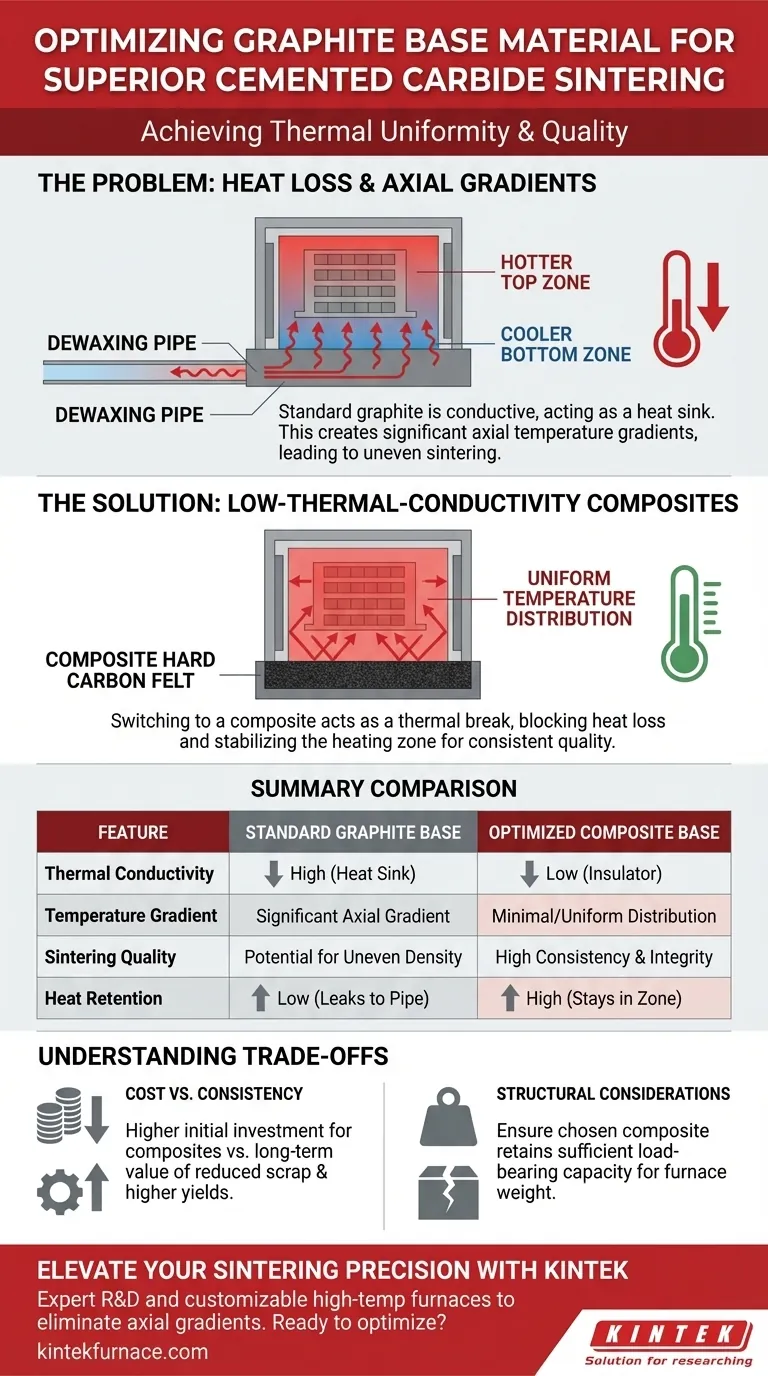
Optimizing the graphite base material is a critical step in achieving thermal uniformity during the cemented carbide sintering process. By replacing standard graphite bases with low-thermal-conductivity materials, you effectively block heat loss pathways connected to the dewaxing pipe, ensuring that temperature distribution remains consistent across the entire furnace load.
Heat loss through the furnace base creates axial temperature gradients that compromise sintering integrity. switching to a low-thermal-conductivity composite acts as a thermal break, raising the temperature in the lower zones and guaranteeing consistent quality for every component in the batch.
The Mechanics of Heat Loss
The Vulnerability of the Base
In a typical vacuum sintering furnace, the graphite base is structurally connected to the dewaxing pipe.
While necessary for the process, this connection creates a conductive path for heat to escape the heating zone.
The Problem with Standard Graphite
Standard graphite is relatively thermally conductive.
Consequently, it acts as a heat sink, drawing energy away from the bottom of the furnace load and channeling it out through the dewaxing system.
Creating an Axial Gradient
This heat loss results in a significant axial temperature gradient.
The bottom of the heating zone becomes cooler than the top, leading to uneven sintering where parts at the bottom may not achieve full density or the desired microstructure.
Material Optimization Strategy
Switching to Composite Materials
To counter this, the standard graphite base should be replaced with a material possessing low thermal conductivity.
Composite hard carbon felt is the primary recommendation for this application.
Blocking the Thermal Leak
This composite material acts as an effective insulator rather than a conductor.
It blocks the heat loss path to the dewaxing pipe, retaining energy within the heating zone where it belongs.
Stabilizing the Heating Zone
The immediate result is an increase in the temperature at the bottom of the heating zone.
This equalizes the temperature profile, significantly reducing the axial gradient and ensuring the thermal environment is uniform from top to bottom.
Understanding the Trade-offs
Cost vs. Consistency
High-performance insulating materials like composite hard carbon felt generally command a higher price point than standard graphite components.
You must weigh this initial investment against the long-term value of reduced scrap rates and higher process yields.
Structural Considerations
While excellent for insulation, some composite felts may have different structural properties compared to solid graphite blocks.
It is essential to ensure the chosen material retains sufficient load-bearing capacity for your specific furnace weight requirements.
Making the Right Choice for Your Goal
To optimize your sintering furnace effectively, consider your specific production priorities:
- If your primary focus is Precision Quality: Prioritize composite hard carbon felt bases to minimize temperature gradients and ensure uniform microstructure across the entire load.
- If your primary focus is Cost Management: Evaluate if your current scrap rate justifies the upgrade; if the axial gradient is causing measurable defects, the material upgrade will likely pay for itself.
Optimizing the base material transforms the furnace floor from a heat sink into a thermal stabilizer, securing the consistency of your final product.
Summary Table:
| Feature | Standard Graphite Base | Optimized Composite Base |
|---|---|---|
| Thermal Conductivity | High (acts as a heat sink) | Low (acts as an insulator) |
| Temperature Gradient | Significant axial gradient | Minimal/Uniform distribution |
| Sintering Quality | Potential for uneven density | High consistency and integrity |
| Heat Retention | Low; heat leaks to dewaxing pipe | High; energy stays in heating zone |
| Best For | Budget-focused operations | Precision & high-yield production |
Elevate Your Sintering Precision with KINTEK
Don't let heat loss compromise your product integrity. KINTEK provides expert R&D and manufacturing of high-performance lab high-temp furnaces—including Muffle, Tube, Rotary, Vacuum, and CVD systems—all customizable to solve your thermal uniformity challenges. Our specialized graphite and composite solutions are designed to eliminate axial gradients and maximize your process yield.
Ready to optimize your furnace performance? Contact KINTEK today for a custom consultation and see how our tailored high-temperature solutions can transform your lab's efficiency.
Visual Guide
References
- Mao Li, Hesong Li. Numerical simulation of the heating process in a vacuum sintering electric furnace and structural optimization. DOI: 10.1038/s41598-024-81843-8
This article is also based on technical information from Kintek Furnace Knowledge Base .
Related Products
- 2200 ℃ Graphite Vacuum Heat Treat Furnace
- Spark Plasma Sintering SPS Furnace
- High Temperature Muffle Oven Furnace for Laboratory Debinding and Pre Sintering
- Chairside Dental Porcelain Zirconia Sintering Furnace with Transformer for Ceramic Restorations
- Dental Porcelain Zirconia Sintering Ceramic Vacuum Press Furnace
People Also Ask
- Why are vacuum heat treating furnaces essential for aerospace? Ensure Superior Material Integrity for High-Stakes Applications
- What is the primary application of vacuum heat treating furnaces in aerospace? Enhance Component Performance with Precision
- How does a vacuum heat treating furnace improve the condition of metal alloys? Achieve Superior Metal Performance
- How does vacuum heat treating work in terms of temperature and time control? Master Precise Material Transformations
- What is the process of vacuum heat treating? Achieve Superior Metallurgical Properties













