
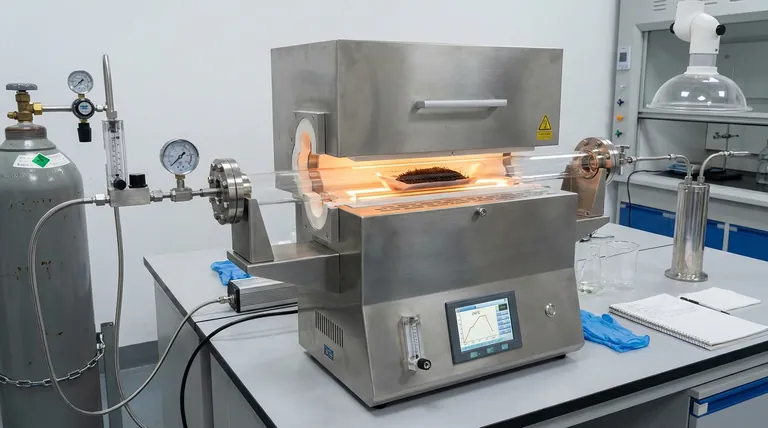
A high-temperature Tube Furnace facilitates the preparation of activated straw char by creating a precisely controlled, inert environment essential for chemical activation. It operates by heating potassium carbonate-impregnated bio-char to exactly 600°C under a continuous nitrogen flow. By strictly maintaining a heating rate of 10°C/min and holding the temperature for two hours, the furnace drives significant pore development and chemical surface changes, transforming raw biomass into a high-surface-area catalyst support.
The Tube Furnace acts as more than a heat source; it is a precision reactor that synchronizes chemical activation with thermal decomposition. This synchronization is critical for generating the specific porous architecture required to effectively upgrade bio-oil.
Creating the Ideal Reaction Environment
To convert straw into a functional catalyst support, the reaction environment must be rigorously controlled to prevent combustion and promote carbonization.
The Importance of an Inert Atmosphere
The Tube Furnace utilizes a sealed reaction zone under a continuous flow of nitrogen. This creates an oxygen-free (anaerobic) atmosphere that is critical for the process.
Without this protection, the biomass would simply burn (oxidize) rather than carbonize. The inert gas ensures that the potassium carbonate impregnation can chemically activate the char without interference from atmospheric oxygen.
Efficient Devolatilization
Within this controlled atmosphere, the furnace facilitates the steady release of volatile organic compounds. This "cleaning" of the matrix is necessary to open up the carbon structure for further modification.
Precision Thermal Management
The quality of activated char is highly sensitive to temperature fluctuations. The Tube Furnace ensures reproducibility through programmable control.
Controlled Heating Rates
The furnace does not blast the material with heat; it applies a ramp rate, typically 10°C/min, to reach the target temperature. This gradual increase allows for the orderly release of volatiles and prevents thermal shock that could collapse the char structure.
By controlling the rate, the furnace induces the transformation of biomass from amorphous carbon to more ordered, nanocrystalline graphite structures.
Uniform Temperature Distribution
Once the target temperature (e.g., 600°C) is reached, the furnace maintains it with high precision, often within ±5°C. This prevents localized overheating, which can lead to excessive carbonization and reduced surface area.
Holding this temperature for a set duration (e.g., 2 hours) ensures the chemical activation reaction penetrates the entire batch uniformly.
Driving Structural Transformation
The ultimate goal of using this apparatus is to alter the physical architecture of the straw char to make it a suitable host for catalysis.
Developing the Pore Network
The combination of chemical agents (K2CO3) and stable high heat creates primary channels within the biochar matrix. These channels serve as diffusion paths, significantly increasing the specific surface area.
Enhancing Bio-Oil Upgrading Potential
This high surface area is the defining characteristic that allows the char to function effectively in bio-oil upgrading. It provides ample contact points for catalytic reactions to occur, improving the efficiency of the upgrading process.
Understanding the Trade-offs
While the Tube Furnace is the gold standard for laboratory-scale precision, there are operational constraints to consider.
Batch Size Limitations
Tube furnaces are generally limited by the diameter of the tube, restricting the volume of straw char you can produce in a single run. They are ideal for research and development but may present bottlenecks for large-scale production.
Sensitivity to Process Parameters
The high precision of these furnaces means the output is strictly tied to your programming. Minor deviations in the heating curve or nitrogen flow rate can drastically alter the pore structure, requiring rigorous calibration and monitoring.
Making the Right Choice for Your Goal
To maximize the utility of your Tube Furnace for char preparation, align your settings with your specific objectives.
- If your primary focus is Maximum Surface Area: Prioritize precise temperature holding at 600°C to 700°C to optimize the interaction between the char and the chemical activator.
- If your primary focus is Structural Stability: strictly adhere to the 10°C/min (or lower) heating rate to ensure the orderly evolution of the carbon matrix without collapsing the pores.
- If your primary focus is Reproducibility: Ensure your furnace creates a completely oxygen-free environment to prevent oxidation from altering the surface chemistry between batches.
Precision in your thermal profile is the single greatest predictor of your catalyst's performance.
Summary Table:
| Parameter | Typical Setting | Function in Activation |
|---|---|---|
| Atmosphere | Nitrogen (Inert) | Prevents oxidation; ensures anaerobic carbonization |
| Heating Rate | 10°C/min | Allows orderly devolatilization and structural stability |
| Target Temp | 600°C - 700°C | Optimizes chemical activation with K2CO3 |
| Dwell Time | 2 Hours | Ensures uniform pore development across the batch |
| Environment | Sealed Tube | Protects nanocrystalline graphite structure |
Elevate Your Material Research with KINTEK Precision
Unlock superior catalytic performance with advanced thermal processing solutions. Backed by expert R&D and world-class manufacturing, KINTEK provides high-precision Tube, Muffle, Rotary, Vacuum, and CVD systems tailored for researchers and industrial labs.
Whether you are developing high-surface-area bio-char or synthesizing complex nanomaterials, our customizable high-temperature furnaces deliver the thermal uniformity and atmospheric control your projects demand.
Ready to optimize your chemical activation process? Contact our technical experts today to find the perfect furnace for your unique needs.
References
- Alhassan Ibrahim, El Barbary Hassan. Catalytic Upgrading of Rice Straw Bio-Oil via Esterification in Supercritical Ethanol over Bimetallic Catalyst Supported on Rice Straw Biochar. DOI: 10.3390/en17020407
This article is also based on technical information from Kintek Furnace Knowledge Base .
Related Products
- Vacuum Sealed Continuous Working Rotary Tube Furnace Rotating Tube Furnace
- 1400℃ High Temperature Laboratory Tube Furnace with Alumina Tube
- 1700℃ High Temperature Laboratory Tube Furnace with Alumina Tube
- Magnesium Extraction and Purification Condensing Tube Furnace
- High Pressure Laboratory Vacuum Tube Furnace
People Also Ask
- What is the purpose of rotary tube furnaces? Achieve Uniform Heat Treatment for Powders and Granules
- What are the key advantages of using a rotary tube furnace? Achieve Dynamic, Uniform Heating for Powders
- What are the advantages of rotary tube furnaces in fuel compatibility? Boost Efficiency and Cut Costs
- How does the amount of material processed vary between batch and continuous rotary tube furnaces? Scale Your Production Efficiently
- What is the temperature range of some rotary tube furnaces? Achieve Uniform Heating Up to 1200°C



















